
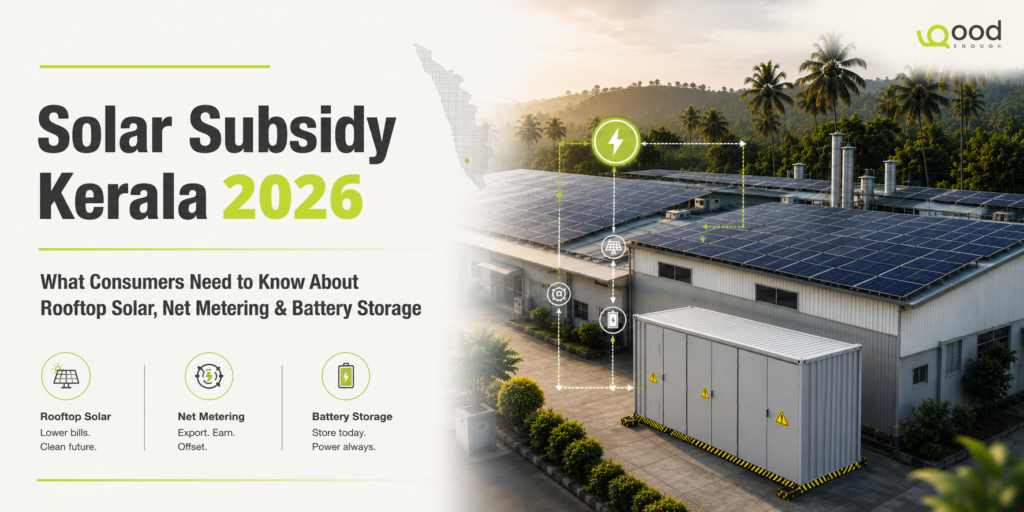
Solar Battery Storage Kerala: Subsidies, Net Metering & BESS in 2026
Solar battery storage Kerala is no longer a niche upgrade in 2026, it is becoming the difference between a rooftop solar system that truly pays off and one that underperforms as policy tightens.
Kerala already has around 946.9 MW of rooftop solar across roughly 1.52 lakh systems, meeting approximately 22% of the state’s daytime electricity demand. At the national level, India added around 3.2 GW of rooftop solar in 2024, with residential consumers accounting for nearly three-quarters of new capacity. But as this rapid growth continues, the rules around exporting solar power and drawing it back from the grid are tightening and the consumers who adapt earliest will protect their returns the longest.
What Is the Solar Subsidy in Kerala, And Does It Cover Batteries?
The solar subsidy Kerala framework combines central government support with KSEB-facilitated implementation to reduce upfront costs for residential and group housing installations. The two main pillars are:
PM Surya Ghar: Muft Bijli Yojana a national programme targeting rooftop solar in one crore households, with Central Financial Assistance (CFA) in tiered slabs: higher per-kW support up to 2–3 kW, with a capped total at 3 kW and above.
MNRE Grid-Connected Rooftop Solar Phase II channels CFA to domestic consumers through DISCOM portals, with typical support of 40% on benchmark cost up to 3 kW and 20% for 3–10 kW systems, plus provisions for group housing common facilities up to 500 kW.
KSEB’s own ecosystem including the Soura programme and the e-Kiran portal operationalises these subsidies through empanelled vendors and standardised pricing.
What these subsidies do not cover is battery storage. BESS is not included in MNRE or KSEB CFA calculations. Solar battery storage Kerala is an additional investment but one that is increasingly making strategic sense as net metering rules change.
KSERC 2025: How New Rules Are Making Solar Battery Storage Kerala More Valuable
In November 2025, the Kerala State Electricity Regulatory Commission (KSERC) notified the Renewable Energy and Related Matters Regulations, 2025 effective 6 November 2025, with billing mechanisms applicable from 1 January 2026. These regulations are the single most important reason why solar battery storage Kerala has moved from “nice to have” to “strategically essential” for larger consumers.
Net Metering Limits Under KSERC 2025
Domestic consumers can now use net metering up to 20 kW per service connection. Common facilities in multi-storey residential buildings are capped at 500 kW. Industrial consumers are allowed up to 500 kW, and agricultural consumers up to 3,000 kW.
Grid Support Charges: What They Mean for You
Systems up to 10 kW face no grid support charges, protecting the core residential market. For systems above 10 kW, Grid Support Charges (GSC) apply on banked solar energy drawn during non-solar hours: ₹0.50 per unit for the first 300 such units per month, and ₹1 per unit thereafter.
Export Compensation Has Changed
Surplus units can still be banked, but year-end settlement is now linked to KSEB’s average purchase cost potentially around ₹3 per unit significantly lower than the ₹7–9 per unit retail rate you pay when drawing from the grid.
The implication is clear: exporting your solar and buying it back later is no longer free. Solar battery storage Kerala lets you store that surplus yourself and use it at full retail value which is a far better economic outcome.
Why Solar Battery Storage Kerala Makes Financial Sense in 2026
The Export Arbitrage Has Narrowed
Under earlier net metering frameworks, aggressively oversized systems that exported in the afternoon and drew power back at night were financially efficient because import and export were settled at similar tariffs. That gap has now closed. A battery eliminates the arbitrage problem entirely store at zero cost, use at full value.
Evening Peak Loads Are the Real Cost Driver
For most Kerala households, apartments, offices, and factories, peak consumption happens in the evening: ACs, EVs, lifts, pumps, and lighting. Solar generation is zero at that time. Without storage, that gap is filled by grid power at retail rates. Solar battery storage Kerala directly solves this mismatch by shifting afternoon generation into evening use.
Grid Support Charges Penalise Export-Heavy Systems Above 10 kW
For systems above 10 kW typical in factories, commercial buildings, and large residential complexes KSERC 2025 directly penalises heavy export-and-reimport behaviour through grid support charges. A well-designed battery system can reduce or eliminate these charges by absorbing surplus during the day and supplying loads at night.
Solar Battery Storage Kerala Across Consumer Segments
Homes (≤10 kW)
Net metering without grid support charges remains available, so batteries are not mandatory. However, households with high evening loads EVs, air conditioners, home offices increasingly find that even a modest battery improves self-consumption and adds outage resilience. As export settlement rates evolve further, the economics of home-scale solar battery storage Kerala will only strengthen.
Apartments and Group Housing
Common-area solar plants up to 500 kW are allowed under KSERC 2025. Pairing rooftop solar with battery storage lets lifts, corridor lighting, pumps, and STP systems run on stored solar through the evening exactly when solar output is zero. This makes limited roof space deliver far greater value than solar alone.
Industrial and Commercial Users
This is where solar battery storage Kerala delivers its most compelling financial case today. Industrial consumers face demand charges, time-of-day tariffs, and high DG operational costs. A well-designed solar + BESS system systematically cuts all three. For factories and commercial buildings above 10 kW, avoiding grid support charges while shaving demand peaks can mean substantial, measurable annual savings.
Agricultural Consumers
Agricultural prosumers are fully exempt from grid support charges under KSERC 2025. But in areas with unreliable supply, a battery converts intermittent daytime solar into dependable energy for water pumping, cold storage, and irrigation delivering operational value well beyond bill reduction.
Choosing the Right Battery Storage System for Kerala Conditions
Not all BESS products are equal and in Kerala’s climate, that difference matters. Systems need to handle high ambient temperatures, voltage fluctuations typical of Kerala’s distribution network, and daily deep cycling across a 20-year lifespan. Generic imported batteries not designed for these conditions often underperform or degrade faster than expected.
For commercial and industrial customers evaluating solar battery storage Kerala, modular systems designed specifically for Indian grid and climate conditions offer the most reliable performance. A 250 kWh / 125 kVA BESS is well-suited to mid-scale factories, commercial complexes, and large residential developments looking to cut demand charges, reduce DG dependency, and stabilise power quality including for EV charging infrastructure.
At a larger scale, multi-megawatt-hour systems (5 MWh and above) are increasingly deployed across industrial parks, grid-connected microgrids, and large commercial estates. Systems built for Indian grid conditions, high-temperature environments, and peak demand challenges support not just cost reduction but genuine long-term energy independence.
GoodEnough Energy, a BESS manufacturer based in India, offers solutions across both scales: the modular StorEDGE 0.25 (250 kWh / 125 kVA) for C&I customers seeking demand charge reduction and DG displacement, and the flagship StorEDGE 5.0 (5 MWh / 2.5 MVA) engineered for industrial, grid stability, and large-scale renewable integration applications. Both are built for Indian operating conditions and directly relevant to the growing solar battery storage Kerala market.
The Future: Solar Battery Storage Kerala in a Maturing Policy Environment
Kerala has long-term decarbonisation ambitions 100% renewable electricity by 2040 in state planning documents. With 947 MW of rooftop solar already meeting 22% of daytime demand, the grid is approaching a point where evening peak management becomes as important as daytime generation capacity.
KSERC’s direction is consistent: future reforms will reward storage-linked solar prosumers and gradually raise expectations for export-heavy systems. Time-of-day pricing, differential export tariffs for battery-backed systems, and vehicle-to-grid integration are all logical next steps.
For anyone investing in rooftop solar in Kerala today, solar battery storage Kerala is not a future upgrade it is increasingly the foundation of a future-proof energy investment.
Ready to Invest in Solar Battery Storage Kerala?
The shift from pure solar to solar + battery storage is not a future trend in Kerala it is happening now, driven by KSERC 2025 regulations, narrowing export compensation, and the rising cost of evening grid power.
Whether you’re a homeowner evaluating a 5 kW system, an apartment association managing common-area loads, or an industrial buyer looking to cut demand charges and eliminate DG dependency getting the storage strategy right from the start is what separates a smart, durable energy investment from one that disappoints over a 20-year horizon.