

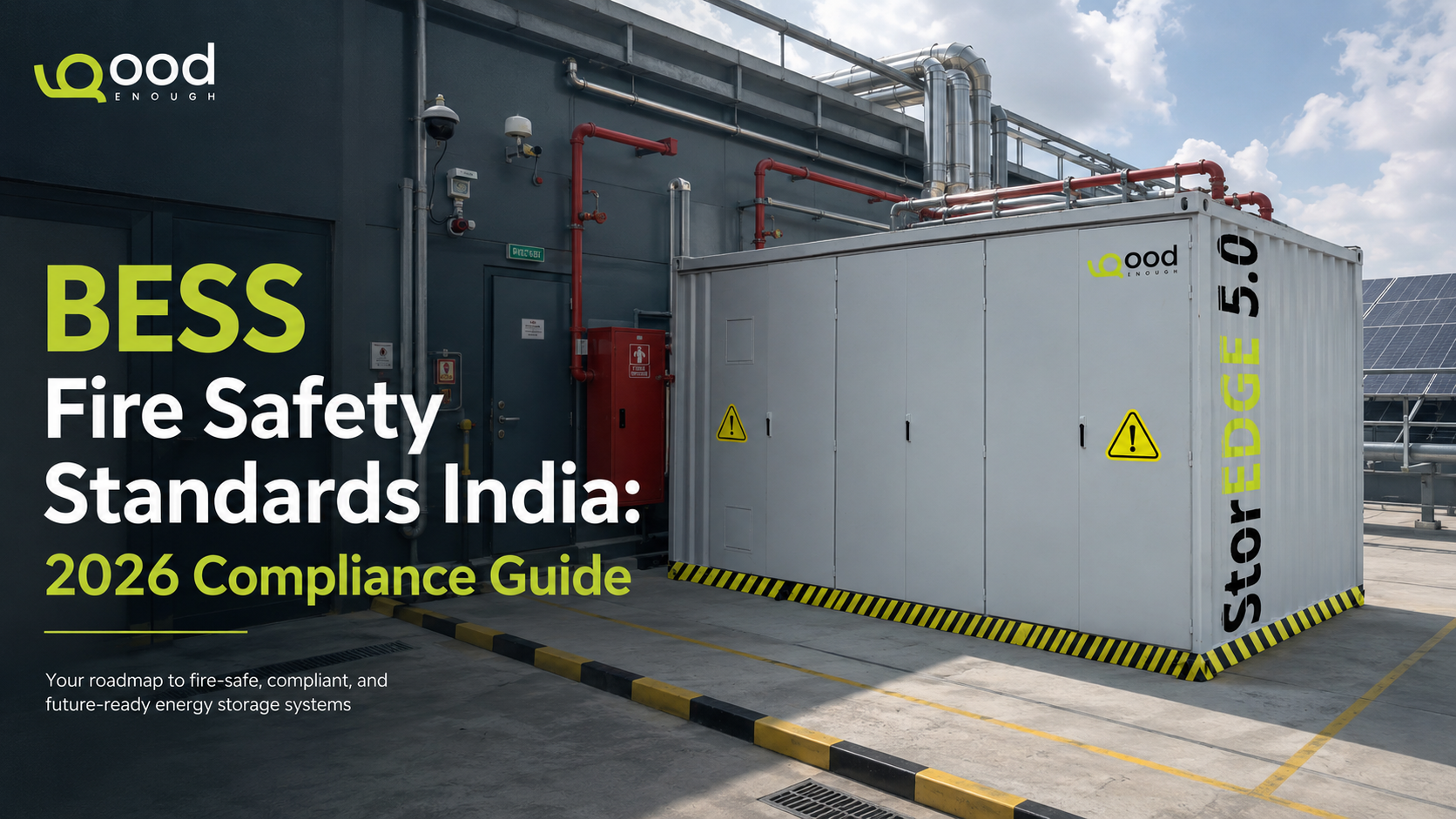
BESS Fire Safety Standards India: What Every 2026 Project Must Engineer For
India’s battery storage boom has outpaced its safety playbook. As gigawatt-scale projects break ground, BESS fire safety standards India relies on are still catching up with the pace of deployment. This article breaks down the fire codes, grid rules, and design choices that separate a compliant project from a liability. You’ll learn what regulators expect, where the gaps remain, and how engineering teams are closing them.
Why BESS Fire Safety Standards India Matter in 2026
Battery storage has moved from pilot projects to core grid infrastructure. With that shift comes real consequence. A poorly engineered site doesn’t just risk equipment it risks lives, land, and public trust in the entire energy transition.
Regulators know this. That’s why BESS fire safety standards India now touches everything from cell chemistry selection to site setback distances. Developers who treat safety as an afterthought are finding it far costlier to retrofit later.
The Rising Stakes of Grid-Scale Battery Deployment
India is targeting over 40 GWh of battery storage capacity by the end of this decade. Most of that capacity uses lithium-ion cells, which carry a well-documented thermal runaway risk.
Thermal runaway happens when a cell overheats and triggers a self-sustaining chain reaction. One failed cell can propagate to neighboring modules within seconds. This is precisely why fire codes now mandate specific spacing, ventilation, and detection thresholds rather than leaving them to developer discretion.
Most sites in India today sit close to substations, industrial parks, or agricultural land, sometimes near residential clusters. That proximity raises the stakes for any fire event and explains why regulators have grown stricter rather than more lenient as deployment scales up.
Callout: A single thermal event in a poorly ventilated container can escalate to full-system failure in under three minutes. Detection speed, not just suppression capacity, is now the design priority.
Regulatory Gaps in BESS Fire Safety Standards India
India doesn’t yet have a single, unified national fire code exclusively for battery storage. Instead, developers must reconcile several overlapping frameworks.
- Central Electricity Authority (CEA) technical regulations
- Bureau of Indian Standards (BIS) battery and enclosure specifications
- State-level fire NOC requirements, which vary widely
- International references like NFPA 855, used as design guidance
This patchwork approach means two projects in different states can face different fire clearance timelines for near-identical systems. Harmonization is underway, but until it lands, engineering teams must design to the strictest applicable standard, not the minimum.
Some states have started publishing dedicated BESS fire NOC checklists, while others still process applications under generic industrial fire rules. This inconsistency is one of the biggest practical headaches developers report today. Until a unified national code arrives, tracking BESS fire safety standards India state-by-state remains part of the job for developers and their EPC partners.
Core BESS Fire Safety Standards India Must Follow
What is a BESS fire code, in practical terms? It’s a set of enforceable rules governing cell selection, enclosure design, gas detection, suppression systems, and emergency response planning for battery storage sites.
Two frameworks dominate current practice: India’s own IS 16046 series and the internationally referenced NFPA 855.
IS 16046: A Core Part of BESS Fire Safety Standards India
IS 16046 covers the safety requirements for secondary lithium cells and batteries used in stationary applications. It sets test protocols for thermal abuse, short-circuit tolerance, and mechanical integrity.
At GoodEnough Energy, we have observed that projects designed around IS 16046 from the concept stage face fewer late-stage redesigns. Retrofitting a container layout after procurement is far more expensive than specifying compliant modules upfront.
The standard also outlines labeling, transport, and storage handling requirements for lithium cells before they ever reach a site. Skipping these earlier steps often creates compliance headaches during commissioning, when there’s far less room to make changes without delaying grid connection.
NFPA 855 Influence on Indian Site Design
NFPA 855, the US-origin standard for stationary energy storage systems, isn’t legally binding in India. Even so, most utility-scale developers use it as a design benchmark because it’s the most detailed framework available.
BESS Fire Safety Standards Comparison
Key standards relevant for Battery Energy Storage Systems in India.
| Standard | Origin | Primary Focus | Status in India |
|---|---|---|---|
| IS 16046 | India (BIS) | Cell and battery safety testing | Mandatory |
| NFPA 855 | USA (NFPA) | Site layout, spacing & suppression | Voluntary Reference |
| CEA Grid Standards | India (CEA) | Grid interconnection & protection | Mandatory |
| UL 9540A | USA (UL) | Thermal runaway propagation testing | Increasingly requested by insurers |
Why does this matter for design? Because insurers and lenders in India now frequently request UL 9540A propagation test data even though it isn’t a legal requirement. Financing has effectively become a second layer of compliance enforcement.
Grid Standards and Interconnection Requirements
Fire safety alone isn’t enough. BESS fire safety standards India enforces work alongside grid codes that govern how storage systems behave once connected.
CEA Technical Standards for Connectivity
The CEA’s technical standards for connectivity to the grid set voltage ride-through, frequency response, and protection coordination requirements. A BESS must disconnect safely during a fault without creating a secondary fire hazard from arcing or uncontrolled discharge.
Grid compliance and fire compliance aren’t separate silos. A protection relay that fails to isolate a faulted string quickly enough can turn an electrical fault into a thermal event.
Protection Coordination and Thermal Runaway Response
Effective protection design layers several defenses together:
- Cell-level voltage and temperature monitoring
- Module-level fusing to isolate faults early
- Rack-level gas detection tuned to off-gassing signatures
- Container-level suppression, typically clean agent or water mist
- Site-level setback distances from occupied structures
Each layer buys response time. The goal isn’t to prevent every fault that’s unrealistic at scale. The goal is containing a fault before it propagates.
How much time does containment actually buy? In well-designed systems, early gas detection can trigger suppression and site alerts within seconds of an off-gassing event, well before flames appear. That window is what separates a controlled incident from an evacuation. Any engineering team serious about BESS fire safety standards India enforces should treat detection speed as a headline design metric, not a secondary spec.
Engineering Checklist: Building Compliant BESS Projects
Developers preparing a project in 2026 should work through this sequence early, not after procurement.
- Select cells with third-party abuse testing data, not just datasheet claims.
- Model propagation behavior using UL 9540A-style testing, even if not mandatory.
- Design enclosure spacing to meet the strictest applicable setback rule.
- Specify gas detection calibrated for your chosen cell chemistry’s off-gas profile.
- Align protection relay settings with CEA grid code requirements before commissioning.
- Document a fire response plan with local authorities before energization.
- Plan for decommissioning and thermal risk at end-of-life, not just installation.
Callout: Fire NOC delays are among the top causes of BESS commissioning slippage in India today. Early coordination with state fire authorities shortens this timeline significantly.
The engineering team at GoodEnough Energy typically front-loads this checklist during feasibility studies, since retrofitting fire systems after civil works begin adds both cost and schedule risk.
What Are the Benefits of Following BESS Fire Safety Standards India Requires?
Compliant design isn’t only about avoiding penalties. It delivers measurable operational benefits:
- Lower insurance premiums, since underwriters price in propagation test data
- Faster fire NOC approvals when documentation is prepared upfront
- Reduced downtime risk from contained, rather than cascading, fault events
- Stronger investor confidence during due diligence
These benefits compound over a project’s lifetime. A single avoided propagation event can save far more than the cost of the additional gas detection or spacing that prevented it. Lenders increasingly recognize this too, which is why compliant designs are starting to see more favorable financing terms across the sector.
Challenges Developers Still Face
Even well-resourced teams run into friction. Common challenges include inconsistent state-level fire NOC timelines, limited local testing infrastructure for propagation certification, and a shortage of fire engineers with BESS-specific experience.
These aren’t reasons to delay projects. They’re reasons to start compliance planning earlier than the procurement stage.
Skilled fire engineering talent is also scarce right now. Most fire consultants in India built their careers around buildings and industrial plants, not lithium-ion storage sites. Developers who bring in specialists early, rather than treating fire review as a final sign-off step, consistently see smoother approvals.
Conclusion
Fire codes and grid standards for battery storage in India are converging toward a stricter, more unified framework. Projects designed around BESS fire safety standards India enforces today will face fewer surprises as regulations tighten further. The developers who succeed won’t be the ones who move fastest they’ll be the ones who engineer for compliance from day one.
Key Takeaways
- India lacks a single unified BESS fire code; developers must reconcile IS 16046, CEA rules, and state NOC requirements together.
- NFPA 855 and UL 9540A aren’t mandatory but are increasingly demanded by insurers and lenders.
- Fire safety and grid protection design are interconnected, not separate compliance tracks.
- Early-stage design decisions on cell selection and spacing are far cheaper than later retrofits.
- Fire NOC delays remain a leading cause of commissioning slippage.
1. What are BESS fire safety standards India currently follows?
India primarily relies on IS 16046 for cell and battery testing, CEA technical standards for grid interconnection, and state-level fire NOC rules, with NFPA 855 used as voluntary design guidance.
2. Why is thermal runaway the central fire safety concern for BESS?
Thermal runaway can spread from one cell to an entire module within seconds, which is why detection speed and enclosure spacing are prioritized in design codes.
3. Is NFPA 855 mandatory for Indian BESS projects?
No. NFPA 855 isn’t legally binding in India, but most utility-scale developers reference it because it offers the most detailed layout and spacing guidance currently available.
4. What causes the most delays in BESS project commissioning in India?
Inconsistent state-level fire NOC timelines are among the most common causes of commissioning delays, often because fire response documentation wasn’t prepared early enough.
5. What should developers prioritize first when designing for compliance?
Cell selection with verified abuse-testing data and enclosure spacing planning should happen during feasibility studies, well before procurement begins.
