If you are researching BESS cost in India in 2026, there is no single price per kWh that applies to every Battery Energy Storage System (BESS) project. The final cost depends on battery capacity, power rating, discharge duration, battery chemistry, PCS, thermal management, fire-safety systems, grid connection, civil works, installation scope, warranty and operating requirements.
The cost depends on the battery capacity, power rating, discharge duration, battery chemistry, PCS, thermal management, fire-safety system, grid connection, civil work, installation scope, warranty and operating requirements.
For context, published 2026 market guides currently place installed C&I BESS costs broadly in the tens of thousands of rupees per kWh, with smaller systems generally costing more per kWh than larger systems. One 2026 market guide, for example, puts smaller 100–500 kWh systems around ₹30,000–₹40,000/kWh and larger 2–10 MWh systems around ₹20,000–₹28,000/kWh. These are market estimates, not government-mandated prices or GoodEnough Energy quotations.
At utility scale, public Indian project documents show why comparing BESS only by a retail ₹/kWh number can be misleading.
The more useful question is:
What does the complete storage system cost for the power, energy, duration and application I actually need?
BESS cost in India in 2026: what should you budget?
A practical way to think about BESS pricing is to separate equipment cost from installed project cost.
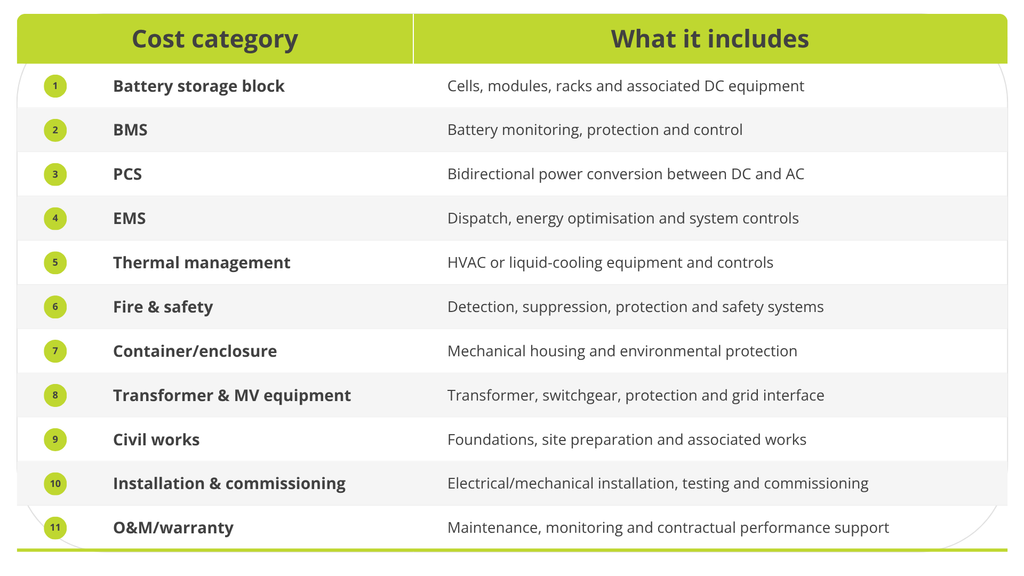
The Ministry of Power’s own description of BESS cost components separates the storage block, balance of system, storage system and power equipment, reinforcing the fact that the battery cells are only one part of the overall project.
Why there is no single BESS price in India
Two systems can both be described as a 1 MWh BESS and have very different prices.
Consider:
- 1 MWh / 500 kW
- 1 MWh / 1 MW
- 1 MWh / 2 MW
They all contain approximately 1 MWh of energy capacity, but their power-conversion requirements are different.
Similarly, a 2-hour system and a 4-hour system designed around the same MW output require different amounts of battery capacity.
This is why procurement teams should ask suppliers to quote both:
₹/kWh of energy capacity and ₹/kW or MW of power capacity, alongside the complete installed project price.
BESS cost per kWh vs storage tariff: don’t confuse the two
This is one of the most important distinctions when evaluating BESS cost in India.
In December 2025, the Ministry of Power reported that the cost of BESS discovered through tariff-based competitive bidding had fallen from approximately ₹10.18/kWh in 2022–23 to around ₹2.1/kWh in recent competitive bids, without VGF. The Ministry also noted that assuming 1.5 cycles per day would correspond to approximately ₹2.8/kWh.
Those figures do not mean you can purchase a BESS for ₹2.1/kWh.
They represent a storage-service economics/tariff measure under a particular bidding structure and utilization assumption.
A buyer purchasing a BESS for an industrial facility is dealing with CAPEX: battery equipment, PCS, EMS, thermal management, protection, installation, electrical infrastructure and other project costs.
That distinction alone can prevent major errors in early-stage project budgeting.
What Indian projects tell us about BESS cost
One useful public benchmark comes from a CERC order concerning the SECI-linked Rajnandgaon project in Chhattisgarh.
The project included a 40 MW / 120 MWh BESS, designed to deliver 40 MW for approximately three hours during peak periods. CERC records that the BESS scope included containerised battery packs, fire protection, power-conditioning units, transformer, HVAC, MV switchgear, auxiliary systems and EMS.
The quoted price for supply, installation, testing and commissioning of that BESS, including BCD and GST, was ₹321.895 crore.
A simple calculation gives:
Assumption:
120 MWh storage capacity
Calculation:
₹321.895 crore ÷ 120 MWh
Result:
≈ ₹2.68 crore/MWh
or approximately ₹26,800/kWh
However, this should not be presented as the 2026 national BESS price.
It was a specific project with a specific scope, procurement structure and technical configuration. The BESS was also integrated with a solar project. It is best treated as a documented Indian project reference point, not a current quotation benchmark.
Another government tender illustrates the scale of current utility storage development. SJVN’s 2025 tender sought developers for 375 MW / 1,500 MWh of standalone BESS in Uttar Pradesh, with an estimated tender value of ₹2,557.5 crore under a VGF-supported competitive-bidding structure.
Dividing the tender estimate by the energy capacity gives:
Assumption:
1,500 MWh
Calculation:
₹2,557.5 crore ÷ 1,500 MWh
Result:
≈ ₹1.71 crore/MWh
Again, this is not equivalent to an equipment quotation. It is a project/tender benchmark under a particular procurement structure.
These examples demonstrate why the phrase “BESS cost per kWh” needs context.
What actually drives BESS pricing?
1. Battery capacity
More MWh generally means more battery cells and associated DC equipment.
But larger projects can achieve economies of scale in areas such as:
- PCS
- controls
- civil infrastructure
- installation
- monitoring
- engineering
This is one reason larger projects can have a lower cost per kWh than small systems.
2. Power rating
A BESS is not defined only by its MWh capacity.
A facility requiring 1 MW for one hour needs very different power-conversion equipment from one requiring 1 MW for four hours.
The PCS rating, transformer and electrical infrastructure can therefore materially affect project cost.
3. Duration
For the same MW rating:
1 MW × 2 hours = 2 MWh
while:
1 MW × 4 hours = 4 MWh
The second system needs roughly twice the energy capacity, although the balance-of-system cost does not necessarily double.
4. Thermal management
Thermal management is another important design decision.
Battery systems generate heat during charging and discharging. The project may therefore require HVAC or liquid-based thermal management depending on system architecture, duty cycle and operating conditions.
Indian projects can also face high ambient temperatures, making thermal design particularly important.
The CERC-documented Rajnandgaon BESS, for example, explicitly included HVAC within its BESS scope.
The cheapest thermal-management option should therefore not automatically be considered the lowest-cost system over its operating life. Auxiliary energy consumption, temperature control, reliability and maintenance also affect economics.
5. PCS and electrical infrastructure
PCS, transformers, switchgear and protection equipment become particularly important when the BESS is connected at medium voltage or higher.
A quote for a battery container alone is therefore not comparable with an installed system connected to an industrial plant or grid substation.
6. Fire and safety systems
A complete BESS project can require:
- fire detection
- suppression
- gas/smoke monitoring
- emergency shutdown
- isolation
- protection systems
- site-level safety infrastructure
The exact requirements depend on the technology and project design.
7. Civil and site conditions
A greenfield project may require considerably more work than an installation at an existing industrial site.
Site access, foundations, cable routes, transformers, evacuation infrastructure and grid interconnection can all change the final project price.
How much does a 1 MWh BESS cost?
When estimating BESS cost in India, one of the most common questions is how much a 1 MWh BESS costs. There is no single verified national 2026 price for a 1 MWh installed C&I BESS.
Published 2026 market estimates currently put larger C&I systems in the broad range of roughly ₹15,000–₹25,000/kWh, while smaller systems can be substantially higher on a per-kWh basis.
That would imply a rough market-guide range of:
1 MWh = 1,000 kWh
Indicative published-market range:
₹15,000–₹25,000/kWh
Illustrative arithmetic:
1,000 × ₹15,000 = ₹1.5 crore
1,000 × ₹25,000 = ₹2.5 crore
But this should not be interpreted as a quotation for a 1 MWh project.
The final number could move materially depending on PCS power, duration, thermal management, electrical infrastructure, installation, warranty, taxes and site conditions.
How to calculate whether a BESS is financially viable
The purchase price is only the starting point.
For an industrial facility, the business case may come from several value streams:
- peak-demand reduction
- time-of-day load shifting
- solar self-consumption
- reduction in diesel-generator operation
- backup power
- renewable-energy integration
- energy arbitrage
Illustrative example
Consider a hypothetical 1 MWh BESS.
Assumptions:
- BESS capacity: 1 MWh
- Usable discharge: 900 kWh
- One full cycle per day
- Effective energy-value difference: ₹5/kWh
- Peak-demand reduction: 500 kW
- Demand-charge saving: ₹300/kW/month
- Illustrative installed CAPEX: ₹3 crore
Energy-value calculation:
900 kWh × ₹5 × 365
= ₹16.43 lakh/year
Demand-charge calculation:
500 kW × ₹300 × 12
= ₹18 lakh/year
Combined illustrative annual value:
₹16.43 lakh + ₹18 lakh
= ₹34.43 lakh/year
Simple payback:
₹3 crore ÷ ₹34.43 lakh
≈ 8.7 years
This is not a forecast or customer case study. It is a methodology example.
Actual economics can be very different because tariffs, demand charges, operating schedules, round-trip efficiency, degradation, financing costs, battery augmentation and utilization vary from facility to facility.
That is why BESS sizing should begin with an interval load profile and tariff analysis, not simply a desired MWh number.
Does government support reduce BESS cost in India?
Government support can improve project economics, but it should not be assumed to apply to every BESS buyer.
India has introduced VGF mechanisms to accelerate BESS deployment.
The Ministry of Power stated that the original VGF programme, approved in 2023, initially targeted 4,000 MWh with ₹3,760 crore of budgetary support; the supported capacity was subsequently increased to 13,220 MWh within the same budget. A second scheme was approved for 30 GWh of BESS capacity with ₹5,400 crore of PSDF support.
MNRE also publishes the VGF scheme documentation for BESS supported through the Power System Development Fund.
For a developer or EPC, the important point is:
Evaluate the applicable scheme and eligibility conditions for the specific project rather than subtracting a generic “BESS subsidy” from the equipment price.
Policy support can change the financing and project economics without changing the underlying supplier quotation.
How should you compare two BESS quotations?
A procurement team should avoid comparing suppliers using only:
₹/kWh
Instead, build a comparison sheet covering:
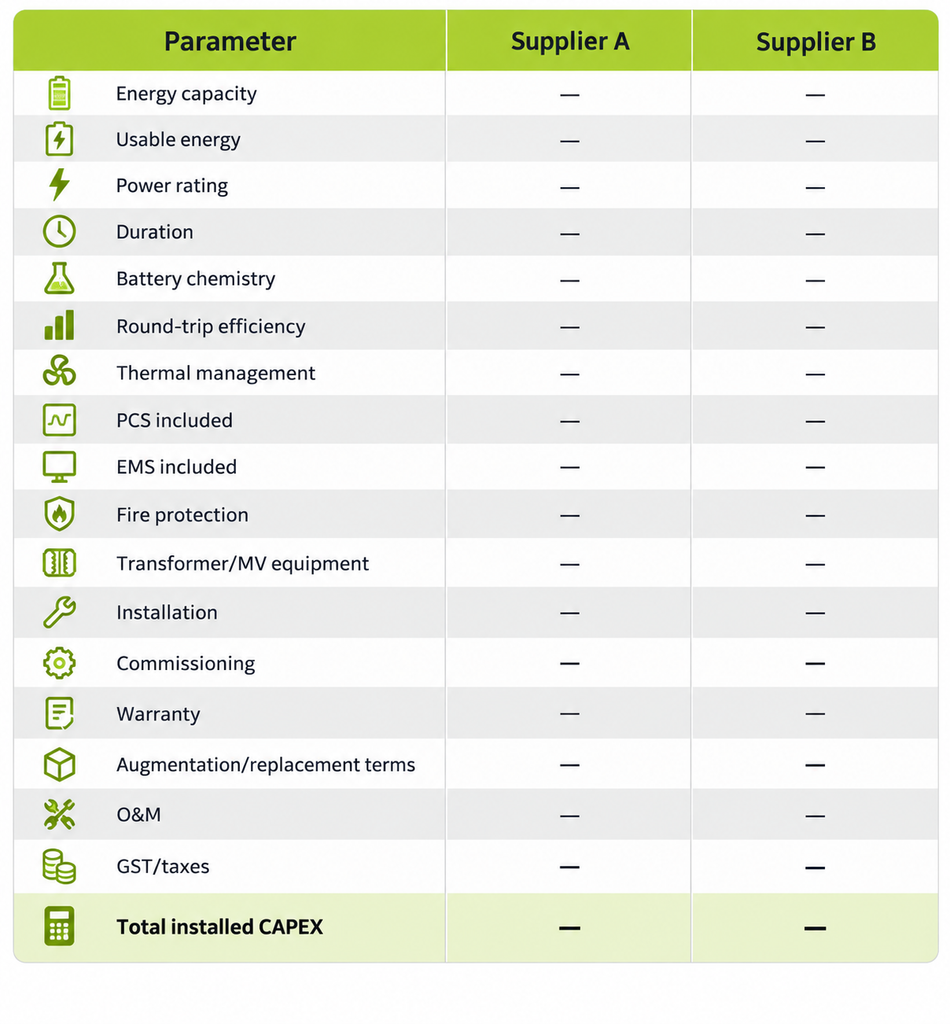
The most important number is often not the lowest equipment price.
It is the cost of achieving the required usable power and energy over the required operating life.
What should a BESS RFQ include?
A serious RFQ should specify at least:
- Required MW power output
- Required MWh capacity
- Discharge duration
- Usable energy requirement
- Required cycles per day
- Operating temperature
- Grid voltage
- Point of interconnection
- Solar integration requirements
- Backup requirements
- Required round-trip efficiency
- Performance guarantee
- Degradation guarantee
- Warranty period
- Thermal-management requirements
- Fire and safety requirements
- EMS/SCADA integration
- Installation and commissioning scope
- O&M requirements
- Battery augmentation/replacement assumptions
Without these parameters, two apparently similar BESS quotations may not actually be comparable.
Where BESS economics can make sense for Indian businesses
For commercial and industrial users, the strongest business case often comes from combining multiple use cases rather than relying on one.
For example, a BESS could be used to:
Reduce peak demand → lower demand-related electricity costs where applicable.
Shift energy → charge during lower-cost periods and discharge during higher-value periods.
Use more solar → store excess solar generation and discharge it later.
Reduce diesel dependence → use stored energy for suitable backup applications.
Improve resilience → provide controlled backup for critical loads.
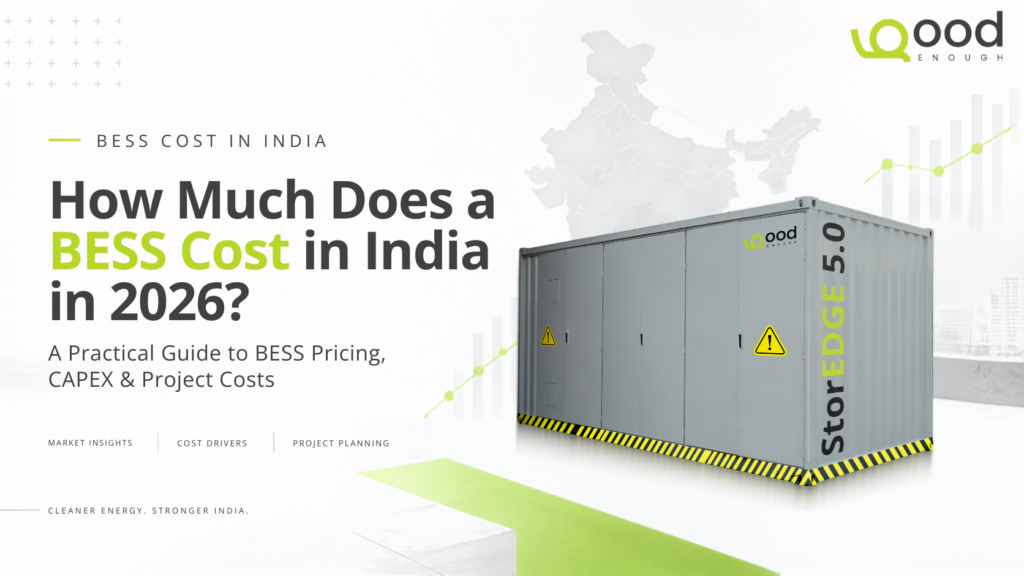
GoodEnough Energy’s portfolio currently includes the StorEDGE 0.25, a 250 kWh / 125 kVA system aimed at commercial and industrial applications, and StorEDGE 5.0, a 5 MWh / 2.5 MVA containerised system for larger industrial and utility-scale applications.
The appropriate system, however, should be determined by the site’s load profile and operating objective—not by choosing the largest available battery.
The bottom line: what does BESS cost in India?
There is no single BESS price in India for 2026.
Published market guides indicate that installed C&I systems can range from roughly ₹15,000–₹40,000+ per kWh depending on system size and configuration, while documented Indian utility projects demonstrate that project scope and procurement structure can move the effective cost substantially.
More importantly, the ₹2–₹3/kWh figures sometimes quoted in discussions about Indian BESS are storage-service/tariff economics, not the purchase price of a battery system.
For an actual project, the correct process is:
Load profile → application → MW/MWh sizing → technical specification → site assessment → RFQ → CAPEX → operating model → ROI/payback
For Indian industrial projects, this approach produces a much more useful answer than simply multiplying a generic ₹/kWh number by battery capacity.
If you are evaluating BESS for a factory, commercial facility, renewable-energy project or utility application, GoodEnough Energy can assess the required power, storage duration and operating objective before recommending a system configuration.