Why Indian Industries Are Asking This Question Now
The battery energy storage system advantages and disadvantages debate has moved from boardrooms of large utilities to the factory floors of mid-sized manufacturers across India.
Rising electricity tariffs, unpredictable grid supply, growing renewable mandates, and tightening ESG expectations have pushed BESS from a niche technology to a mainstream industrial investment. But like any major capital decision, it deserves a clear-eyed look both sides of the equation.
This guide gives you exactly that. No fluff, no hype just the real advantages and real limitations, so you can make the right call for your facility.
What Is a Battery Energy Storage System?
A Battery Energy Storage System (BESS) stores electrical energy in battery cells and releases it on demand. It combines lithium-ion or LFP (Lithium Iron Phosphate) batteries with a Battery Management System (BMS) and an Energy Management System (EMS).
For Indian industries, BESS typically works in three ways:
- Store cheap off-peak grid power and use it during expensive peak hours
- Store surplus solar or wind energy and deploy it when renewables aren’t generating
- Provide instant backup power during grid outages without starting a diesel generator
Battery Energy Storage System Advantages for Indian Industries
1. Significant Reduction in Electricity Bills
The single biggest financial benefit of BESS in India is the reduction in Maximum Demand (MD) charges.
Indian industrial tariffs penalise you for the highest power demand recorded in any 15–30 minute window during the month. A BESS discharges precisely during those peak windows, flattening your demand curve.
Result: MD charges which can be 20–40% of an industrial electricity bill are sharply reduced.
On top of this, Time-of-Use (ToU) arbitrage saves money by charging batteries during cheap off-peak hours and avoiding costly peak-hour consumption.
2. Energy Security Without Diesel
For most Indian factories, a power cut means one thing: fire up the diesel generator. DG sets cost ₹18–22 per unit all-in when you factor in fuel, maintenance, and compliance.
A BESS provides seamless, automatic backup power at a fraction of that cost with zero emissions, no noise, and minimal maintenance overhead.
This is one of the clearest battery energy storage system advantages for facilities in states with frequent grid interruptions, such as parts of UP, Bihar, and Rajasthan.
3. Better Returns from Rooftop Solar
Solar installations without storage have a fundamental problem: generation peaks at midday, but demand often peaks in the evening.
Without BESS, surplus solar power is exported back to the grid at low feed-in rates. With BESS, that energy is captured and used during peak hours maximising the value of every unit generated.
For industries that have already invested in solar, adding a BESS is often the most impactful next step.
4. ESG and Sustainability Compliance
India’s largest companies and their global customers and investors are increasingly demanding measurable decarbonisation. BESS directly reduces Scope 2 emissions by replacing grid power (which is still heavily coal-based in India) with stored renewable energy.
This is not just a reputational benefit. Under emerging SEBI sustainability reporting requirements and global supply chain ESG audits, verified emissions reductions will carry real commercial value.
Businesses can review India’s Business Responsibility and Sustainability Reporting (BRSR) framework published by SEBI to better understand evolving ESG disclosure expectations.
5. Government Incentives and Policy Tailwinds
The Indian government has made BESS more financially accessible through:
- Viability Gap Funding (VGF) for large-scale BESS projects via SECI and NTPC
- PLI (Production Linked Incentive) scheme for domestic battery manufacturing
- Renewable Purchase Obligation (RPO) rules that now include a storage component
- DISCOM-level incentives in states like Gujarat, Karnataka, and Maharashtra
These policies meaningfully improve the financial case for battery energy storage systems and they are becoming more generous, not less.
Battery Energy Storage System Disadvantages: What You Need to Know
Understanding the battery energy storage system advantages and disadvantages means being equally honest about the challenges. Here are the real ones.
1. High Upfront Capital Expenditure
This is the most common reason industrial buyers pause. A 1 MW / 2 MWh BESS installation in India today costs approximately ₹4–7 crore depending on the chemistry, vendor, and project complexity.
That is a significant capital outlay, especially for mid-sized manufacturers managing tight cash flow.
The good news: financing options including equipment leasing, Energy-as-a-Service (EaaS) models, and green bonds are growing rapidly. Some vendors now offer BESS on a monthly subscription with zero CapEx.
2. Battery Degradation Over Time
Lithium-ion and LFP batteries lose a portion of their storage capacity with each charge cycle. Over a 10-year period, a typical BESS may retain 70–80% of its original capacity.
This is a manageable disadvantage, not a dealbreaker especially with LFP chemistry, which offers 4,000–6,000 cycles before significant degradation. But it must be factored into your financial model.
Work with vendors who provide performance guarantees and capacity warranties over the full project life.
3. Space and Infrastructure Requirements
A utility-scale or large commercial BESS installation needs dedicated floor space typically between 100–400 sq. metres for a 1–2 MWh system along with proper ventilation, fire suppression systems, and electrical infrastructure.
For facilities with limited space, this can be a genuine constraint. However, containerised BESS solutions are increasingly available, allowing flexible siting in car parks, yards, or rooftops.
4. Thermal Safety and Fire Risk
Large battery installations carry a risk of thermal runaway a chain reaction that can cause fire if individual cells overheat. This risk is real, but it is well-understood and manageable.
LFP chemistry is significantly safer than older NMC (Nickel Manganese Cobalt) batteries. Proper BMS design, fire suppression systems, and ventilation controls bring this risk to an acceptable level.
Always ask vendors for their thermal safety design documentation and look for projects with third-party safety certifications.
5. Operation and Maintenance Expertise
A BESS is a sophisticated system. Getting the best performance requires:
- Regular performance monitoring via the EMS
- Proactive maintenance of inverters, cooling systems, and cells
- Software updates to optimise charge/discharge scheduling
Many industrial buyers underestimate this. The solution is to choose vendors who offer long-term Operations and Maintenance (O&M) contracts essentially outsourcing the technical complexity while you focus on your core business.
Weighing the Battery Energy Storage System Advantages and Disadvantages: A Quick Scorecard
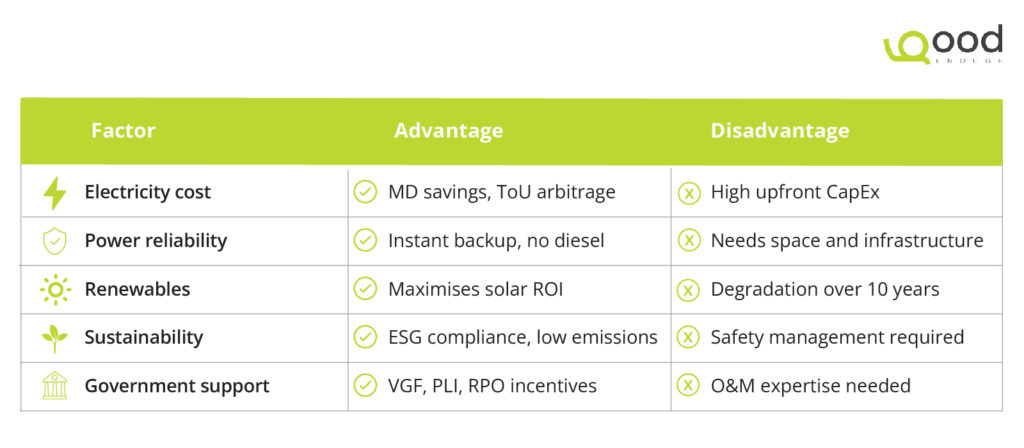
The pattern is clear: the disadvantages of BESS are largely about upfront investment and careful management. The advantages compound over time lower bills, better reliability, and stronger sustainability credentials.
Is BESS Right for Your Facility? Ask These Three Questions
Before making a decision, industrial decision-makers should work through:
1. What is my current electricity bill structure? If MD charges are above ₹10 lakh per month, the ROI case for BESS is almost always strong.
2. Do I have an existing or planned solar installation? If yes, BESS will significantly increase the financial return on that investment.
3. Am I facing grid reliability issues or ESG pressure? If either answer is yes, BESS addresses both in a single investment.
Conclusion
The battery energy storage system advantages and disadvantages, when laid out honestly, tell a clear story for most Indian industrial businesses: the benefits are large, growing, and compound over time. The challenges are real but addressable through the right vendor choice, financing structure, and O&M arrangement.
Battery costs in India have fallen over 80% in the last decade. Government support is strengthening. Electricity tariffs are rising. Every year you delay the BESS decision, you pay more for power and fall further behind competitors who have already made the switch.
The question for most industrial decision-makers is no longer “Should we evaluate BESS?” It is “How quickly can we move?”
Want a customised BESS analysis for your facility? Talk to an expert who understands Indian industrial tariff structures, available incentives, and the right battery chemistry for your specific load profile.