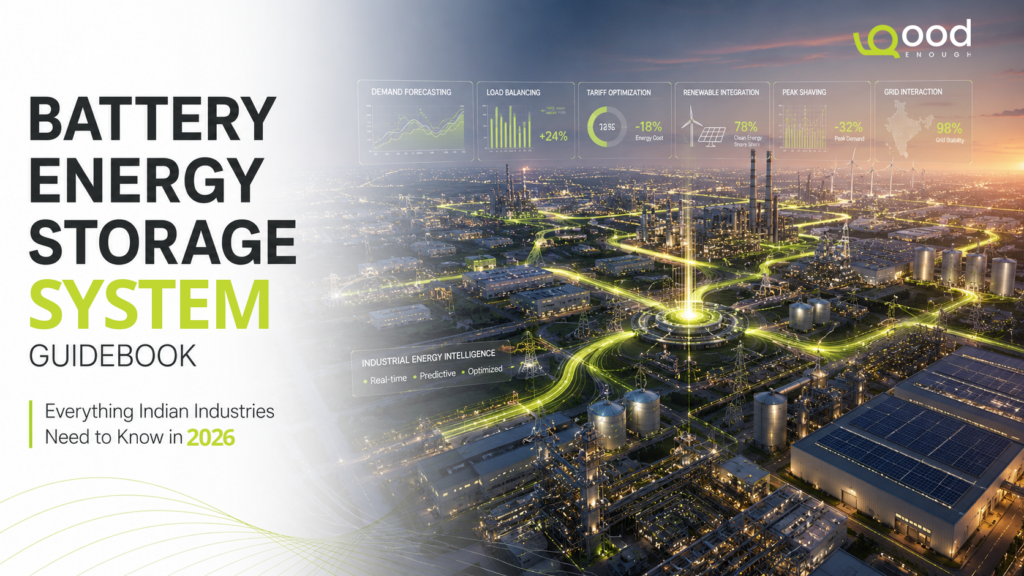
If you manage a factory, plant, or large commercial facility in India, power is one of your biggest operating costs and one of your biggest headaches. Unplanned outages stall production lines. Peak-hour tariffs inflate your electricity bills. Diesel generators burn cash and emit fumes. This is exactly why a clear, practical battery energy storage system guidebook has become essential reading for industrial decision-makers across the country. Whether you are exploring BESS for the first time or looking to scale up an existing setup, this guide walks you through everything you need to know without unnecessary jargon.
What Is a Battery Energy Storage System?
A Battery Energy Storage System (BESS) is a technology that stores electrical energy in batteries and releases it on demand. Think of it as a giant, intelligent power bank for your facility. It can charge during off-peak hours when electricity tariffs are low, and discharge during peak hours or grid outages protecting your operations and slashing costs.
For Indian industries, the value proposition is especially strong. India’s power grid, while improving rapidly, still experiences voltage fluctuations, tripping, and demand-supply gaps in many industrial belts. At the same time, daytime solar energy is increasingly affordable. A well-designed BESS bridges these realities storing cheap solar or grid power and deploying it exactly when your facility needs it most.
Core Components Covered in Every Battery Energy Storage System Guidebook
Understanding what makes up a BESS is the foundation of any battery energy storage system guidebook. Here are the key building blocks:
1. Battery Modules
The heart of the system. Lithium Iron Phosphate (LFP) batteries dominate the industrial segment today because of their long cycle life (3,000–6,000 cycles), thermal stability, and declining costs. For Indian conditions high ambient temperatures and dusty environments LFP is typically the recommended chemistry.
2. Battery Management System (BMS)
The BMS monitors each cell’s voltage, temperature, and state of charge. It prevents overcharging, deep discharging, and thermal events essentially acting as the brain that keeps your investment safe and performing at its best.
3. Power Conversion System (PCS)
The PCS converts DC power stored in the batteries into AC power usable by your machinery and equipment. The efficiency of the PCS directly impacts how much of your stored energy you actually get back.
4. Energy Management System (EMS)
The EMS is the software layer that decides when to charge, when to discharge, and how much. A good EMS integrates with your existing SCADA or plant monitoring systems and can be programmed for peak shaving, demand response, backup power, or solar self-consumption.
Battery Energy Storage System Applications in Indian Industries
No industrial energy storage solutions guide is complete without real-world applications. Here is how Indian factories and plants are deploying BESS today:
• Peak Demand Shaving: Many industrial consumers in India pay a demand charge based on their highest 15-minute or 30-minute consumption in a billing cycle. A BESS can cap that peak by discharging during high-load windows, directly reducing this tariff component by 20–35%.
• Solar Self-Consumption: Pairing a rooftop or ground-mount solar plant with battery storage for factories allows excess daytime generation to be stored and used during the evening shift or at night maximising ROI on your solar investment.
• Backup Power & Continuity: For industries where even a 5-minute outage means scrapped batches or safety risks pharmaceuticals, food processing, precision manufacturing a BESS provides seamless, millisecond-switchover backup without diesel fumes or maintenance overhead.
• Power Quality Improvement: Voltage sags, harmonics, and frequency variations can damage sensitive equipment and cause rejects on the production line. A BESS with a high-quality PCS actively conditions the power supply, protecting your machinery.
• Time-of-Use (ToU) Arbitrage: With ToU tariffs spreading across Indian DISCOMs, industries can charge their BESS during low-cost slots (often night hours) and avoid grid draw during expensive peak slots a strategy that can deliver payback periods as short as 4–5 years.
How to Size a BESS for Your Industrial Facility: A Step-by-Step Approach
Sizing is often the most confusing part of any BESS for industry India project. Get it wrong and you either overspend or underperform. Here is a simplified framework:
Step 1: Audit Your Load Profile
Pull 6–12 months of smart meter or SCADA data. Identify your peak demand periods, average daily consumption, shift timings, and any critical loads that must never go down. This data drives every sizing decision.
Step 2: Define Your Primary Objective
Are you primarily trying to reduce electricity cost India-wide on your bill, or do you need backup reliability? Peak shaving requires high power (kW) capacity. Backup power requires high energy (kWh) capacity. Clarity here prevents over-sizing one dimension at the expense of another.
Step 3: Calculate Required Power and Energy
As a rule of thumb: multiply your peak shaving target (kW) by the duration of the peak window (hours) to get a rough kWh requirement. Add a 20–30% buffer for degradation and round-trip efficiency losses. Always confirm with a qualified energy storage engineer.
Step 4: Evaluate Financing Models
In India, BESS can be purchased outright (CAPEX), financed through equipment loans, or procured under an Energy-as-a-Service (EaaS) or Battery-as-a-Service (BaaS) model where you pay monthly based on usage or savings. EaaS models are gaining traction because they eliminate upfront capital barriers and shift performance risk to the provider.
India Policy Landscape and Incentives for Industrial Energy Storage
Any comprehensive commercial energy storage system guide must cover the regulatory environment. India has made strong policy moves in favour of energy storage:
• The National Framework for Promoting Energy Storage (2022) set a target of 51.5 GWh of storage by 2027, with significant industrial and utility allocations.
• The Production Linked Incentive (PLI) scheme for Advanced Chemistry Cell (ACC) manufacturing is driving domestic battery production, which will reduce costs for industrial buyers over the next 2–4 years.
• Several state DISCOMs including those in Maharashtra, Gujarat, Tamil Nadu, and Rajasthan are piloting or rolling out ToU tariffs, making BESS arbitrage increasingly viable.
• Under the Renewable Purchase Obligation (RPO) framework, industries that pair storage with renewable energy assets can meet compliance targets more efficiently.
Choosing the Right BESS Vendor in India: 6 Questions to Ask
With dozens of suppliers now active in the Indian market, vendor selection is critical. Use this checklist from our battery energy storage system guidebook framework:
• What battery chemistry do you use, and why is it right for my operating environment?
• Can you provide references from similar industrial installations in India?
• What is the warranted cycle life and capacity retention guarantee (e.g., 80% at year 10)?
• Who monitors and maintains the system post-installation, and what is the SLA for response time?
• Does your EMS integrate with my existing SCADA / BMS / ERP platform?
• What financing or EaaS options do you offer, and what are the contractual safeguards?
Understanding ROI: What Can Indian Industries Realistically Expect?
ROI from a commercial energy storage system depends on your tariff structure, load profile, and chosen use case. Across deployments in Indian manufacturing, cement, textile, and food-processing sectors, the following benchmarks are commonly observed:
• Peak demand charge reduction: 15–35% reduction in monthly demand charge component.
• Diesel genset displacement: Replacing 50–80% of diesel backup hours with battery backup, saving Rs. 12–20 per kWh on fuel cost alone.
• Solar + storage self-consumption: Improving solar utilisation from ~60% to over 90%, generating faster payback on the combined solar + storage investment.
• Simple payback period: Typically 4–7 years for well-designed systems in high-tariff states, with system lifespans of 10–15 years.
Industry Insight: A mid-sized textile plant in Gujarat with a peak demand of 2 MW installed a 1 MW / 2 MWh BESS system. Within the first year, the plant reduced its electricity bill by Rs. 48 lakhs annually, achieving full payback in under 5 years.
A Practical Battery Energy Storage System Guidebook for Implementation: Step-by-Step Timeline
From first conversation to commissioning, a typical industrial BESS project in India follows this timeline:
• Weeks 1–2: Energy Audit & Feasibility Study: Load profiling, tariff analysis, site inspection.
• Weeks 3–4: System Design & Proposal: BESS sizing, single-line diagram, financial modelling, and ROI projections.
• Weeks 5–8: Procurement & Approvals: Equipment procurement, DISCOM approval where required, civil foundation work.
• Weeks 9–12: Installation & Commissioning: Equipment installation, grid connection, BMS/EMS configuration, and testing.
• Ongoing Monitoring & Optimisation: Remote monitoring dashboards, periodic performance reviews, and firmware updates.
Conclusion: Your Next Step with This Battery Energy Storage System Guidebook
India’s energy landscape is changing fast, tariffs are rising, renewable are scaling, and industrial competitiveness increasingly depends on how intelligently you manage power. This battery energy storage system guidebook has given you the foundational knowledge to evaluate BESS as a strategic asset for your facility not just an energy accessory.
The next step is specific to your plant. A generic approach rarely delivers the best results. Engage with an experienced BESS provider who will conduct a detailed energy audit, propose a right-sized solution, and back it up with a performance guarantee.
Industries that move now will lock in lower system costs before the next wave of demand-driven price increases. More importantly, they will build the energy resilience that modern manufacturing demands.