Executive summary
Battery Energy Storage Systems (BESS) provide fast, accurate, bidirectional power injections and absorption that address the short-term imbalances created by variable renewable generation. This article explains how frequency regulation works in modern power systems, why BESS are uniquely suited to real-time regulation, the step-by-step operational loop (sensing → control → dispatch → recovery), and the economic and regulatory mechanisms that value accuracy. Also BESS Grid Stability solutions are enabling power grids to manage renewable variability more effectively. By integrating battery storage with solar generation, operators can stabilize frequency and maintain uninterrupted power supply.
How Renewable Energy Is Impacting BESS Grid Stability
Grid frequency is the instantaneous balance between generation and load, expressed in hertz (Hz). In synchronous AC grids, frequency deviates when generation and demand are not equal: a generation shortfall → frequency falls; an excess → frequency rises.
Key drivers that make frequency stability harder today:
- Reduced mechanical inertia. Conventional thermal and hydro generators contain large rotating masses that naturally slow the rate of frequency change after disturbances (this is “inertia”). Inverter-based renewables (solar PV, many wind turbines) are not inherently synchronous and therefore do not provide the same physical inertia unless specifically configured to emulate it. Reduced inertia increases the rate of change of frequency (RoCoF) and shortens the window available for corrective action.
- Higher variability and uncertainty. Solar and wind fluctuate on multiple time scales (seconds to hours) because of cloud cover, gusts, and diurnal cycles. More variability increases the frequency of small imbalances and the magnitude of fast events the system must absorb.
- Limits of conventional generation. Thermal plants provide reliable secondary and tertiary services but have slow ramp rates and minimum run constraints. Fast governor action is constrained by mechanical and thermal limits, making them less effective for sub-second to few-second corrections that rising RoCoF requires.
Definition (inertia): the stored kinetic energy in rotating masses of synchronous machines that resists changes in frequency. Lower system inertia → higher RoCoF → more need for ultra-fast corrective devices.
How Frequency Regulation Works in Modern Power Systems
Frequency regulation is organized in hierarchical control layers. Each layer has a distinct timescale, objective, and typical provider.
Primary control (seconds)
- What it does: Arrests the initial frequency excursion immediately following a disturbance (seconds).
- Mechanism: Local automatic response e.g., governor action on a synchronous generator or inverter fast-droop/FFR response on an inverter-coupled asset.
- Objective: Stabilize frequency slope and limit deviation magnitude until slower reserves act.
Secondary control (tens of seconds to minutes)
- What it does: Restores frequency toward nominal and frees up primary resources.
- Mechanism: Centralized AGC (Automatic Generation Control) dispatches set-point changes to resources to bring Area Control Error (ACE) toward zero.
- Objective: Rebalance the scheduled interchange and secure system frequency near nominal.
Tertiary control (minutes)
- What it does: Replenishes reserves, handles longer-duration imbalance and economic dispatch.
- Mechanism: Manual or automated dispatch of slower units or instructions to market participants.
- Objective: Return the system to normal operating conditions and optimize cost.
Definition (Fast Frequency Response – FFR): an ancillary service that acts faster than traditional governor response (sub-second to a few seconds) to arrest RoCoF and reduce nadir depth. Modern standards (e.g., IEEE and national grid codes) classify FFR types and performance requirements.
Why Battery Energy Storage Is Uniquely Suited for Frequency Regulation
BESS bring four technical advantages that align exactly with fast frequency regulation needs:
- Sub-second response time. Power electronics and control logic enable BESS to inject/absorb power within tens to hundreds of milliseconds – far faster than mechanical governors. This counters high RoCoF and reduces frequency nadir.
- High accuracy and controllability. Advanced control systems provide precise power set-points and state-of-charge (SoC) aware dispatch, enabling accurate tracking of an AGC signal or autonomous droop/FFR schemes.
- Bidirectional. BESS can both source and sink power instantaneously – critical for both arresting downward frequency excursions (discharging) and preventing over-frequency (charging).
- Decoupled energy and power capacity. Designers can size BESS power rating to meet instantaneous regulation needs while energy capacity covers the expected duration of events plus recovery/rebalancing cycles.
These attributes make BESS the canonical fast frequency response BESS technology and a practical renewable energy intermittency solution at scale. For policy and grid code contexts, several jurisdictions are already specifying performance and telemetry requirements for storage to provide primary/secondary services.
How BESS Performs Real-Time Frequency Regulation (Step-by-Step)
Below is the operational loop for a BESS delivering frequency regulation in real time. Follow a single event (generation deficit → frequency drop) through the system.
- Sensing (milliseconds):
- Wide-area or local frequency measurement (f(t)) via PMU or local phasor/ADC.
- RoCoF detectors and nadir estimators may also run to select response mode.
- Decision/Control (tens to hundreds of ms):
- Local controller evaluates f(t) relative to thresholds (droop/FFR trigger).
- If configured for grid-support, the BESS issues an immediate power command (e.g., proportional to Δf or RoCoF).
- For AGC participation, central signal arrives and is tracked.
- Dispatch/Power Injection (ms→s):
- Power electronics translate command to DC-AC conversion, adjusting inverter setpoints.
- BESS ramps to commanded real power (P) while respecting inverter limits (Imax), SoC constraints, and thermal limits.
- Recovery & Rebalancing (seconds→minutes):
- After the immediate event, the BESS may need to recharge (if it discharged) using scheduled energy or market purchases.
- Secondary/tertiary reserves coordinate long-term balancing and restore SoC to pre-event targets.
- Telemetry & Verification (continuous):
- Compliance requires logged performance (response time, delivered energy, accuracy). Grid operators use these records to settle markets and tune control settings.
- Compliance requires logged performance (response time, delivered energy, accuracy). Grid operators use these records to settle markets and tune control settings.
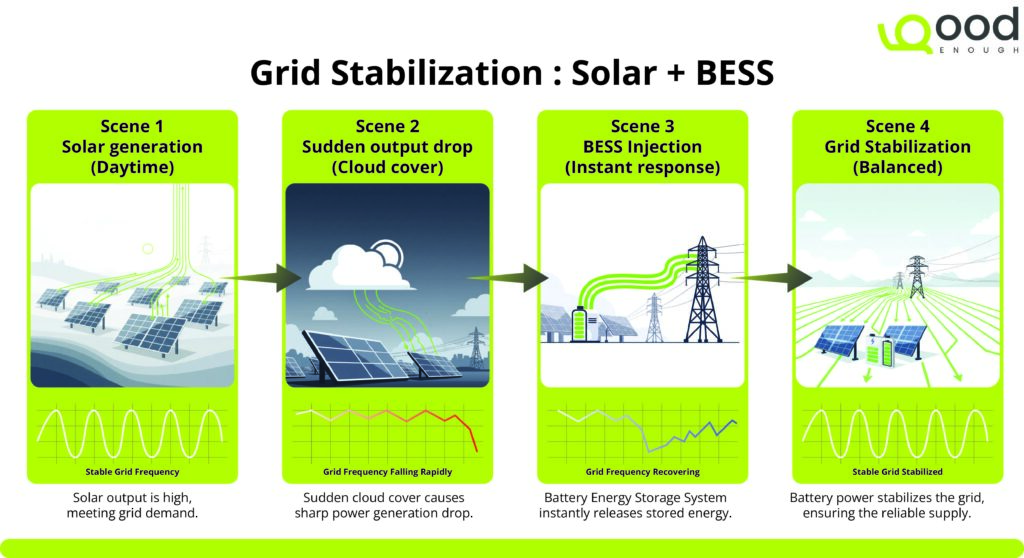
Example 1: The image explains how batteries support the grid when solar power suddenly drops. When sunlight is strong, solar panels generate enough electricity to keep the grid stable. But if cloud cover reduces solar output, the grid experiences a temporary power gap. Battery storage systems respond within milliseconds by injecting stored energy, stabilising grid frequency and maintaining reliable electricity flow until balance is restored.
Operational and Grid-Level Benefits of BESS Grid Stability Solutions
- Improved reliability and security. Faster arrest of frequency deviations reduces loss-of-load risk and generator tripping cascades. Fewer emergency actions preserve system stability.
- Higher renewable hosting capacity. By addressing short-term variability and RoCoF, BESS relax the operational limits that previously constrained renewable dispatch, enabling higher VRE penetration without compromising frequency targets.
- Reduced need for spinning reserves. Fast storage can substitute (or reduce) the amount of online spinning thermal capacity required solely for contingency response, improving overall fleet efficiency.
- Faster restoration and lower wear on conventional plants. Short-duration imbalances are handled electrically rather than by thermal cycling, reducing thermal plant wear, fuel cycling costs, and maintenance.
Operational flexibility. BESS are multi-service assets: the same device can provide frequency regulation, ramp support, voltage control (via reactive capability), black-start capability (if configured), and energy arbitrage – improving utilisation and lowering system-level costs when optimised.
Economic and Market Implications
How frequency regulation services are valued
- Procurement models. Ancillary services can be purchased via markets (pay-for-performance, capacity payments, energy settlement) or procured administratively (regulated tariffs/contracts). Market designs differ in time granularity, product definition (e.g., FFR vs. primary droop vs. AGC), and settlement rules.
- Performance metrics that determine revenue:
- Response time: faster responses typically command higher value in pay-for-performance frameworks.
- Accuracy (tracking error): markets often measure and reward accurate following of AGC or frequency signals.
- Availability and duration: the guaranteed power for a minimum duration influences capacity payments.
- Response time: faster responses typically command higher value in pay-for-performance frameworks.
- Why accuracy matters economically. Higher accuracy reduces imbalance penalties for system operators and stabilizes dispatch schedules, which in turn lowers total system operating cost. For BESS owners, superior tracking performance increases market clearing success and revenue per MW. Models show allocating a portion of battery capacity to regulation (rather than only arbitrage or peak shifting) can materially improve project returns.
Cost trade-offs to consider
- Capital vs. operational value. BESS CAPEX has fallen, but economic viability depends on stacking revenue streams and policy clarity on eligible services.
- Degradation costs. Cycling for frequency services accelerates battery wear; controllers must trade off revenue today vs. asset life and replacement cost.
- Market design risk. Jurisdictions that limit ancillary services to traditional generators or that fail to quantify fast services will under-reward BESS, affecting investment decisions. Regulatory updates to include storage explicitly can unlock revenue and system benefits.
Common Misconceptions About BESS and Frequency Control
- Myth -“Batteries replace generators.”
Reality: BESS are complementary: they provide rapid, short-duration responses and can reduce the need for some spinning reserve but cannot replace bulk energy supply for long duration needs unless sized for that purpose. They shift the shape and cost of system resource needs not remove the need for generation entirely. - Myth – “Storage is only backup.”
Reality: Frequency regulation is a continuous operational service, not just emergency backup. Many BESS earn most revenue from fast ancillary streams and grid services rather than rare backup events. - Myth – “All BESS behave the same.”
Reality: Power electronics, inverter control firmware, SoC management, and ancillary-service software determine actual performance. Certification, telemetry, and compliance standards matter for grid acceptance. - Myth – “More power rating always equals better frequency control.”
Reality: Sizing must match expected event durations and control strategy. High power for very short durations may be optimal for RoCoF mitigation, while energy capacity is vital for sustained imbalances and recovery. Optimal design balances power, energy, and economic objectives.
How BESS Grid Stability Will Shape Frequency-Stable Grids
Key determinants:
- Policy & market design: Explicit inclusion of storage in ancillary service definitions, pay-for-performance schemes for FFR, and clear SoC/telemetry requirements will shape investments. India and other markets are evolving rules to make BESS eligible and to set technical standards.
- Standards & certification: IEEE standards and national grid codes that define response classes, testing procedures, and compliance metrics (e.g., IEEE Std. on inverter performance and IEGC clauses) will provide interoperability and trust.
- Advanced aggregated control & AI: Aggregation of distributed assets (fleeted BESS + DERs) with coordinated control will provide synthetic inertia and distributed FFR — enabling resilience without depending on a few large units.
- Economics & circularity: Improved economics through stacking services, second-life batteries, and recycling policy will reduce life-cycle cost and promote scale. Regulatory incentives and clearer valuation of reliability will accelerate deployment.
- Local manufacturing and supply chain scale: Domestic gigafactories and ramped production (for example, recently announced factory capacities) reduce lead times and cost risk, enabling faster deployment of grid-support storage. In India, commissioning of larger local manufacturing capacity is reshaping project economics.
Tailoring Implementation: Goodenough Energy’s recent commissioning activity and local gigafactory capacity (operational 7 GWh facility with planned expansion) positions it to supply both project-scale BESS and software-enabled regulation services suited for the Indian grid and export markets. When deploying frequency regulation products, consider:- Product configuration: Provide both high-power, short-duration options optimized for FFR and higher-energy variants for combined regulation + energy shifting.
- Grid code compliance: Ensure firmware supports CEA/IEGC telemetry and frequency controller requirements; support AGC tracking and local droop/FFR modes.
- Performance verification: Offer transparent test logs (response time, energy delivered, accuracy) to grid operators to qualify in ancillary markets.
- Market stacking & degradation management: Provide SoC management services that split capacity between regulation (higher revenue, higher cycling) and energy markets (lower cycling) to control lifecycle cost.
Deploying Grid Regulation Solutions with Goodenough Energy
Goodenough Energy’s recent commissioning activity and local gigafactory capacity (operational 7 GWh facility with planned expansion) positions it to supply both project-scale BESS and software-enabled regulation services suited for the Indian grid and export markets. When deploying frequency regulation products, consider:
- Product configuration: Provide both high-power, short-duration options optimized for FFR and higher-energy variants for combined regulation + energy shifting.
- Grid code compliance: Ensure firmware supports CEA/IEGC telemetry and frequency controller requirements; support AGC tracking and local droop/FFR modes.
- Performance verification: Offer transparent test logs (response time, energy delivered, accuracy) to grid operators to qualify in ancillary markets.
Market stacking & degradation management: Provide SoC management services that split capacity between regulation (higher revenue, higher cycling) and energy markets (lower cycling) to control lifecycle cost.
What is the fastest response a BESS can provide for frequency regulation?
Modern grid-scale BESS coupled with power-electronic inverters can deliver substantive power changes in tens to a few hundred milliseconds. The realized response depends on inverter control, telemetry latency, and site architecture; IEEE and research classifications define several FFR types to align performance expectations with grid needs.
Can a BESS provide primary frequency response and participate in AGC?
Yes. A BESS can be configured for autonomous primary droop/FFR action and simultaneously participate in centralized AGC schemes. Controllers must manage SoC and offer telemetry to demonstrate reliability and tracking accuracy for market settlement.
How does battery cycling for frequency services impact asset life?
Frequency regulation involves frequent shallow or deep cycles that accelerate calendar and cycle degradation. Asset life impact is a function of cycle depth, rate, temperature, and chemistry. Proper SoC management and economic stacking formalise the trade-off between near-term revenue and long-term replacement cost.