
The Kerala government solar scheme has transformed rooftop solar from a niche option into a mainstream choice for households, apartments, and small businesses across the state. At the same time, new Kerala solar rules especially the KSERC 2025 regulations on net metering and grid support charges will directly affect how much you actually save on your KSEB electricity bill.
Kerala’s rooftop solar capacity almost doubled between 2023 and late 2024, reaching about 946.9 MW across roughly 1.52 lakh systems and meeting around 22% of the state’s daytime demand from rooftop solar alone. But as penetration has grown, KSERC has moved from “promote at all costs” to “promote with grid stability and financial discipline”, which means every new consumer under the kerala government solar scheme needs to understand the changing rules.
What Is the Kerala Government Solar Scheme?
The Kerala government solar scheme is an umbrella term for state‑backed rooftop solar programmes implemented mainly through KSEB, historically led by the Soura initiative and now closely aligned with the central PM Surya Ghar rooftop programme. Under these schemes, domestic consumers can install grid‑connected rooftop systems and receive central financial assistance (CFA) plus KSEB‑facilitated implementation support.
KSEB’s Soura programme was initially launched to add 1,000 MW of rooftop solar to the grid under the Urja Kerala Mission, using models where KSEB or empanelled vendors installed systems and consumers either leased their roofs or co‑invested. According to KSEB data and media reports, over 1 lakh solar plants totalling more than 600 MW had been installed under various schemes by late 2023, with more than 90% of beneficiaries being domestic consumers.
Subsidy levels for domestic consumers typically follow MNRE guidelines: 40% CFA on benchmark cost up to 3 kW, and 20% CFA from 3–10 kW, with similar 20% support for group housing common facilities up to 500 kW. This is why the kerala government solar scheme has been especially attractive for 1–3 kW and 3–10 kW home systems.
What Changed Under KSERC 2025 Regulations?
In November 2025, the Kerala State Electricity Regulatory Commission notified the KSERC (Renewable Energy and Related Matters) Regulations, 2025, often referred to as the Kerala new solar rules 2025. These regulations come into force from 6 November 2025, with the mechanisms (net metering, banking, grid support charges) fully applicable from 1 January 2026.
Key changes relevant to kerala government solar scheme consumers include:
- Revised net metering limits
- Grid support charges
- No grid support charges for prosumers with renewable energy systems up to and including 10 kW.
- For systems above 10 kW, charges apply only on units drawn from the grid during non‑solar hours that are adjusted against banked solar energy, at ₹0.50 per unit for the first 300 such units and ₹1 per unit thereafter.
- Agricultural consumers are fully exempt from grid support charges.
- Export and banking rules
- Surplus units can still be banked and adjusted, but settlement at the end of the year will follow updated formulas and tariffs notified by KSERC/KSEB; the exact export compensation may evolve through separate tariff orders.
In short, the KSERC 2025 regulations net metering framework remains friendly to typical Soura and PM Surya Ghar‑type domestic systems, but it tightens rules for larger plants and for those treating the grid as a free battery.
Net Metering vs Net Billing vs Gross Metering in Kerala
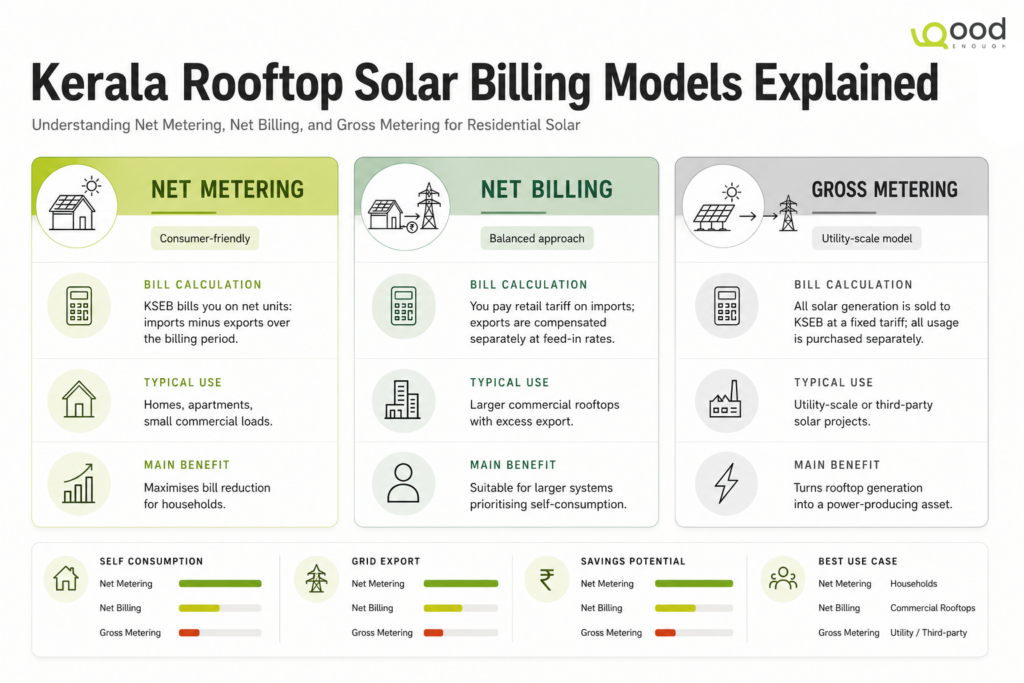
One of the biggest points of confusion for kerala government solar scheme applicants is the difference between net metering, net billing, and gross metering in Kerala.
Simple comparison of metering models
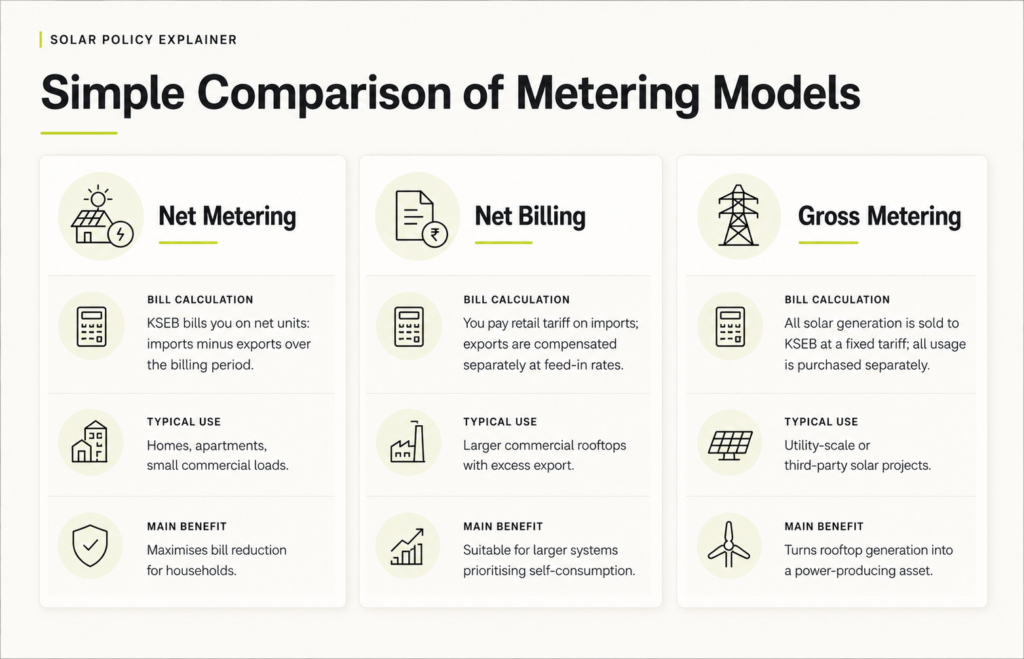
KSERC 2025 explicitly allows all three models and leaves many tariff details to separate orders, which means the exact export rate for net billing/gross metering will depend on future KSEB/KSERC decisions. For most domestic consumers under the kerala government solar scheme, net metering will continue to be the default and most sensible option.
Kerala Rooftop Solar Net Metering Limit 3 kW & 5 kW Explained
You will still see a lot of discussion about the Kerala rooftop solar net metering limit 3 kW 5 kW, especially on social media and older blogs. This comes from the draft version of the KSERC 2025 regulations, which had proposed:
- Net metering only up to 3 kW.
- Net metering up to 5 kW if at least 30% of the capacity was backed by storage (battery).
The idea was to force larger rooftop systems into net billing or gross metering to protect the grid from heavy daytime exports and expensive evening imports. Prosumers, installers, and consumer groups strongly opposed this, arguing it would kill rooftop economics for mid‑size homes and small institutions.
The final KSERC 2025 regulations dropped the 3 kW/5 kW hard cap and instead:
- Allow domestic net metering up to 20 kW directly.
- Remove net metering limits for small systems typical of the kerala government solar scheme (1–3 kW, 3–10 kW), as long as they stay below 10 kW to avoid grid support charges.
- Introduce more nuanced conditions (including future storage requirements) for larger capacities—details here are still being refined through follow‑up orders and may evolve.
For a typical homeowner or small EPC‑backed project under the kerala government solar scheme, the earlier 3 kW/5 kW scare is largely historical; what matters now is staying within the 20 kW domestic cap and 10 kW grid‑support‑free band.
Kerala Grid Support Charges for Solar Consumers
The phrase Kerala grid support charges solar has been a major source of concern—often interpreted as a hidden tax on rooftop owners.
What the final regulations actually say:
- Prosumers with renewable energy systems up to 10 kW pay no grid support charges.
- For systems above 10 kW using net metering, grid support charges are payable only on energy drawn from the grid during non‑solar hours that is adjusted against the prosumer’s banked solar units.
- Charges are ₹0.50 per unit for the first 300 such units per month, and ₹1 per unit for any additional units.
- All agricultural consumers with renewable systems are fully exempt.
Example: If a prosumer draws 400 units during non‑solar hours and has 300 banked units, charges apply only on those 300 units, not the entire 400.
From a consumer perspective, this means:
- Small domestic systems under the kerala government solar scheme (≤10 kW) are protected.
- Larger homes and small commercial users may see a modest reduction in savings if they rely heavily on exporting daytime surplus and consuming heavily at night.
- The policy signals a shift: the grid is no longer a free, unlimited battery for large consumers.
Is Solar Still Worth It in Kerala After KSERC 2025?
The honest question many people are asking is: is solar still worth it in Kerala after KSERC 2025?
On the positive side:
- Kerala is one of India’s rooftop leaders, accounting for about 10.6% of the country’s rooftop additions in the first nine months of 2024 and ranking among the top five states for cumulative installed capacity.
- Rooftop systems now generate enough power to meet around 22% of Kerala’s daytime demand, with over 1.52 lakh systems installed by October 2024 and a near‑100% growth rate since 2023.
- Central and state subsidies under the Kerala government solar scheme (40% + 20% CFA, soft loans, KSEB‑facilitated EPC) still significantly lower upfront cost and improve payback for 1–10 kW systems.
On the challenging side:
KSERC 2025 has clearly reduced the attractiveness of oversized systems that export a lot and depend on generous net metering/banking, especially above 10 kW.
Export compensation for net billing and gross metering will depend heavily on future tariff orders; if feed‑in rates are low, pure export‑driven models will struggle.
Policy uncertainty remains around future storage rules for larger domestic systems and the exact implementation of advanced models like Virtual Net Metering.
Overall, for a typical household installing a 2–5 kW system under the kerala government solar scheme, solar is still very much worth it if:
- Most usage (fans, fridge, washing machine, some cooling) occurs during the day.
- The system is sized to match realistic consumption rather than chasing “zero bill”.
- The consumer is prepared for moderate, not exaggerated, returns and a 6–10+ year payback depending on tariff evolution and usage patterns (exact payback varies case‑by‑case and should not be assumed).
Kerala Government Solar Scheme for Apartments and Flats
Apartments and group housing societies are a crucial segment for the kerala government solar scheme, but they face extra complexity.
Under KSERC 2025:
- Net metering is allowed up to 500 kW for the common service connection in multi‑storey residential buildings.
- This makes rooftop solar ideal for common loads like lifts, corridor lighting, pumps, STP, parking lights, etc.
- Individual flat meters do not automatically get direct net metering credit from a shared plant; advanced models like Virtual Net Metering and energy sharing are conceptually provided for but still need detailed implementation.
Practical challenges for apartments include:
- Finding enough shadow‑free roof area to make a meaningful plant.
- Agreeing on cost sharing, ownership, and benefit distribution among flat owners.
- Aligning plant size with common load patterns to avoid large, low‑value exports.
Despite these issues, the Kerala government solar scheme remains attractive for apartment associations that have high common bills and are able to manage internal governance effectively.
Future of Kerala Rooftop Solar Policy 2026
Looking beyond KSERC 2025, Kerala rooftop solar policy 2026 domestic consumers will be shaped by three big drivers:
- Renewable energy and climate targets
- Kerala’s official documents and KSEB commentary emphasise long‑term goals of 100% renewable electricity by 2040 and carbon neutrality by 2050, with rooftop solar as a central pillar.
- Distributed solar growth and grid balancing
- Kerala has about 947 MW of rooftop capacity already meeting 22% of daytime demand; as this share rises, grid balancing challenges will intensify, especially during evening peaks.
- This explains the draft’s push for storage and the final regulations’ grid support charge structure; more refinements are likely.
- Storage and battery adoption trends
- The draft KSERC 2025 regulations clearly tried to mandate batteries for systems above 3 kW, and while the final rules softened this, the direction of travel is clear: storage will become more important over time.
- Future reforms may link higher export tariffs to time‑of‑day pricing, EV‑to‑grid (V2G) participation, or minimum storage contributions, especially for larger kerala government solar scheme beneficiaries.
For consumers, the takeaway is that policy will continue to support rooftop solar but with more conditions around when and how energy is delivered to the grid.
Conclusion
The kerala government solar scheme has undeniably helped Kerala become one of India’s rooftop solar frontrunners, but the KSERC 2025 regulations mark the beginning of a more mature phase in which net metering, grid support charges, and storage will all matter for your final ROI. For homeowners, apartments, and EPC‑driven projects, the new reality is clear: design systems around realistic self‑consumption, respect the 10 kW and 20 kW thresholds, follow official KSEB and KSERC updates closely, and treat policy literacy as part of the investment—not an afterthought
1. What exactly is covered under the kerala government solar scheme?
The Kerala government solar scheme mainly refers to state‑supported rooftop programmes implemented by KSEB—such as Soura and successor schemes—combined with MNRE’s PM Surya Ghar subsidies for 1–10 kW residential systems. These cover EPC empanelment, subsidies (40% up to 3 kW, 20% up to 10 kW), and grid‑connected net metering where eligible.
2. Do KSERC 2025 regulations stop small homes from using net metering?
No. The KSERC 2025 regulations net metering framework actually allows domestic consumers to use net metering up to 20 kW, and systems up to 10 kW are exempt from grid support charges. For most small homes under the kerala government solar scheme, net metering remains the default option.
3. Why is everyone talking about Kerala rooftop solar net metering limit 3 kW 5 kW?
That 3 kW/5 kW cap was part of the draft regulations, which proposed strict net metering limits and mandatory batteries above 3 kW. After strong feedback from consumers and industry, the final rules dropped this cap and adopted the more generous 20 kW domestic limit; the phrase survives mainly in older commentary.
4. How do grid support charges affect my solar ROI?
If your system is ≤10 kW, grid support charges do not apply, so your kerala government solar scheme economics remain largely unchanged. Above 10 kW, you will pay ₹0.50–₹1 per unit on banked energy adjusted during non‑solar hours, which slightly reduces savings but does not eliminate the benefit of a well‑designed system.