Battery storage for data centers is becoming a critical solution as electricity costs continue to rise across India’s digital infrastructure. With increasing power tariffs, peak demand charges, and growing reliability concerns, managing energy efficiently has become a top priority for data center operators. The good news? Advanced battery energy storage systems (BESS) offer a practical and proven way to reduce costs, minimise diesel dependence, and ensure uninterrupted power.
How Battery Storage for Data Centers Works in Real-World Operations
Battery energy storage systems (BESS) store electricity and release it when needed, enabling data centers to manage power more efficiently.
A typical system includes:
- Battery modules (commonly lithium-ion)
- Power conversion systems (inverters)
- Battery management systems (BMS)
- Cooling and control software
The role of battery storage for data centers goes beyond backup power, enabling real-time energy management and grid stability.
These systems respond within milliseconds, ensuring seamless operations without interruptions.
Why Battery Storage for Data Centers Is Becoming Critical in India
India’s data center industry is expanding rapidly, driven by cloud adoption, AI workloads, and digital transformation. This growth is putting immense pressure on power infrastructure, especially in key hubs like Mumbai, Chennai, and NCR.
Rising electricity costs, grid instability, and increasing restrictions on diesel generators are forcing operators to rethink their energy strategy.
This is why battery storage for data centers is gaining rapid adoption across India. Battery systems provide instant backup, stabilise power fluctuations, and reduce dependency on diesel for short-duration outages.
But the real pain point isn’t just the per-unit rate. Industries often pay heavily due to:
- High contracted demand penalties
- Time-of-day tariff surcharges during peak hours
- Power factor penalties
- Reactive energy charges
Understanding what’s driving your bill is the first step to reducing industrial electricity cost in India effectively.
Use Cases of Battery Storage for Data Centers in India
1. Understand Your Electricity Bill (Hidden Charges)
Most industries don’t fully understand their electricity bill and that’s expensive. Your bill isn’t just about units consumed. It includes several hidden components.
What to look for:
- Demand charges: Charged based on your peak kVA or kW usage in a billing period even if that peak lasted just 15 minutes.
- ToD (Time-of-Day) tariffs: Higher rates during morning and evening peak windows (typically 6–10 AM and 6–10 PM).
- Power factor charges: Penalties if your power factor falls below 0.9 or 0.95 in most states.
- Wheeling and cross-subsidy surcharges: Applicable on open-access renewable energy purchases.
Pro Tip: Conduct a detailed bill audit with your energy manager every quarter. Identifying billing anomalies alone can save 5–10% of your total electricity cost.
2. Reduce Peak Demand Charges in India
Peak demand charges in India can account for 20–35% of a large industrial unit’s monthly electricity bill. You are essentially paying a high price for that brief moment when all your machines run simultaneously.
How to reduce peak demand:
- Stagger the start-up of heavy machinery to avoid simultaneous load spikes
- Schedule high-energy processes (ovens, compressors, chillers) during off-peak hours
- Use automatic load-shedding systems to cap demand at a pre-set threshold
- Deploy a Battery Energy Storage System (BESS) to shave demand peaks automatically
Peak shaving alone can reduce your monthly electricity bill for industries by ₹2–10 lakhs, depending on your plant size and tariff structure.
3. Use Time-of-Day Tariffs Smartly
Most state DISCOMs in India now apply time-of-day tariffs at higher rates during peak demand windows and lower rates during off-peak hours (often midnight to 6 AM or weekends).
Smart industries use this to their advantage by:
- Shifting energy-intensive operations to off-peak hours
- Charging battery storage during cheap off-peak windows
- Discharging stored energy during expensive peak periods
- Automating shift scheduling around ToD windows
A BESS paired with time-of-day tariff optimization is one of the most powerful tools to reduce electricity bill for industries in India today.
4. Use Battery Energy Storage Systems (BESS)
A Battery Energy Storage System (BESS) in India is rapidly becoming the go-to solution for industries looking to slash power costs. Here’s why it works:
- Peak shaving: BESS automatically discharges during high-demand periods, cutting your contracted demand and peak charges.
- ToD arbitrage: Charge batteries when power is cheap; use that energy when it’s expensive.
- Backup power: Eliminates expensive DG set fuel costs during grid outages.
- Solar integration: Store excess solar power and use it during peak hours or at night.
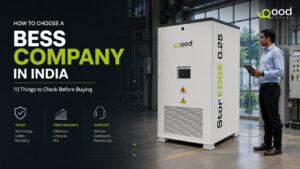
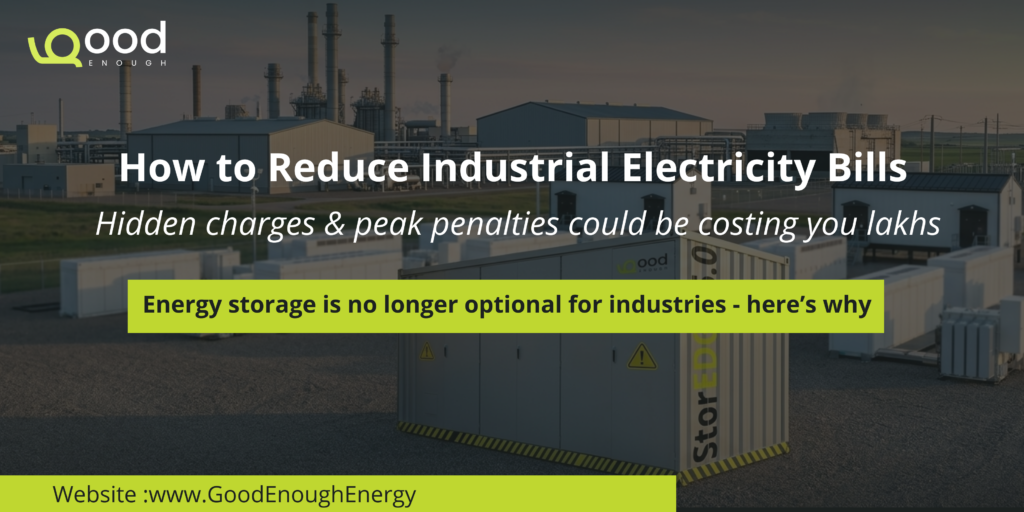
For commercial and industrial facilities, a modular BESS like the StorEDGE 0.25 (250 kWh / 125 kVA) by GoodEnough Energy is a practical starting point. It’s designed specifically for factories, buildings, and microgrids across India helping cut demand charges, reduce DG dependency, and lower electricity bills by up to 50%, without requiring large upfront infrastructure changes.
Pro Tip: An industrial unit with a 500 kVA connected load can reduce its monthly electricity bill by ₹3–8 lakhs using a well-sized BESS solution with a typical ROI period of 3–5 years.
BESS for industries is now supported by central and state government incentives, making it more affordable than ever to deploy in India.
5. Install Solar for Industries in India
Solar for industries in India is no longer just a green initiative it’s a financial imperative. Rooftop or ground-mounted solar systems can reduce the per-unit cost of power to ₹2–3.5 from ₹8–12 in peak ToD slots.
Options available:
- Captive solar: Own and operate your solar plant for maximum savings.
- Open access solar: Procure solar power from a third-party plant via the grid.
- RESCO model: Zero capex pay only for units generated.
When combined with BESS, solar becomes a complete energy management solution generating power during the day and storing it for peak-hour use. This combination is transforming how industries manage their electricity cost in India.
6. Improve Energy Efficiency in Industries
Better energy efficiency in industries means doing the same work with less electricity. Small operational changes and equipment upgrades can deliver consistent savings month after month.
- Replace old motors with IE3/IE4 energy-efficient motors
- Install Variable Frequency Drives (VFDs) on pumps, fans, and compressors
- Upgrade to LED industrial lighting (saves 50–70% on lighting costs)
- Improve insulation on furnaces, boilers, and process equipment
- Maintain compressed air systems to eliminate leaks (can waste 20–30% of generated air)
These measures reduce power consumption in industry without disrupting operations and many qualify for SIDBI, BEE, or state-level energy efficiency financing.
7. Monitor and Optimize Power Usage
You can’t manage what you don’t measure. Smart energy monitoring systems give real-time visibility into every machine, circuit, and shift enabling faster, data-driven decisions.
- Deploy IoT-based energy meters at machine and panel levels
- Set up automated alerts for demand threshold breaches
- Use energy dashboards to track unit consumption by shift, line, or product
- Integrate with your BESS or solar system for unified control
Industries that implement smart monitoring typically see an additional 5–15% reduction in their monthly electricity bill, simply by identifying and eliminating waste.
Future of Battery Storage for Data Centers and Digital Infrastructure
As India moves towards a cleaner energy mix, the role of battery storage will continue to grow. With increasing renewable energy adoption and evolving regulations, data centers will need flexible and reliable power solutions.
Battery storage is expected to become a core component of data center infrastructure, enabling operators to optimise costs while meeting sustainability goals.
Conclusion: Smart Energy = Lower Costs
Reducing industrial electricity cost in India is not about a single fix it’s a layered strategy. From understanding your bill’s hidden charges and managing peak demand, to deploying BESS and solar solutions, every step compounds the savings.
The most successful industrial plants in India today are combining battery energy storage, solar power, time-of-day tariff management, and smart monitoring into one integrated energy strategy. For large-scale operations requiring grid-level reliability, systems like the StorEDGE 5.0 (5 MWh / 2.5 MVA) by GoodEnough Energy are purpose-built for Indian grid conditions engineered to handle high temperatures, peak demand pressure, and renewable integration at scale. The result? Lower bills, greater energy independence, and a stronger bottom line.
Ready to Cut Your Industrial Electricity Bill?
Our BESS experts will analyze your current electricity bills and design a custom energy storage solution tailored to your plant’s load profile, tariff structure, and savings goals.
Contact us today to schedule your free energy audit and discover how much your plant can save.