Maharashtra energy storage policy
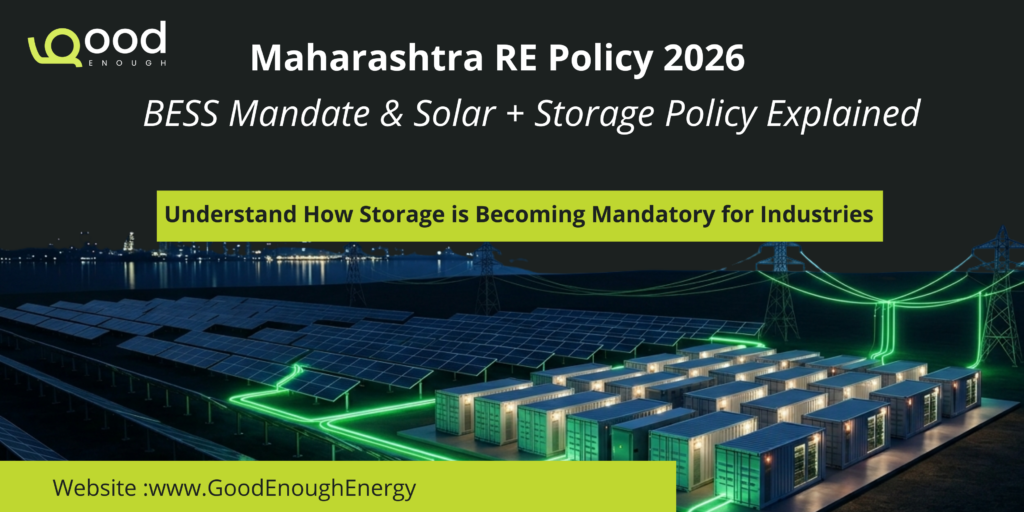
Maharashtra RE Policy 2026 is a landmark state policy that targets 65% of electricity demand from renewable energy by FY 2035–36 while mandating large-scale deployment of energy storage across the grid. For businesses, Maharashtra RE Policy 2026 is not just about “more solar and wind”; it fundamentally changes how commercial, industrial, and utility stakeholders must plan for battery energy storage systems (BESS), rooftop solar, open access, and grid stability. Under Maharashtra RE Policy 2026, every new large renewable project and most 100 kW+ rooftop or open access systems will gradually be required to include battery storage, making BESS central to long-term energy and cost strategy. (Source)
Why Maharashtra RE Policy 2026 Matters for India’s Power Sector
Maharashtra is one of India’s largest industrial and power-consuming states, so Maharashtra RE Policy 2026 effectively acts as a template for how high-renewable, storage-backed grids could work across India. The policy aims for around 100 GW of renewable capacity and roughly 10% of peak demand to be met through energy storage (ESO) by FY 2035–36, which is aligned with national studies by CEA and MNRE on India’s storage needs for a 500 GW non-fossil system by 2030.
For investors and developers, Maharashtra RE Policy 2026 provides clear demand signals: 10 GW of new RE with co-located storage by 2029–30 and 25 GW with storage by 2035–36, plus transmission-linked storage and distributed BESS targets. This scale, combined with India’s broader energy transition, makes Maharashtra a priority market for advanced BESS technologies, system integrators, and EPCs. (Source)
How BESS helps comply
Under the BESS Mandate Maharashtra, storage is no longer an optional add-on capacity; it is embedded into the core design of new renewable projects, especially those contracted by DISCOMs. New solar PV, wind, and wind–solar hybrid projects procured by distribution licensees must include storage sized to at least 50% of the renewable capacity, with a minimum storage duration of 2 hours for projects commissioned up to FY 2029–30 and 4 hours for projects commissioned from FY 2030–31 onwards.
Mandatory storage for rooftop and C&I systems, Penalty if not complied?
BESS Mandate Maharashtra also extends to rooftop and distributed systems above a threshold size. From 1 April 2026 (or the notified date), any rooftop or grid-interactive solar or wind project above 100 kW must integrate storage equal to at least 50% of the renewable capacity for a minimum of 2 hours, and this requirement will be reviewed and tightened every two years for new projects.
For commercial and industrial (C&I) consumers factories, commercial buildings, logistics parks, and data centers this means that future high-capacity rooftop solar or behind-the-meter projects in Maharashtra will be designed as solar + BESS systems by default rather than solar-only. Existing rooftop projects are encouraged, though not mandated, to add storage, allowing them to participate in demand flexibility, peak shaving, and reliability services.
Stand-alone, distributed, and grid-scale BESS
Beyond co-located storage, BESS Mandate Maharashtra promotes:
- Stand-alone storage projects (both pumped storage and BESS), including technology-agnostic tenders where only MW/MWh and delivery year are specified, enabling innovation and cost discovery.
- Distributed BESS on rural feeders and critical loads such as healthcare centers, cold storage, and small industries, with around 10% of the state’s overall storage target to be met by such decentralised systems.
- Grid-scale BESS in the 500–1000 MW range specifically to improve grid stability and provide ancillary services, backed by studies undertaken by MSETCL and MSLDC.
These measures make Maharashtra one of the first Indian states where BESS is planned systematically from distribution level up to the transmission and system-operator level.
Solar Storage Policy MH
Solar Storage Policy MH focuses on how solar + storage can support urban growth, industrial clusters, and consumer-led renewable adoption. Maharashtra already has about 5 GW of rooftop solar as of early 2026, and Solar Storage Policy MH builds on this by prioritizing connectivity and incentives for rooftop and open access projects that integrate storage.
Solar + storage for rooftop and small consumers
Under Solar Storage Policy MH, rooftop projects integrated with a minimum level of storage receive priority grid connectivity. For small consumers (1–100 kW), the policy builds on MERC’s net metering and grid-interactive rooftop regulations, ensuring that consumer choice is preserved while DISCOM costs and reliability are protected.
Banking, grid support charges, and access to net metering or net billing are structured so that small and medium consumers can adopt rooftop solar eventually with storage without destabilizing the grid or shifting hidden costs to other users. Over time, Solar Storage Policy MH is likely to encourage residential societies, MSMEs, and commercial buildings to add BESS to their existing rooftop solar plants to reduce evening peak draw and improve resilience.
Solar + storage hubs near cities and industrial clusters
Solar Storage Policy MH also proposes “urban and industrial solar + storage hubs” of around 100–250 MW each, strategically located near major cities and industrial belts. These hubs aim to reduce transmission congestion, cut technical losses, and provide highly reliable, clean power for sensitive loads such as data centers, IT parks, and high-load industrial estates.
For utilities and developers, these hubs are a major opportunity to design standardized solar + BESS projects that can sell firm, dispatchable renewable capacity to multiple off-takers under long-term contracts.
Technology Overview: Battery Energy Storage Systems for Maharashtra
Battery Energy Storage Systems (BESS) store electricity in batteries during periods of low cost or excess generation and discharge it when power is expensive or scarce, typically over durations of 1–4 hours. Modern lithium-ion BESS solutions are modular, scalable, and can deliver multiple services: peak shaving, time-of-use arbitrage, backup power, frequency support, and ramping support for solar and wind.
In the context of Maharashtra RE Policy 2026, typical configurations include:
- Co-located solar + BESS at utility scale, with storage sized at 50% of the solar nameplate capacity for 2–4 hours, providing dispatchable evening power.
- C&I BESS for factories and commercial buildings, usually 0.25–5 MWh, used for demand charge reduction, DG replacement, and backup.
- Grid-scale BESS (hundreds of MWh) providing ancillary services, congestion management, and transmission deferral at substations.
Indian grid conditions, high ambient temperatures, voltage fluctuations, and frequent distribution-level issues require BESS that are engineered for thermal management, robust power electronics, and compliance with Indian standards and DISCOM interconnection norms.
Business Value for Data Centers, Manufacturing, and Utilities
Data centers and digital infrastructure
With the rapid growth of data centers in India and especially in hubs like Mumbai and Pune, Maharashtra RE Policy 2026 opens a pathway for data centers to secure high-renewable, high-reliability power through solar + BESS and green open access. By combining long-term RE PPAs with on-site or near-site BESS, data centers can:
- Meet internal and client decarbonization targets.
- Stabilize power quality and ride through grid disturbances.
- Optimize energy costs by shifting load away from peak tariffs using storage.
Manufacturing and large C&I loads
For manufacturing plants auto, steel, engineering, food processing the BESS Mandate Maharashtra converts compliance into a potential cost-saving opportunity. Plants that design their rooftop and open access projects with BESS from the outset can:
- Reduce demand charges by shaving peaks.
- Cut diesel generator usage during grid outages.
- Use storage to maximize on-site solar self-consumption under ToD tariffs.
Bulk procurement programs for MSME-scale BESS (10–100 kW, 2–4 hours) supported by funds like Harit Urja Nidhi further lower the entry barrier for smaller industrial and commercial consumers to adopt storage.
Utilities and system operators
For MSEDCL, MSETCL, and other licensees, Maharashtra RE Policy 2026 and Solar Storage Policy MH provide tools to maintain reliability in a high-RE system. Transmission-linked storage (4 GWh by 2029–30 and 10 GWh by 2035–36) and grid-scale BESS projects of 500–1000 MW help smooth net load profiles, reduce curtailment, and improve utilization of existing lines.
As India moves toward higher electrification of mobility, industry, and potentially green hydrogen, such storage-backed transmission and distribution investments will be critical to avoid bottlenecks and brownouts.
How Solutions like StorEDGE 0.25 and StorEDGE 5.0 Fit Maharashtra RE Policy 2026
Maharashtra RE Policy 2026 and BESS Mandate Maharashtra are particularly aligned with modular C&I and mid-scale grid solutions. For example, a 250 kWh / 125 kVA modular C&I BESS such as StorEDGE 0.25 from an Indian BESS manufacturer can be an effective building block for rooftop solar + storage systems above 100 kW, helping commercial and industrial users meet the 50% storage mandate while cutting demand charges and DG run hours. (Source)
At the utility and large industrial level, a 5 MWh / 2.5 MVA system such as StorEDGE 5.0, engineered for Indian grid conditions and high ambient temperatures, can support applications like peak shaving at substations, RE firming for open access consumers, and participation in future ancillary service markets under Maharashtra RE Policy 2026. By deploying such systems in industrial clusters or as part of solar + storage hubs, stakeholders can comply with Solar Storage Policy MH while unlocking new revenue streams from flexibility and reliability services.
Because both C&I and grid-scale BESS are explicitly recognized in Maharashtra RE Policy 2026, solutions in the 0.25–5 MWh range are positioned to serve everything from factory rooftops and commercial buildings to mini-clusters within RE industrial zones and urban feeders.
Maharashtra RE Policy 2026 and India’s Energy Transition
Maharashtra RE Policy 2026 fits into India’s broader strategy to integrate high shares of renewables while maintaining system reliability and affordability. Nationally, tenders for large-scale BESS (for example, thousands of MWh across multiple states) and guidelines for energy storage systems are creating a standardized regulatory and technical framework that Maharashtra is now applying at state level through clear mandates and targets.
By emphasizing both centralized and distributed storage, Solar Storage Policy MH also supports a more resilient grid architecture, where power can be balanced closer to load centers and critical services even during extreme weather or grid disruptions. For businesses operating across multiple Indian states, Maharashtra’s approach signals how future state policies might look, linking renewable procurement, open access, and rooftop solar directly to BESS adoption.
Conclusion: Maharashtra RE Policy 2026 and the Road Ahead
Maharashtra RE Policy 2026, along with BESS Mandate Maharashtra and Solar Storage Policy MH, firmly shifts the state toward a “renewables plus storage” future. For data centers, factories, commercial buildings, and utilities, the priority now is to quickly deploy the right-sized BESS to stay compliant, cut energy costs, and improve reliability.
Contact us today to get quotes and a site-specific BESS design that helps you comply with Maharashtra RE Policy 2026 while reducing your energy bills.
Maharashtra renewable energy policy pdf
You can access the official Maharashtra renewable energy policy pdf from state government and energy department websites for detailed clauses and targets.