A Solar BESS Project Europe strategy is rapidly gaining momentum as industrial energy users seek protection from rising electricity prices, grid constraints, and energy market volatility. Across Germany, the UK, Italy, Spain, and the Netherlands, businesses are combining solar power with battery energy storage systems to reduce costs, improve reliability, and support decarbonization goals.
Electricity prices across Europe have climbed sharply over the past three years. For factories, logistics hubs, commercial campuses, and industrial facilities, energy costs are no longer a background expense; they are a boardroom issue. At the same time, grid congestion is worsening in Germany, Italy, the Netherlands, and across much of the continent, making it harder for industrial consumers and renewable developers to rely solely on grid power.
But executing a Solar BESS project well requires getting three things right: understanding the project economics, sizing the system correctly for your load profile, and navigating grid connection requirements in your target country. This guide covers all three.
Why Solar BESS Projects Are Accelerating Across Europe
Europe’s energy transition is reshaping how industrial facilities think about power procurement. Several forces are converging simultaneously:
• Industrial electricity prices in Germany, Italy, and Spain have consistently ranked among the highest in the developed world, pushing large energy consumers toward self-generation.
• The EU’s Fit for 55 package and national decarbonization targets are creating regulatory pressure to reduce carbon footprints and a paired Solar BESS system directly supports Scope 2 emissions reductions.
• Grid congestion is a real operational constraint. In Germany alone, grid redispatch costs exceeded €4 billion in 2023. For utility-scale solar developers, curtailment risk is a growing concern that storage helps mitigate.
• Capacity market schemes in the UK, frequency response markets in Germany (FCR, aFRR), and balancing services across Europe create revenue streams that a standalone solar asset cannot access.
• Corporate and industrial buyers increasingly require green energy guarantees, creating demand for 24/7 clean power solutions that solar-plus-storage is well positioned to deliver.
Together, these factors explain why the European BESS market is growing rapidly and why developers who move early are securing the better grid connection slots, incentive windows, and offtake agreements.
Understanding Solar BESS Project Economics
Key Revenue Streams
A well-structured Solar BESS project in Europe can access multiple value streams. The most common:
• Self-consumption optimisation: Use solar generation directly and store surplus for evening or peak-tariff hours. This is the primary driver for C&I projects.
• Peak shaving and demand charge reduction: Reduce peak demand draw from the grid to lower capacity charges often a significant line item on industrial electricity bills.
• Energy arbitrage: Charge the battery during low-price periods (overnight, midday solar surplus) and discharge during high-price periods.
• Grid services: In the UK, Germany, France, and the Netherlands, BESS assets can participate in frequency regulation and balancing markets, generating ancillary service revenue.
• Capacity market participation: The UK Capacity Market and similar mechanisms in France and Poland allow storage assets to earn capacity payments for firm availability.
Typical ROI Expectations for a Solar BESS Project in Europe
ROI varies significantly by country, system size, electricity tariff structure, and which revenue streams the project can access. As a general benchmark:
• C&I Solar BESS projects (250 kWh–2 MWh range): Payback periods of 5–8 years are common in high-tariff markets like Germany, Italy, and the UK. IRRs typically range from 10–18% depending on self-consumption rates and local incentive schemes.
• Utility-scale Solar BESS (5 MWh and above): Payback periods of 7–12 years with returns shaped heavily by grid service revenue and capacity market participation. Projects co-located with large solar farms benefit from shared infrastructure costs.
• Key factors that improve returns: high on-site consumption, access to grid services, favourable network charges, green energy premium offtake, and low financing costs.
These figures are indicative. Every project should be modelled on actual load data, tariff structures, and local market conditions before investment decisions are made.
How to Size a Solar BESS System Correctly
Incorrect sizing is one of the most common reasons Solar BESS projects underperform. The system needs to be large enough to deliver meaningful savings, but not so large that capital is deployed inefficiently.
Load Profile Analysis
Start with at least 12 months of half-hourly electricity consumption data. This reveals your peak demand windows, overnight base load, shift patterns, and seasonal variation. Without this, any system sizing is guesswork.
Solar Generation Assessment
Model expected solar yield using site-specific irradiance data. Tools like PVGIS provide reliable generation profiles for European locations. The ratio of solar generation to on-site demand determines how much storage you actually need. An oversized solar array with insufficient storage means wasted generation or curtailment.
Battery Duration Selection
Duration how many hours the battery can discharge at full power is a critical design choice:
• 1-hour systems: Well suited to peak shaving and fast-response grid services. Lower capital cost but limited energy shifting.
• 2-hour systems: The most common choice for C&I Solar BESS projects. Balances cost and energy shifting capability for most industrial load profiles.
• 4-hour systems: Suited to utility-scale projects targeting energy arbitrage, capacity markets, and extended self-consumption. Higher capex but broader revenue stack.
Common Sizing Mistakes to Avoid
• Sizing based on nameplate capacity without accounting for real-world degradation over the system’s life.
• Ignoring grid export limits many DSOs impose export caps that effectively limit how much solar generation is useful.
• Undersizing the inverter relative to the battery, creating a bottleneck on charge and discharge rates.
• Failing to account for future load growth, which can make a correctly sized system today inadequate in three years.
Grid Connection Considerations for European Solar BESS Projects
Grid connection is frequently the longest lead-time element of any Solar BESS project in Europe. Planning for it early is not optional it is critical to project delivery.
• Distribution System Operator (DSO) applications: Most C&I projects connect to the distribution network. DSOs in Germany, the UK, and the Netherlands have faced capacity constraints, and queue times have extended significantly in recent years.
• Transmission System Operator (TSO) requirements: Utility-scale projects connecting at high voltage must comply with TSO grid codes, which in Germany (Bundesnetzagentur) and the UK (National Grid ESO) include technical requirements around frequency response, reactive power, and fault ride-through.
• Interconnection timelines: Realistic timelines range from 6 months for small C&I connections in less congested areas to 3–5 years for utility-scale projects in grid-constrained zones in Germany and the Netherlands.
• Curtailment risk: Grid operators may instruct BESS operators to limit output during periods of high renewable generation. Storage can mitigate this risk by absorbing curtailed energy for later dispatch.
• Grid compliance: Ensure your BESS meets IEC 62933, EU grid codes, and relevant national technical standards. Non-compliant systems will not receive grid connection approval.
Why Battery Technology Selection Matters
Not all battery technologies perform equally in commercial and industrial applications.
• Lithium-ion (NMC): High energy density, widely deployed, but carries greater thermal management requirements and a more limited cycle life than LFP.
• Lithium Iron Phosphate (LFP): The preferred chemistry for stationary storage applications. Longer cycle life (typically 8,000–10000+ cycles), superior thermal stability, lower fire risk, and better performance in high-cycle use cases like daily solar self-consumption.
• Emerging technologies (flow batteries, sodium-ion): Longer duration and potentially lower cost at scale over time, but still in early commercial deployment stages in Europe.
For most Solar BESS projects in Europe today whether C&I or utility-scale LFP is the recommended chemistry. Its combination of safety, cycle life, and total cost of ownership makes it the practical choice for assets expected to operate for 15–25 years.
Choosing the Right BESS Partner for European Projects
The BESS manufacturer you select affects your project’s bankability, long-term performance, and after-sales risk. Evaluate partners on:
• Manufacturing capability and capacity can they deliver at your project scale and timeline?
• Scalability: do their products suit both your current project and future expansion?
• Engineering and commissioning support: do they offer in-house engineering or rely entirely on third-party integrators?
• Safety certifications IEC 62619, CE marking, and relevant national certifications are baseline requirements for European projects.
• Bankability lenders and investors will scrutinise manufacturer track record, financials, and warranty terms. A manufacturer without a credible reference portfolio adds financing risk.
• Long-term service support performance guarantees, monitoring, and maintenance availability over the system’s life.
Why GoodEnough Energy Is Positioned for Global Solar BESS Projects
As Europe accelerates its energy storage deployment, developers and industrial energy users are increasingly looking for reliable BESS partners with strong engineering capabilities and diversified supply chains. GoodEnough Energy brings over 13 years of expertise in LFP battery technology, backed by in-house R&D and one of India’s largest BESS manufacturing facilities with a planned capacity of 7 GWh. With scalable, safety-focused energy storage solutions designed for commercial, industrial, and utility-scale applications, GoodEnough Energy is well-positioned to support Europe’s growing Solar + BESS market.
StorEDGE 0.25: Commercial and Industrial BESS
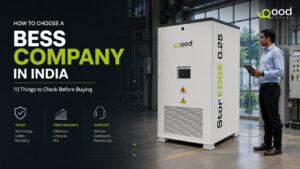
The StorEDGE 0.25 is a 250 kWh / 125 kVA modular battery energy storage system designed for manufacturing facilities, commercial buildings, industrial campuses, and microgrid applications.
Key applications:
• Peak shaving and demand charge reduction
• Solar self-consumption optimisation
• Reduced diesel generator dependency
• Power reliability and backup
• EV charging load management
Its modular architecture means projects can start at a single unit and scale as energy requirements grow.
StorEDGE 5.0: Utility-Scale BESS
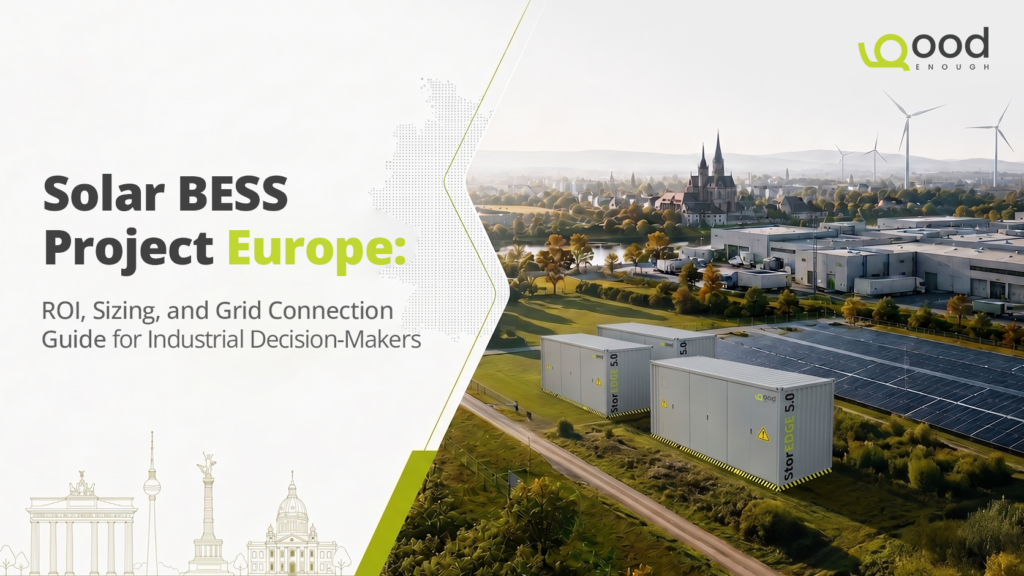
The StorEDGE 5.0 is a containerised utility-scale system with 5 MWh storage capacity and 2.5 MVA power output, intended for large industrial sites, solar farm co-location, and grid-connected storage projects.
Key applications:
• Renewable energy integration and curtailment reduction
• Grid stabilisation and frequency support
• Peak demand management at utility scale
• Large-scale energy arbitrage
GoodEnough Energy combines in-house engineering capability, LFP battery technology, and scalable containerised architecture with end-to-end project support. European developers evaluating supply chain diversification should include them in their vendor assessment process.
Conclusion
A Solar BESS project in Europe, done well, is one of the strongest investments available to industrial facilities and renewable energy developers in the current market. Electricity prices remain structurally high, decarbonisation pressure is real, and the revenue stacks available to storage assets continue to grow as European grid operators introduce new flexibility mechanisms.
But getting it right requires three things: a rigorous approach to ROI modelling based on actual site data; careful system sizing that matches battery duration and capacity to your real load profile; and early engagement with grid connection processes, which remain the most common project-delay risk across Germany, the UK, the Netherlands, and beyond.
Technology choice matters too. LFP-based systems from manufacturers with genuine engineering depth and strong service support are the foundation of a bankable, long-life asset.
If you are evaluating a Solar BESS project in Europe whether for a manufacturing facility, commercial campus, or utility-scale renewable development explore what GoodEnough Energy’s StorEDGE range can offer. Contact our team to discuss your project requirements and how scalable, LFP-based energy storage can be sized and delivered for your site.