Rajasthan has always been India’s solar powerhouse but in 2025, it is rapidly becoming the country’s energy storage powerhouse too. If you run a factory, plant, or industrial facility in the state, there has never been a more important time to understand what a Battery Energy Storage System in Rajasthan means for your business. New regulations, new incentives, and new cost-saving opportunities are all converging at once and the industrialists who move early will be the ones who gain the most.
This article breaks it all down in plain language: what BESS is, why Rajasthan is pushing it hard, what the new regulations mean for you, and how to actually use storage to reduce your energy bills.
Why Rajasthan Is Doubling Down on Battery Energy Storage
Rajasthan generates more solar power than almost any other Indian state. That’s a great problem to have except when the sun is blazing at noon and your grid is already overloaded, or when demand spikes in the evening and there’s no sun left to meet it. The grid becomes unreliable. Industrial consumers get hit with expensive peak tariffs. Voltage fluctuations damage equipment.
Battery energy storage fixes all of this by capturing surplus power when it’s cheap and releasing it when it’s expensive or when the grid is stressed.
The Rajasthan Electricity Regulatory Commission (RERC) recognised this and moved decisively. In 2025, the Commission finalised the RERC BESS Regulations 2025 a comprehensive framework that governs the planning, deployment, and operation of Battery Energy Storage Systems across the state. These regulations apply to everyone: distribution licensees, generators, open access consumers, and behind-the-meter industrial users like you.
This isn’t just policy on paper. Rajasthan has also issued its Green Energy Open Access (GEOA) Rules, 2025, which contain hard mandates: any renewable energy project above 5 MW must now integrate a BESS capable of storing at least 5% of the plant’s capacity for a minimum of two hours. For captive power plants generating above 100% of a consumer’s contracted demand, BESS integration is compulsory.
Rajasthan is the first Indian state to mandate BESS for large-scale green open access projects. The message to industry is clear storage is no longer optional.
What the RERC BESS Regulations 2025 Mean for Industrial Consumers
If you are an industrial or commercial consumer in Rajasthan, here is what the new regulations mean in practical terms.
Behind-the-Meter BESS Is Fully Permitted
The RERC regulations explicitly permit consumers to install a Battery Energy Storage System behind their meter either as a standalone unit or paired with a rooftop or ground-mounted solar plant. You can use the stored energy for self-consumption, run your operations during peak tariff hours on battery power, and even supply surplus stored energy back to the grid during peak hours at an incentivised tariff.
Energy Arbitrage Is Now Legal and Encouraged
Under the new rules, consumers operating a BESS in Rajasthan are permitted to participate in energy arbitrage buying electricity from the grid during cheap off-peak hours, storing it, and selling it back or consuming it during expensive peak hours. This is a direct mechanism to reduce your electricity bills.
For industrial plants paying high Time-of-Day (ToD) tariffs, this is significant. Instead of drawing expensive peak-hour power from the grid, you discharge your battery. Your MD (Maximum Demand) charges also reduce because your BESS caps your peak draw.
Renewable Energy Credentials Are Protected
One concern many industrialists have is whether storing renewable energy in a battery and then discharging it later causes them to lose its “green” status. The RERC regulations address this directly: electricity generated from renewable sources and stored in a BESS retains its renewable character upon discharge. So your RPO (Renewable Purchase Obligation) compliance is safe.
The Financial Case for a Battery Energy Storage System in Rajasthan
Regulations matter but what really moves industrial decision-makers is money. So let’s talk numbers.
Transmission and Wheeling Charge Exemptions
Rajasthan has structured some of the most generous BESS incentives in the country. Under the GEOA Rules, a standalone Battery Energy Storage System supplying power during peak hours or non-solar hours is 100% exempt from transmission and wheeling charges for seven years. For open access consumers pairing BESS with a renewable plant, a 75% exemption applies when BESS capacity equals 5% of RE capacity rising to 100% exemption when storage exceeds 30% of RE capacity.
For an industrial unit running on green open access power, this is a substantial reduction in your total cost of energy.
MD Charge Reduction
One of the largest hidden costs for industrial consumers in Rajasthan is Maximum Demand charges. If your plant draws a surge of power for even 15–30 minutes during peak hours, it can inflate your MD charge for the entire month. A Battery Energy Storage System can be programmed to kick in during those peak demand windows, capping your grid draw and directly reducing MD charges. Many industrial units in Rajasthan have reported MD charge savings of 20–35% after deploying BESS.
ToD Tariff Arbitrage Savings
Rajasthan DISCOMs apply Time-of-Day tariffs that can make peak-hour electricity significantly more expensive than off-peak rates. A correctly sized BESS charges itself during the cheaper hours and discharges during costly peak windows, converting that tariff differential into direct savings month after month.
Common Industrial Pain Points That BESS Solves
Industrial decision-makers in Rajasthan consistently raise a few energy-related complaints:
“Our power bills are out of control.” Peak demand charges and ToD surcharges are the biggest culprits. A Battery Energy Storage System in Rajasthan directly addresses both through scheduled charge/discharge management.
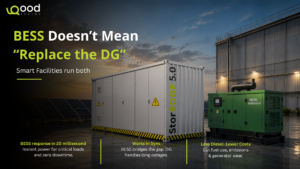
“Grid outages disrupt production.” Even a 30-minute outage on a production line can cost lakhs in lost output, rework, and downtime. BESS provides instantaneous backup power far faster than a diesel genset keeping critical loads running seamlessly.
“Our solar system doesn’t work at night.” This is the most common limitation of rooftop solar. Pairing your solar installation with a BESS extends your savings into the evening hours, significantly improving your solar payback period.
“We’re worried about upcoming compliance mandates.” With RERC finalising its BESS framework and the state mandating storage for larger captive installations, proactive compliance now avoids a regulatory scramble later.
What to Look for in a BESS Solution for Your Plant
Not all energy storage systems are the same. When evaluating a Battery Energy Storage System in Rajasthan for your industrial facility, here are the key parameters to assess:
Battery Chemistry: LFP (Lithium Iron Phosphate) chemistry is the most suitable for industrial deployments. It offers long cycle life (3,000+ cycles), excellent thermal stability, and is inherently safer than other lithium chemistries critical for plant environments.
System Sizing: Your BESS should be sized based on your peak demand profile, not just your average consumption. An energy audit combined with demand curve analysis will identify the right capacity.
Power Rating vs Energy Rating: These are different numbers. Power rating (kVA/MVA) determines how fast you can charge or discharge. Energy rating (kWh/MWh) determines how long you can sustain output. For MD charge reduction, power rating matters most. For backup power, energy rating matters most.
Integration with Solar: If you have or plan a solar installation, ensure the BESS is compatible with your inverter/PCU and can be managed via a single Energy Management System (EMS).
RERC Compliance: Ensure the system and its installation meet the safety, cybersecurity, and technical standards mandated by the RERC BESS Regulations 2025 and the Central Electricity Authority (CEA).
How GoodEnough Energy Can Help
GoodEnough Energy is one of India’s focused BESS manufacturers, headquartered in Greater Noida and purpose-built for the Indian industrial market. Founded in 2023, the company designs and manufactures two products specifically suited to the needs of industrial and commercial consumers:
StorEDGE 0.25 A 250 kWh / 125 kVA system designed for commercial and industrial (C&I) applications. Ideal for manufacturing units, processing plants, and commercial facilities looking to reduce peak demand charges, achieve ToD arbitrage, and extend solar self-consumption into evening hours.
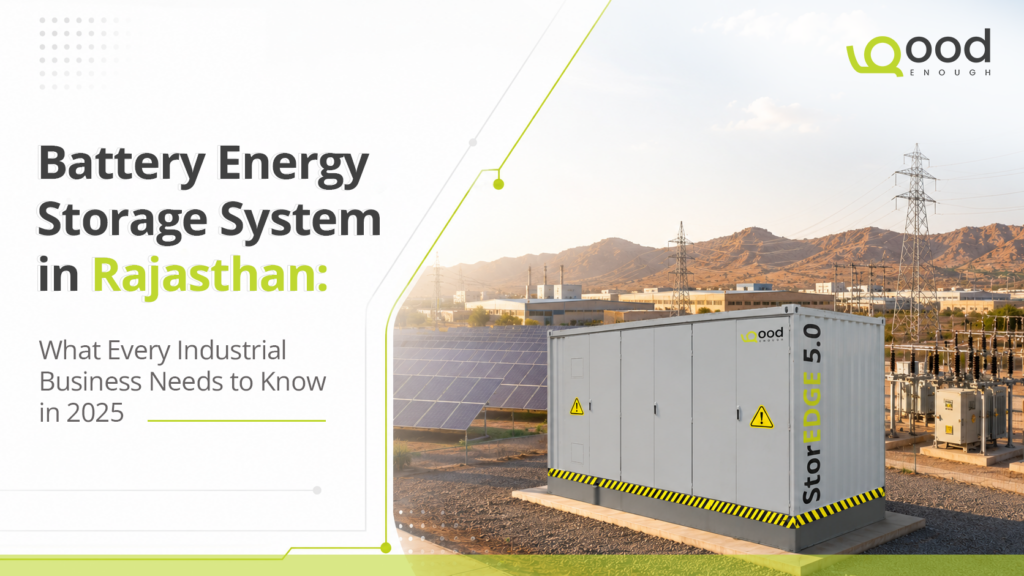
StorEDGE 5.0 A 5 MWh / 2.5 MVA utility-scale containerised system, suited for large industrial campuses, infrastructure projects, and open access consumers requiring significant storage capacity to meet RERC compliance thresholds.
Both systems use LFP chemistry and are designed with Indian grid conditions in mind including compatibility with Rajasthan’s DISCOM infrastructure and the technical standards outlined in the RERC BESS Regulations 2025.
GoodEnough Energy works closely with industrial decision-makers to size the right system, prepare the business case (including ROI projections based on your actual tariff structure), and support the installation and commissioning process.
If your facility is in Rajasthan and you are evaluating a Battery Energy Storage System for cost reduction or regulatory compliance, GoodEnough Energy is a direct conversation worth having.
The Window Is Open But Not Forever
Here is the reality that every plant head and energy manager in Rajasthan should understand: the financial incentives currently available, the transmission charge exemptions, the ToD arbitrage opportunity, the MD savings are time-bound. The 100% wheeling charge exemption on standalone BESS, for example, applies only to the first 2,000 MW of BESS deployments or until 2030, whichever comes first.
Early movers capture full incentives. Late movers pay more for the same hardware and may miss the exemption window entirely.
A Battery Energy Storage System in Rajasthan is not a futuristic idea it is a present-day financial tool that the state’s own regulatory framework is actively incentivising. The RERC has built the rules. The incentives are live. The compliance mandates are in place for larger captive users.
The question for industrial leaders in Rajasthan is no longer whether to consider BESS. The question is how soon to act.
Next Step
If you want to understand what a Battery Energy Storage System in Rajasthan would mean specifically for your plant in terms of sizing, cost, savings, and compliance reach out to GoodEnough Energy. Their team works directly with industrial buyers to build a clear, numbers-backed picture of what storage can do for your facility.
Visit goodenough.energy or get in touch directly to start the conversation.