
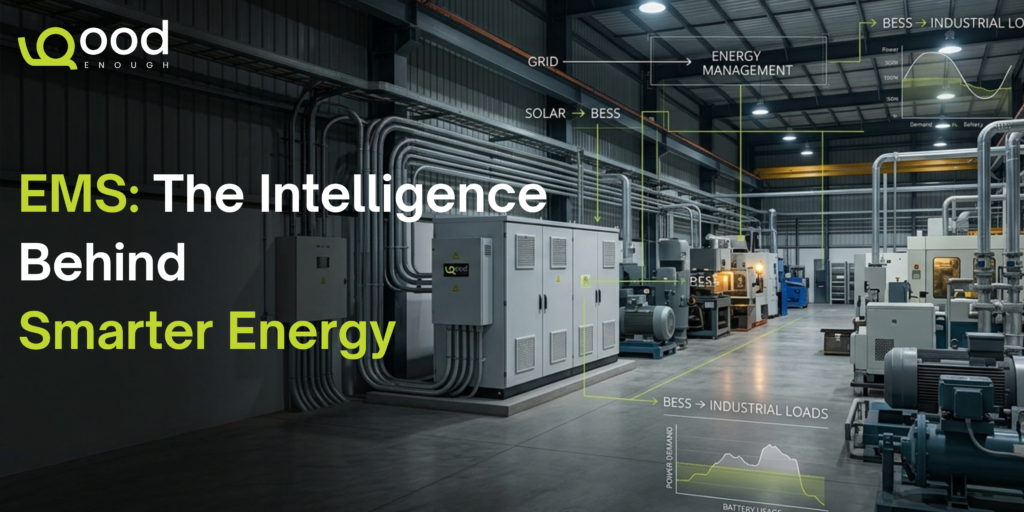
Energy Management System for Industries: Reduce Peak Demand & Energy Costs
An Energy Management System for Industries helps businesses monitor, optimize and control electricity consumption across the grid, solar, Battery Energy Storage Systems (BESS) and plant loads. By managing energy flows in real time, an EMS can help industrial facilities reduce peak demand, optimize energy costs and improve renewable-energy utilization.
For manufacturing facilities, electricity costs depend on more than total energy consumption. Short periods of high power demand, expensive tariff windows and mismatches between solar generation and plant consumption can significantly increase operating costs.What Is Peak Demand and Why Does It Matter?
Peak demand is the highest level of electrical power a facility draws from the grid during a defined measurement interval.
Manufacturing plants often experience peaks when’ several high-power machines operate simultaneously. Motors, compressors, furnaces, chillers, pumps, HVAC systems, and production lines can create short but significant demand spikes.
Electricity tariffs in India can include demand-based charges alongside energy charges. The Central Electricity Authority’s latest tariff data shows that demand charges vary significantly by consumer category and state. [View the CEA’s Tariff and Duty of Electricity Supply in India report.]
For example, consider a factory with a contracted demand of 2,000 kVA. If simultaneous equipment operation pushes its measured demand substantially higher, the plant may face additional financial exposure.
The important point is simple:
Reducing energy consumption and reducing peak demand are two different energy-management strategies.
A factory can consume the same amount of electricity while lowering its maximum grid demand.
How an EMS Controls Peak Demand
An Energy Management System continuously monitors the facility’s electrical profile and identifies changes in demand before they become expensive peaks.
It can monitor:
- Real-time power consumption
- Maximum demand
- Solar generation
- BESS state of charge
- Grid conditions
- Time-of-day tariffs
- Equipment loads
- Production schedules
The EMS uses this information to determine when power should come from the grid, solar or BESS.
Instead of reacting after a demand peak occurs, the system can respond proactively and keep grid demand closer to a predefined threshold.
How EMS + BESS Enables Peak Shaving
Peak shaving reduces the amount of electricity a facility draws from the grid when demand approaches a costly threshold.
For example, imagine a manufacturing plant normally operating at 1,500 kW. If several compressors, motors and production machines start simultaneously, demand could temporarily increase to 2,000 kW.
An appropriately sized BESS could discharge 400 kW during this period.
The grid would then supply approximately:
2,000 kW − 400 kW = 1,600 kW
The EMS coordinates this response automatically, using real-time load data and the battery’s available energy.
The actual savings depend on the site’s tariff structure, demand measurement method, peak duration, BESS power rating and energy capacity.
How an Energy Management System Works With BESS
A BESS needs an intelligent control layer to determine when to charge, when to discharge and how much power to deliver.
A typical EMS control loop works in six steps:
1. Monitor
Collect real-time data from the grid, solar system, BESS and plant loads.
2. Detect
Identify when demand is approaching the configured peak threshold.
3. Predict
Assess the expected load, available battery energy and upcoming operating conditions.
4. Dispatch
Send instructions to the PCS to charge or discharge the battery.
5. Optimize
Maintain grid demand within the desired range while protecting battery operating limits.
6. Recharge
Restore the battery during suitable periods, such as low-tariff or high-solar windows.
This coordination allows the battery to be used strategically rather than simply discharged whenever demand increases.
Why Manufacturing Plants Need an Energy Management System
Industrial facilities rarely have a constant electricity demand.
Load can change because of:
- Production shifts
- Machine start-up cycles
- Compressors and chillers
- Furnaces
- Pumps
- HVAC systems
- EV charging
- Seasonal conditions
- Changes in production volume
These fluctuations can create short periods of extremely high demand.
An EMS creates a central intelligence layer that brings these energy sources and loads together, allowing manufacturers to make better decisions about when and where electricity is consumed.
The objective isn’t necessarily to switch equipment off.
Instead, the goal is to coordinate energy resources without compromising production.
Managing Different Industrial Loads
A factory may have predictable high-load activities.
For example:
| Load | Typical Energy Challenge | Potential EMS Action |
| Compressors | High starting demand | Coordinate operation |
| HVAC/chillers | Large recurring load | Optimize schedules |
| Furnaces | High continuous demand | Avoid simultaneous peaks |
| Pumps | Variable operating periods | Schedule intelligently |
| EV chargers | Sudden power demand | Controlled charging |
| Production machinery | Shift-based peaks | Coordinate with BESS |
| Solar plant | Variable generation | Maximize self-consumption |
The objective is not necessarily to switch equipment off. Instead, the system can coordinate when different resources operate. That distinction matters in manufacturing because production continuity remains the priority.
How BESS Reduces Demand Charges in Factories
BESS can support multiple energy-management strategies from a single system.
It can:
- Reduce peak grid demand by discharging during high-load periods
- Store surplus solar for use when generation falls
- Shift energy consumption away from expensive tariff periods
- Support critical loads during grid interruptions
- Reduce dependence on diesel backup for suitable applications
The value of BESS depends on how intelligently it is operated. An Energy Management System for Industries provides the intelligence needed to determine when the battery should charge, discharge or remain in reserve based on demand, tariffs, solar generation and operating conditions.
GoodEnough Energy’s industrial BESS solutions are designed for applications including peak demand reduction, solar integration, and backup power. Its StorEDGE 0.25, for example, combines 250 kWh of energy storage with a 125 kVA power rating for commercial and industrial applications.
For larger applications, StorEDGE 5.0 is positioned as a 5 MWh / 2.5 MVA system with peak-demand management capabilities.
The Role of an In-House EMS at GoodEnough Energy
One important consideration when selecting a BESS is the intelligence controlling it.
At GoodEnough Energy, the Energy Management System is developed in-house. This gives the engineering team direct control over the software layer responsible for energy dispatch and system integration.
This architecture can also be important from a security and control perspective.
An in-house EMS can reduce dependence on an externally controlled software layer. It also gives the manufacturer greater visibility into system logic, integration, updates, and technical support.
For industrial facilities, this matters because the EMS can influence critical operations.
GoodEnough Energy’s BESS architecture integrates BMS and EMS functions with power conversion and multiple operating modes.
For an industrial BESS, the battery is only one part of the solution. The intelligence controlling when and how it operates can determine the economic outcome.
Using EMS to Optimize Solar + BESS
Solar generation and industrial electricity demand don’t always occur at the same time.
A factory may generate its highest solar output during the afternoon while experiencing another significant demand peak later in the day.
BESS can bridge this timing gap.
When solar generation exceeds immediate plant demand, the EMS can direct surplus energy toward the battery. When solar output falls or grid demand approaches a defined threshold, the EMS can discharge the stored energy.
This can help businesses:
- Increase solar self-consumption
- Reduce grid imports
- Reduce peak demand
- Improve renewable-energy utilization
- Reduce exposure to high-cost tariff periods
The result is a coordinated solar + BESS + EMS system rather than three independent technologies.
How to Estimate BESS Savings for an Industrial Facility
BESS savings should be calculated from the site’s actual electricity profile rather than battery capacity alone.
Before sizing a system, collect:
- Interval electricity-consumption data
- Monthly maximum demand
- Contract demand
- Applicable demand charges
- Time-of-day tariff structure
- Solar generation data
- Production schedules
- Existing DG usage
- Critical-load requirements
- Planned production expansion
For example, if a facility consistently reduces its measured peak by 300 kVA, and its applicable demand charge is ₹X/kVA/month, the simplified demand-charge saving would be:
300 × ₹X per month
However, a proper BESS business case should also account for:
- Battery degradation
- Round-trip efficiency
- Charging costs
- PCS losses
- Financing
- Maintenance
- System availability
- Expected cycling
For this reason, a site-specific EMS/BESS simulation is more reliable than a generic ROI calculator.
What to Consider Before Installing BESS
Peak shaving sounds straightforward, but industrial systems require careful engineering.
Correct BESS Sizing
A battery needs enough power to handle the peak and enough energy to sustain discharge for the required duration.
A 1 MW battery with insufficient energy capacity may handle a short spike but cannot manage a prolonged peak.
Tariff and Demand Rules
Demand measurement differs across electricity distribution utilities.
The project must therefore use the facility’s actual tariff structure rather than generic assumptions.
Battery Degradation
Frequent cycling affects battery performance over time.
The EMS should therefore balance savings against battery operating limits.
Power Quality
The PCS and control system must respond quickly without creating undesirable electrical behavior.
Cybersecurity and System Control
Industrial energy systems are becoming increasingly software-driven.
The EMS should have appropriate access controls, secure communications, monitoring, and update mechanisms.
This is another reason the control architecture deserves as much attention as battery chemistry.
How to Implement an Industrial EMS + BESS
A practical implementation should follow a structured process.
Step 1: Establish the baseline
Analyze historical electricity bills and interval load data.
Step 2: Identify peak events
Determine which machines, processes, or schedules create demand spikes.
Step 3: Map available energy resources
Include grid supply, solar, BESS, DG sets, and controllable loads.
Step 4: Define the operating strategy
Set priorities such as peak shaving, solar self-consumption, backup, or tariff optimization.
Step 5: Size the BESS
Select the required power rating and energy capacity based on actual load behavior.
Step 6: Configure the EMS
Define dispatch thresholds, battery limits, charging windows, and load priorities.
Step 7: Measure performance
Track maximum demand, energy costs, battery cycling, solar utilization, and operational reliability.
This approach makes the project measurable from both engineering and financial perspectives.
Key Takeaways
- Peak demand can materially affect manufacturing electricity costs.
- Peak shaving reduces the amount of power drawn from the grid during demand spikes.
- BESS can discharge during high-load periods to reduce grid demand.
- An Energy management system India solution coordinates batteries, solar, grid supply, and loads.
- Correct BESS sizing requires actual interval load data.
- Solar and BESS can work together to improve renewable-energy utilization.
- An in-house EMS can provide greater control over software, integration, and security.
- Demand-charge savings depend on the site’s tariff structure and operating profile.
- Manufacturers should evaluate BESS using lifecycle economics rather than battery capacity alone.
Conclusion
For manufacturing plants, energy optimization is moving beyond simply reducing total electricity consumption.
The bigger opportunity is controlling when electricity is consumed and where it comes from.
A well-designed Energy management system India solution can coordinate BESS, solar generation, grid supply, and plant loads around the facility’s operational requirements.
The result can be lower peak demand, better solar utilization, improved energy visibility, and greater control over operating costs.
However, the technology only creates value when it is correctly sized and intelligently controlled.
GoodEnough Energy approaches industrial storage as an integrated system rather than treating the battery as an isolated asset. Its BESS platforms combine storage hardware, power conversion, BMS, and EMS capabilities for industrial energy applications.
For manufacturers evaluating peak demand charge reduction, the right starting point is therefore not simply asking, “How large a battery do we need?”
It is asking:
“How does our plant consume power, when do our peaks occur, and how can an intelligent energy-management layer control those peaks?”
That question leads to a far more accurate BESS business case.