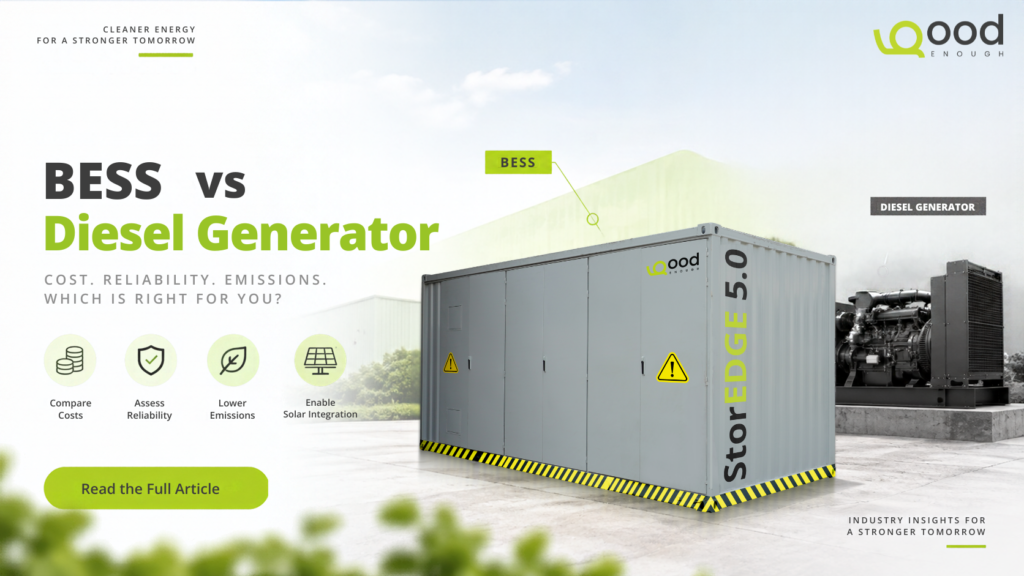
BESS vs diesel generator is becoming an important consideration for Indian factories and industrial facilities looking to improve backup power, reduce diesel dependence, and manage rising energy costs. For decades, diesel generators have been the default solution for industrial backup power, but Battery Energy Storage Systems (BESS) are changing how businesses approach reliability, energy management, and power continuity.
But industrial power requirements are changing.
Production lines increasingly depend on sensitive electrical equipment, facilities are adding rooftop or captive solar, electricity demand charges can materially affect operating costs, and businesses are looking for ways to reduce diesel consumption and emissions.
That is where Battery Energy Storage Systems (BESS) enter the conversation.
The comparison, however, is not simply “BESS versus DG: which is better?”
The more useful question is:
Which backup architecture fits the facility’s load profile, outage duration, energy costs and operational requirements?
For short-duration backup, power-quality support and facilities that can use the battery for energy management between outages, BESS can provide functions beyond traditional backup generation. Diesel generators still have an important role where outages are long, loads are very large, or extended runtime is the primary requirement.
India’s energy-storage ecosystem is also developing rapidly. The Ministry of New and Renewable Energy lists multiple national initiatives supporting BESS, including the 2025 VGF scheme and amendments, while the CEA’s National Electricity Plan identifies significant future requirements for energy storage.
So, how should an industrial facility compare the two?
BESS vs Diesel Generator: How Do They Actually Work?
A diesel generator converts the chemical energy in diesel fuel into mechanical energy and then electricity.
A BESS stores electricity and releases it through a power conversion system when required. A complete BESS typically includes batteries, a Battery Management System (BMS), Power Conversion System (PCS), Energy Management System (EMS), protection equipment and thermal-management systems.
The two technologies therefore approach backup differently.
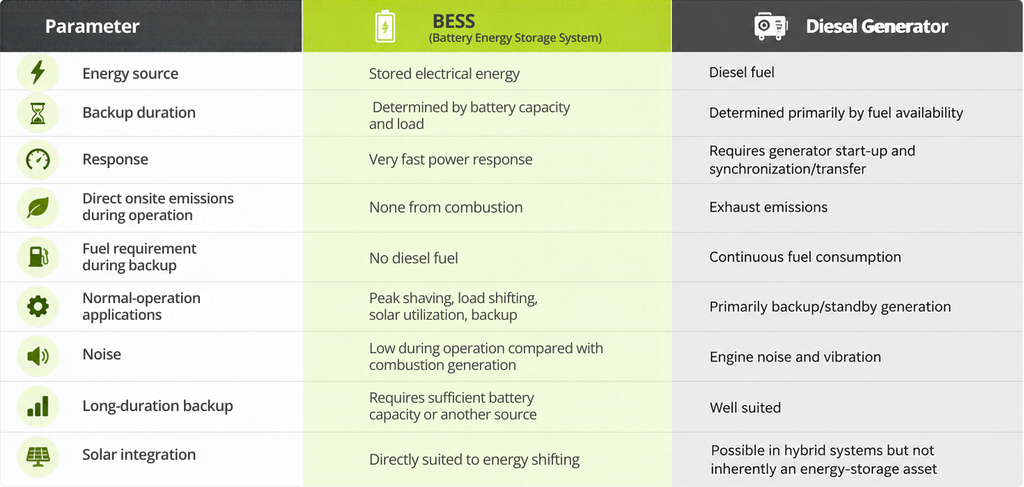
The important point is that BESS and DG should not always be treated as mutually exclusive technologies.
In many industrial applications, the better engineering question is how they can work together.
1. BESS vs Diesel Generator: Cost Comparison
One of the biggest mistakes in comparing battery storage with diesel generation is looking only at upfront capital cost.
A DG system may have a lower initial equipment cost, but its operating economics include:
- Diesel consumption
- Lubricants and consumables
- Preventive maintenance
- Servicing
- Battery starting-system maintenance
- Fuel storage and handling
- Operator requirements
- Exhaust and noise considerations
- Downtime associated with maintenance
A BESS has a different cost structure.
Its economics depend on:
- Battery capacity in kWh/MWh
- Power rating in kW/kVA/MW
- PCS and EMS
- Thermal management
- Installation and electrical integration
- Battery degradation
- Number and depth of cycles
- Electricity cost used for charging
- Financing and project life
Therefore, there is no universal ₹/kWh figure that can accurately determine whether BESS or DG is cheaper for every facility.
A site-specific model should compare the total cost over the expected operating period.
A simple BESS economic model
For an industrial facility, the value of BESS may come from several sources:
BESS value = avoided DG energy cost + peak-demand savings + energy-arbitrage value + avoided downtime + solar utilization value
Not every facility will capture all five.
That is why the load profile matters more than a generic technology comparison.
2. BESS vs Diesel Generator: Reliability & Backup Duration
This is one of the most important technical differences.
A diesel generator needs to start, reach operating conditions and transfer the load.
A battery system can respond much faster because stored electrical energy is already available and the PCS can rapidly provide power.
For facilities where even a short interruption can trip equipment, the distinction can matter.
Examples include:
- Continuous manufacturing
- Food processing
- Cold storage
- Precision manufacturing
- Data centres
- Telecom infrastructure
- Critical electrical systems
However, response speed is only one part of reliability.
A battery is ultimately constrained by its available stored energy.
For example, a simplified system with:
250 kW critical load × 2 hours = 500 kWh
would require approximately 500 kWh of usable energy before accounting for system losses, reserve requirements and other design considerations.
A DG, by contrast, can continue generating for much longer if sufficient fuel is available.
Therefore:
Fast response → BESS advantage
Extended runtime → DG advantage
3. BESS vs Diesel Generator: Emissions & Sustainability
Diesel generators combust fuel during operation and therefore produce onsite exhaust emissions.
Battery storage does not involve onsite combustion while discharging.
However, it would be misleading to describe every BESS as completely emissions-free in lifecycle terms. The overall environmental impact depends on how the electricity used to charge the battery is generated, as well as battery manufacturing, replacement and end-of-life management.
The operational distinction remains important:
A BESS can provide stored electrical energy without burning diesel at the point of use.
This becomes particularly relevant for industrial facilities with solar generation.
Instead of allowing excess solar generation to go unused, a BESS can store energy and make it available later.
The Government of India’s energy-storage framework explicitly recognizes applications such as energy shifting, peak shifting, renewable integration and energy arbitrage.
4. BESS Can Work Even When the Grid Is Available
This is where the comparison becomes more interesting.
A diesel generator generally sits idle until backup generation is required.
A BESS can potentially operate every day.
For example, during normal grid operation, a BESS can be configured to:
Peak shaving
Charge when electricity demand or tariffs are lower and discharge during high-demand periods.
Solar shifting
Store excess solar energy during the day and discharge it when solar generation falls.
Energy arbitrage
Charge during lower-cost periods and discharge during higher-cost periods, subject to the site’s tariff structure.
Backup
Maintain stored energy for critical loads when the grid fails.
This means one battery can potentially provide multiple value streams from the same asset.
GoodEnough Energy’s StorEDGE 0.25, for example, is a 250 kWh / 125 kVA commercial and industrial BESS designed for applications including peak-demand management, diesel reduction, solar integration and backup.
A Real Industrial Example: Reducing Diesel Dependence in Meerut
The practical economics become clearer when looking at an actual deployment.
At an industrial rolls manufacturing facility in Meerut, Uttar Pradesh, the facility had significant diesel-generator expenditure for extended backup and excess solar energy that could not be effectively utilized.
GoodEnough Energy deployed a 125 kVA / 261.2 kWh cabinet-style BESS at the facility.
According to the project’s documented results:
- Daily energy cost reduced from ₹13,720 to ₹3,920
- Diesel runtime was reduced by approximately 85–90%
- Excess solar energy could be stored and utilized
- Estimated payback was 1 year 2 months
- Projected lifetime savings were ₹5.27 crore over 10,000 operating cycles
These figures are project-specific estimates based on the facility’s operating profile, not a universal BESS-versus-DG benchmark.
But they demonstrate an important principle.
The BESS was not simply acting as a replacement generator.
It was addressing backup + diesel consumption + solar utilization together.
That distinction matters when calculating the economics of industrial battery storage.
Another Real-World Example: BESS for a Port Facility
A different application can be seen at a port and logistics facility in Visakhapatnam, Andhra Pradesh.
The site faced three interconnected challenges:
- Heavy dependence on DG sets
- Excess solar generation that could not be effectively stored
- The need for reliable microgrid operation
GoodEnough Energy deployed a 125 kVA / 261.2 kWh cabinet-style BESS at the facility. The project was designed to support microgrid operation, improve energy utilization and reduce diesel dependence.
This illustrates another important aspect of the battery storage vs diesel generators for industrial backup comparison.
The battery does not have to be evaluated only as an emergency asset.
Where solar and microgrid operation are part of the site’s architecture, storage can become an active part of the facility’s energy-management system.
What About Manufacturing Facilities With Sensitive Loads?
Power quality can be just as important as backup duration.
At a food and dairy manufacturing facility in Greater Noida, Uttar Pradesh, voltage fluctuations and power disturbances were causing critical equipment to trip, while power interruptions were disrupting continuous manufacturing operations.
GoodEnough Energy deployed a 125 kVA / 261.2 kWh BESS. The documented project outcomes include stabilization of critical loads, instant power support and improved production continuity.
This is an important use case because the financial impact of an outage is not always equal to the amount of electricity that was lost.
A brief interruption can potentially:
- Stop a production line
- Cause equipment trips
- Require a restart procedure
- Lead to material wastage
- Disrupt temperature-controlled processes
- Affect product quality
For these facilities, the value of BESS may therefore include power-quality and continuity benefits, not simply diesel-fuel savings.
When Does a Diesel Generator Still Make Sense?
BESS should not be presented as a universal replacement for diesel generators.
DG remains relevant when:
1. Outages are very long
If a facility regularly requires many hours of continuous backup, sizing a battery for the entire outage can become capital-intensive.
2. The load is extremely large
A facility with several megawatts of continuous critical load may require substantial storage capacity if it expects the BESS alone to cover a long outage.
3. Fuel-based backup is already established
An existing DG fleet with remaining useful life may still have economic value.
4. The site is remote
At remote or weak-grid locations, a hybrid configuration involving solar, BESS and DG may provide greater operational flexibility.
5. Backup duration is unpredictable
If the facility cannot reliably estimate how long outages will last, retaining a long-duration generation source can provide an additional layer of resilience.
Why a Hybrid BESS + DG System Can Make Sense
For many industrial facilities, the decision does not have to be:
BESS OR DG
It can be:
BESS + DG
A possible architecture looks like this:
Grid + Solar → BESS → Critical Loads
with
DG → Extended Backup
In this configuration:
- BESS handles fast-response backup
- BESS can support critical loads during short outages
- Solar can charge the battery
- BESS can reduce peak demand during normal operation
- DG remains available for prolonged outages
- Diesel runtime can potentially be reduced
The precise configuration must be engineered around the site’s load profile, protection scheme, operating philosophy and required autonomy.
GoodEnough Energy’s product portfolio includes systems designed for C&I applications as well as larger industrial and grid applications. Its StorEDGE 5.0 is specified as a 5 MWh / 2.5 MVA system for applications including industrial energy optimization, renewable integration and microgrid operation.
How Should an Industrial Facility Decide?
Instead of asking only “How much does a BESS cost?”, evaluate these seven parameters:
| Parameter | Questions to Ask |
| Critical load | How many kW/kVA actually need backup? |
| Outage duration | What is the typical and maximum outage duration? |
| Outage frequency | How often does the facility experience interruptions? |
| DG cost | How much diesel is consumed annually? |
| Electricity tariff | Are there peak/ToD or demand charges that storage can address? |
| Solar generation | Is excess solar available for charging? |
| Downtime cost | What does one hour—or one minute—of production loss cost? |
Then calculate two separate requirements:
Power requirement
How much instantaneous power does the BESS need to deliver?
Measured in kW/kVA/MW.
Energy requirement
How long does the BESS need to deliver that power?
Measured in kWh/MWh.
For example:
250 kW critical load × 2 hours = 500 kWh
This is only a simplified sizing example. Actual design must account for usable battery capacity, PCS rating, reserve margin, efficiency, degradation, operating temperature and the facility’s electrical architecture.
BESS vs Diesel Generator: The Decision in One Table
| Requirement | BESS | Diesel Generator |
| Very fast response | Strong fit | Requires generator start/transfer sequence |
| Short-duration backup | Strong fit | Suitable |
| Long-duration backup | Requires sufficient storage or hybrid | Strong fit |
| Diesel reduction | Yes | No |
| Solar energy storage | Yes | No |
| Peak shaving | Yes | Generally not its primary function |
| Energy arbitrage | Yes | No |
| Onsite combustion emissions | No | Yes |
| Fuel logistics | Not required for discharge | Required |
| Continuous extended operation | Limited by stored energy | Fuel-dependent |
| Existing DG asset | Can complement it | Already available |
| Microgrid applications | Strong fit | Can provide generation in hybrid systems |
The Bottom Line
The battery storage vs diesel generators for industrial backup decision is not simply a comparison between two backup machines.
It is a comparison between two different approaches to managing energy.
A diesel generator is primarily a fuel-based generation asset. Its major strength is long-duration generation when fuel is available.
A BESS is an energy-storage and power-management asset. In addition to backup, it can potentially support peak shaving, solar utilization, energy shifting and power-quality management.
For some facilities, BESS can reduce or partially replace DG operation. For others, particularly where long-duration backup is essential, a hybrid BESS + DG architecture may be more appropriate.
The right answer depends on the facility’s load profile, outage pattern, tariff structure, solar generation, backup requirement and economics.
And real deployments show why the evaluation needs to go beyond equipment price. GoodEnough Energy’s projects include industrial manufacturing, food and dairy, textile, automotive, infrastructure and port facilities, with BESS being applied to different combinations of backup, diesel reduction, solar utilization, peak management and power-quality requirements.
For an industrial facility considering BESS, the first step should be a site-specific assessment rather than choosing a battery size from a generic benchmark.