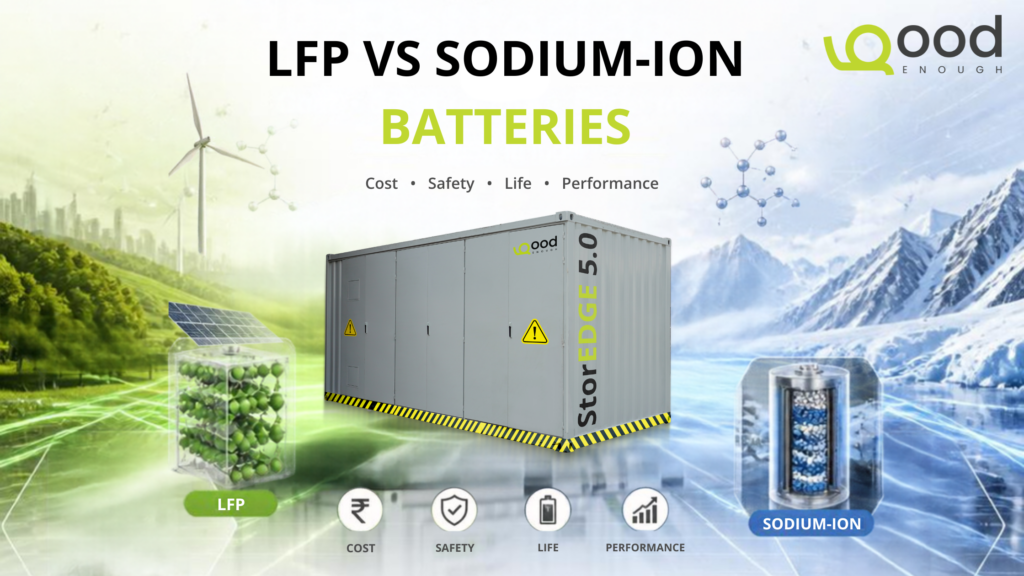
LFP vs sodium-ion batteries is an increasingly relevant comparison as India’s Battery Energy Storage System (BESS) market continues to develop. LFP is already an established chemistry for stationary storage, while sodium-ion batteries are moving from development and pilot projects toward commercial deployment. For project developers and energy managers, the question is no longer simply which chemistry is newer or cheaper, but which technology makes the most sense for a specific application.
So, is sodium-ion actually cheaper than LFP? Is it safer? Does its lower energy density matter for a stationary BESS? And should an Indian project consider switching from LFP to sodium-ion?
The answer depends on the project. For most buyers, the right comparison is not simply LFP cell price vs sodium-ion cell price. A BESS is a complete system, and chemistry affects usable energy, footprint, thermal management, controls, warranty structure, supply chain and long-term economics.
LFP vs Sodium-Ion Batteries: Quick Comparison
| Factor | LFP | Sodium-ion |
| Technology maturity | Highly established for stationary storage | Emerging commercial technology |
| Energy density | Generally higher | Generally lower, although improving |
| Cycle life | Well established across many commercial products | Improving; product-specific |
| Safety | Strong safety characteristics when properly engineered | Strong safety potential; product/system-specific |
| Low-temperature performance | More constrained, particularly for charging | One of sodium-ion’s key advantages |
| Supply chain | Mature global ecosystem | Smaller but rapidly developing |
| Bankability | Extensive deployment and operating history | More limited field history |
| Space requirement | Generally lower for the same stored energy | Generally higher |
| Cost outlook | Established and increasingly cost-competitive | Potential supply-chain and material advantages |
| Best fit | Broad range of C&I and utility BESS applications | Selected applications where its specific characteristics create value |
The important caveat is that there is no single performance number for either chemistry. Cell design, cathode/anode materials, operating window, BMS strategy, thermal management and manufacturer specifications can materially change the result.
What Is LFP?
LFP stands for Lithium Iron Phosphate, a lithium-ion battery chemistry using lithium iron phosphate as the cathode material.
LFP has become an important chemistry for stationary energy storage because it offers a combination of relatively high safety characteristics, cycle life, efficiency and cost.
For BESS applications, that matters because the battery may be cycled repeatedly for applications such as:
- Peak shaving
- Load shifting
- Renewable-energy integration
- Energy arbitrage
- Backup power
- Microgrids
- Demand management
LFP also benefits from an established manufacturing and deployment ecosystem.
That maturity matters to project developers because a BESS is a long-term infrastructure asset rather than simply a battery purchase.
What Is Sodium-Ion?
Sodium-ion batteries use sodium ions as the charge carrier instead of lithium ions.
The fundamental operating principle is similar to lithium-ion technology, but sodium-ion cells use different electrode materials and therefore have different performance characteristics.
Sodium-ion is no longer purely a laboratory technology. The IEA reports that commercialisation is accelerating, with major manufacturers developing and scaling the chemistry. However, global sodium-ion production remained less than 1% of lithium-ion production in 2025, illustrating the substantial difference in manufacturing scale and maturity.
The technology also has an important advantage for India: sodium is abundant, while the country’s battery industry remains concerned with imported critical-material supply chains.
However, “sodium is abundant” should not be interpreted as meaning that every sodium-ion battery has a completely domestic supply chain. Cathode materials, hard carbon, manufacturing equipment and other components can still involve internationally concentrated supply chains.
LFP vs Sodium-Ion Batteries: Cost Comparison
This is one of the most misunderstood parts of the comparison.
A buyer may see a forecast suggesting sodium-ion will eventually have a lower material cost than lithium-ion and conclude that a sodium-ion BESS must therefore be cheaper.
That does not necessarily follow.
A BESS cost includes much more than cells.
A simplified project-cost structure can include:
Cells → modules/racks → BMS → thermal management → PCS → EMS → enclosure/container → fire protection → transformers → switchgear → installation → commissioning → controls → warranty/service.
Therefore, the relevant question is not:
“Which chemistry has the cheapest cells?”
It is:
“Which chemistry produces the lowest risk-adjusted lifecycle cost for this particular BESS?”
The IEA notes that sodium-ion’s competitiveness against LFP depends partly on achieving greater energy density or favourable operating conditions, including situations where lithium prices are higher.
Why this distinction matters
Suppose two hypothetical BESS designs both provide 10 MWh of usable energy.
If the sodium-ion system requires more physical space because of lower energy density, the project may require additional:
- container/enclosure area
- civil works
- cabling
- HVAC or thermal-management infrastructure
- fire-safety infrastructure
- balance-of-system equipment
Those costs can offset some of the cell-level advantage.
Conversely, if a project’s operating environment benefits from sodium-ion’s temperature characteristics or supply-chain advantages, the system-level economics could move in the opposite direction.
There is therefore no responsible universal ₹/kWh answer for “LFP vs sodium-ion BESS” without specifying the product, project configuration, warranty, operating profile and date of quotation.
LFP vs Sodium-Ion Batteries: Safety
Safety should also be evaluated at the system level.
A BESS safety assessment should consider:
- cell chemistry
- cell construction
- BMS
- thermal management
- electrical protection
- enclosure design
- fire detection
- fire suppression or mitigation strategy
- ventilation
- monitoring
- installation standards
- commissioning
- operating controls
LFP has a strong safety profile relative to several other lithium-ion chemistries, which is one reason it has become widely used in stationary storage.
Sodium-ion is also attracting attention for safety characteristics, but the chemistry label alone should not be treated as a safety certification.
For procurement, ask the supplier for the actual system-level test and compliance documentation rather than relying on statements such as “sodium-ion is inherently safe” or “LFP cannot experience thermal events.”
The distinction is important:
Chemistry influences risk. Engineering controls manage risk.
Cycle Life: Which Battery Lasts Longer?
In the LFP vs sodium-ion batteries comparison, cycle life is another metric that is often oversimplified.
A battery’s cycle life depends on factors including:
- depth of discharge
- charge/discharge rate
- temperature
- state-of-charge window
- cell design
- charging strategy
- thermal management
- degradation criteria
Therefore, comparing two numbers such as “6,000 cycles vs 8,000 cycles” without examining the test conditions can be misleading.
For a BESS developer, the more useful question is:
How much usable energy can the system reliably deliver over its contracted operating life?
A project that cycles twice every day has very different battery requirements from a backup system that may remain idle for weeks.
Example
Consider a hypothetical 1 MWh BESS.
If it delivers an average of 0.8 MWh of usable energy per daily cycle:
Annual discharged energy = 0.8 MWh × 365
= 292 MWh/year
Over 10 years:
= 2,920 MWh
This is only an illustrative calculation. Actual delivered energy will depend on degradation, usable state-of-charge window, efficiency, operating conditions and system availability.
That is why procurement should evaluate warranted energy throughput and end-of-life capacity, not cycle count alone.
LFP vs Sodium-Ion Batteries: Energy Density
Energy density is one of the clearest technical differences between the two chemistries.
The IEA reported that leading sodium-ion cells had reached around 175 Wh/kg, compared with up to approximately 205 Wh/kg for LFP.
CATL has also publicly reported 175 Wh/kg for its Naxtra sodium-ion battery, demonstrating how quickly the technology is progressing.
But for BESS, cell-level Wh/kg is only part of the story.
The real project question is:
How much usable MWh can I install within my available land, container and electrical infrastructure constraints?
Lower energy density matters more when:
- land is expensive
- the site is space constrained
- the BESS must be installed inside an existing facility
- transportation dimensions are restrictive
- the project has strict footprint limits
It matters less when:
- land is readily available
- the BESS is utility-scale
- the project values other characteristics more strongly
- footprint is not the primary project constraint
For a large ground-mounted BESS project, a modest increase in footprint may be acceptable.
For a constrained industrial facility, it may become a major design consideration.
Temperature Performance: An Important Sodium-Ion Opportunity
Temperature is an area where sodium-ion deserves particular attention.
LFP batteries have operating limitations at low temperatures, especially when charging. Appropriate battery-management and thermal-management strategies can mitigate these constraints.
Sodium-ion technology has attracted attention because some designs maintain stronger performance under low-temperature conditions.
CATL, for example, has publicly reported strong low-temperature performance for its Naxtra sodium-ion technology.
However, these are manufacturer-specific claims, not universal characteristics of every sodium-ion battery.
For an Indian project, temperature analysis should consider the actual site.
A BESS in:
- Rajasthan
- Gujarat
- Maharashtra
- Delhi-NCR
- a Himalayan region
does not experience the same temperature profile.
And even within India, an outdoor battery enclosure can experience much higher internal temperatures than the surrounding ambient environment.
Therefore, the procurement specification should define the required operating temperature range rather than simply asking whether the chemistry is “good in heat.”
Efficiency and Thermal Management
Round-trip efficiency is important because every percentage point lost represents energy that must be purchased or generated again.
But published efficiency numbers can refer to different measurement boundaries.
For example:
Cell efficiency ≠ DC battery-system efficiency ≠ AC-to-AC BESS efficiency.
A project developer should therefore ask:
- Is efficiency measured at cell level?
- DC battery level?
- PCS level?
- AC-to-AC?
- At what load?
- At what temperature?
- Does the figure include auxiliary consumption?
- Does it include HVAC?
- What happens at partial load?
GoodEnough Energy’s own published material on BESS round-trip efficiency highlights why system-level evaluation should account for thermal management, auxiliary power, ambient conditions and actual operating cycles rather than relying only on headline efficiency numbers.
Supply Chain and Bankability
In the LFP vs sodium-ion batteries comparison, supply chain and bankability are also important considerations for a BESS buyer in 2026.
LFP has a mature global supply chain and extensive deployment history.
Sodium-ion is developing rapidly, but the ecosystem remains smaller.
The IEA notes that sodium-ion manufacturing capacity and investment are growing, while also highlighting that the supply chain remains much less developed than lithium-ion.
For a project developer, this creates questions around:
- cell availability
- replacement cells
- warranty support
- long-term service
- spare parts
- certification
- insurance acceptance
- lender requirements
- degradation data
- field operating history
- supplier financial strength
These factors may not appear in a cell-price comparison, but they can materially affect project risk.
What Does This Mean for India?
India’s interest in sodium-ion is no longer theoretical.
MNRE has published a dedicated assessment of the global sodium-ion landscape and its potential for India under the India-UK ASPIRE programme.
The Indian government has also supported work around sodium-ion materials. In April 2026, the Technology Development Board announced financial assistance for commercialising bio-waste/agricultural-waste-derived hard carbon for sodium-ion batteries in India.
More recently, NTPC invited proposals for sodium-ion BESS pilots at thermal power plants and office buildings to evaluate the technology’s performance, safety, reliability, degradation and techno-commercial viability under Indian grid and climatic conditions.
This is significant because it shows the discussion is moving from:
“Could sodium-ion work?”
toward:
“Where does sodium-ion make commercial sense?”
At the same time, India’s BESS market is expanding. The Ministry of Power reported that 13.22 GWh of BESS capacity was under implementation under the government’s earlier VGF scheme, with another 30 GWh VGF scheme approved in 2025.
That creates a growing market in which chemistry selection will increasingly become a project-specific engineering and commercial decision.
Which Chemistry Fits Which BESS Application?
Instead of declaring one chemistry the universal winner, consider the application.
| Project requirement | Factors to examine |
| C&I peak shaving | Cost, cycle life, tariff structure, footprint |
| Solar + BESS | Efficiency, cycling profile, degradation, usable energy |
| Utility-scale storage | Bankability, cost, energy density, warranty, supply chain |
| Space-constrained site | Energy density and system footprint |
| Cold environment | Low-temperature charging/discharge performance |
| Backup power | Calendar life, standby performance, response time and safety |
| High-frequency cycling | Cycle life, throughput warranty and thermal management |
| Supply-chain diversification | Material availability and supplier ecosystem |
A Practical BESS Chemistry Procurement Checklist
Before selecting LFP or sodium-ion, ask the supplier for these 10 items:
1. Cell specification
Request the exact cell model and manufacturer.
2. Usable energy
Do not compare only nominal MWh. Ask for guaranteed usable energy.
3. Degradation warranty
Understand the guaranteed state of health at the end of the warranty period.
4. Throughput warranty
Ask how much cumulative energy throughput is covered.
5. Efficiency boundary
Confirm whether quoted efficiency is cell, DC-system or AC-to-AC.
6. Temperature envelope
Obtain charging and discharging limits across the actual site temperature range.
7. Thermal-management requirement
Understand HVAC, liquid cooling, heating and auxiliary-energy requirements.
8. Safety documentation
Request relevant testing, certification and system-level safety documentation.
9. Supply and service
Ask about cell availability, replacement strategy and long-term support.
10. Project-level economics
Compare the complete installed system rather than cell price alone.
Where Does GoodEnough Energy Fit?
The chemistry discussion should ultimately lead back to the actual energy problem.
GoodEnough Energy provides customised energy-storage solutions and states that its services cover consultation, system design and ongoing support.
Its BESS applications include renewable integration, energy management, backup and industrial energy use. Its StorEDGE 5.0 platform, for example, is positioned as a 5 MWh BESS solution for large-scale applications.
For a prospective project, the more useful starting point is therefore not simply:
“LFP or sodium-ion?”
It is:
“What operating profile, tariff structure, power requirement, duration, site conditions and financial objective does the BESS need to satisfy?”
The chemistry can then be evaluated against those requirements.
Conclusion
The LFP vs sodium-ion batteries debate is evolving quickly as India’s BESS market develops.
LFP currently benefits from extensive commercial deployment, a mature supply chain and established project experience. Sodium-ion is developing rapidly and brings potential advantages in areas such as material diversification and low-temperature performance, but its manufacturing ecosystem and field history remain less mature.
For BESS buyers, the most important lesson is simple:
Do not select a chemistry based on one headline metric.
Cell price does not equal project cost.
Cycle count does not equal lifetime value.
Energy density does not automatically determine project suitability.
And chemistry alone does not determine system safety.
Instead, evaluate the complete BESS across usable energy, degradation, efficiency, thermal management, footprint, safety, warranty, supply chain, operating conditions and lifecycle economics.
That approach gives developers, EPCs and energy managers a more defensible basis for deciding whether LFP, sodium-ion or another storage technology fits the project.
Need help evaluating the right BESS configuration for your facility?