UPS vs BESS is an important consideration for businesses looking to improve power reliability, reduce energy costs, or protect critical operations. While both systems use stored electrical energy and can provide backup power, they are designed to solve different electrical challenges. Understanding the difference between a UPS and a BESS can help businesses choose the right solution based on their power, backup, and energy-management requirements.
Both use stored electrical energy. Both can support loads when the grid fails. And both can contain batteries, power electronics and control systems.
But they are not automatically interchangeable.
The simplest way to understand the distinction is:
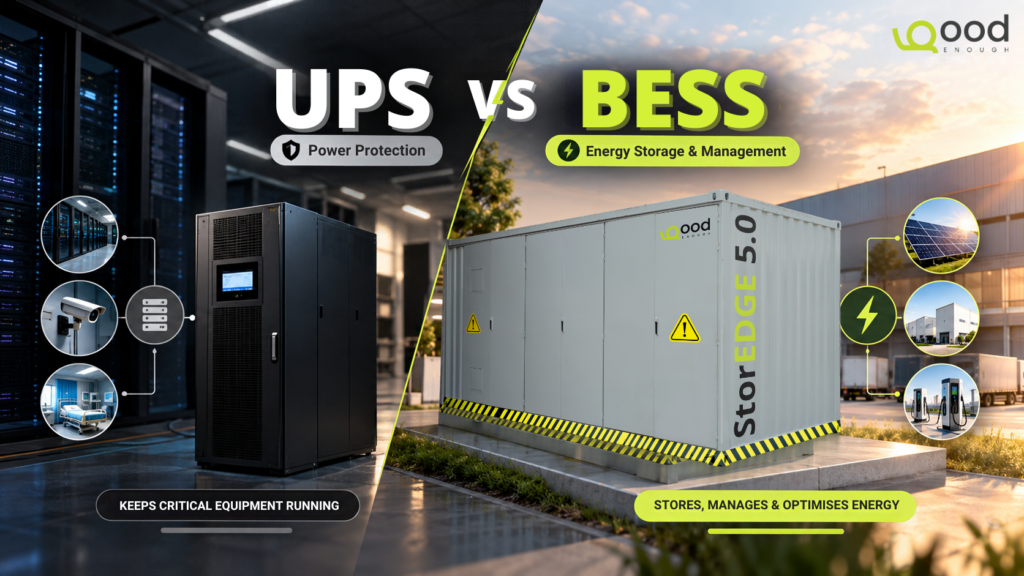
A UPS is primarily designed to protect critical loads from interruptions and power disturbances. A BESS is designed to store, manage and dispatch energy across a wider electrical system.
That distinction becomes particularly important for factories, warehouses, hospitals, data centres, EV charging sites and other commercial and industrial facilities where the objective may be more than simply keeping equipment running during an outage.
Key takeaways
| Requirement | UPS | BESS |
|---|
| Primary purpose | Power continuity and protection | Energy storage and management |
| Typical focus | Critical loads | Facility/site-level energy |
| Short interruptions | Core application | Possible depending on system architecture |
| Longer-duration backup | Possible, but depends on design | Stronger fit when appropriately sized |
| Peak shaving | Not its primary purpose | Major application |
| Solar energy shifting | Limited/not its core purpose | Core application |
| Demand management | Not normally the main function | Major application |
| Energy arbitrage | Not normally the main function | Possible where applicable |
| Critical-load protection | Core application | Possible with suitable backup architecture |
| Integration with broader energy assets | More limited | Designed for integration |
The table describes the typical roles of each technology. Actual capabilities depend on the equipment architecture, controls, power-conversion system and site design.
What is a UPS? Understanding UPS in the UPS vs BESS Comparison
A Uninterruptible Power Supply is a power-continuity system designed to keep connected equipment supplied during interruptions or disturbances in utility power.
A UPS typically includes:
- battery storage
- power electronics
- charging equipment
- control systems
- switching or conversion equipment
- monitoring and protection
The key objective is continuity.
For example, a data centre may have servers and networking equipment that cannot tolerate an interruption while the facility’s backup generation system starts or the grid supply is restored.
In this situation, the UPS acts as the immediate power bridge.
UL Solutions describes the distinction in similar terms: a UPS is intended to use stored energy for standby/emergency power to specific critical loads, whereas an energy storage system is intended to store energy for use when required.
UPS Applications: Where Does UPS Fit?
UPS systems are commonly associated with:
- IT infrastructure
- servers
- telecommunications
- control systems
- medical equipment
- industrial automation
- sensitive electronics
- data centres
The important point is that UPS selection should begin with the load that must remain continuously powered, not simply with the total electricity consumption of the facility.
What is a BESS? Understanding BESS in the UPS vs BESS Comparison
A Battery Energy Storage System (BESS) is an integrated energy-storage system that stores electricity and releases it when required.
A modern BESS can include:
- battery modules/racks
- Battery Management System (BMS)
- Power Conversion System (PCS)
- Energy Management System (EMS)
- thermal management
- protection equipment
- fire-safety systems
- monitoring and communications
CEA’s 2025 draft safety regulations define BESS as a system connected to the power system that stores electrical energy using electrochemical materials and typically includes batteries, PCS and BMS.
Unlike a conventional UPS, a BESS does not have to sit idle waiting for a power failure.
It can potentially operate throughout the day.
For example, a commercial or industrial BESS can be configured to:
- reduce peak demand
- shift energy consumption
- store solar generation
- provide backup power
- support microgrids
- reduce dependence on diesel generation
- improve renewable-energy utilisation
- provide other grid or facility-level services where the system and regulations allow
GoodEnough Energy describes peak shaving as charging during lower-demand periods and discharging during higher-demand periods to optimise energy use and reduce costs.
UPS vs BESS: The Difference That Actually Matters
The biggest mistake is to compare them only by battery size.
The more useful question is:
What job does the system need to perform?
A UPS is normally designed around continuity of power to a defined critical load.
A BESS is normally designed around managing energy over time across a facility or electrical system.
That means the design inputs can be very different.
UPS design starts with:
- critical-load capacity
- power quality
- required continuity
- load sensitivity
- runtime
- transfer/ride-through requirements
UPS vs BESS: How BESS Design Starts
- load profile
- peak demand
- energy consumption
- tariff structure
- renewable generation
- required backup duration
- charge/discharge profile
- required power
- required energy capacity
- operating strategy
This distinction is more useful than saying simply that “UPS is small and BESS is large.”
A large UPS and a small BESS can exist, depending on the application.
UPS vs BESS: kW, kVA and kWh Sizing Explained
One of the most important concepts in comparing UPS and BESS is the difference between power and energy.
kW / kVA = how much power can be delivered
This determines whether the system can support the load at a particular moment.
kWh = how much energy is stored
This helps determine how long the battery can supply a load.
A simplified relationship is:
Required energy ≈ load power × required duration
For example, suppose a critical load is:
500 kW
and the facility wants to support it for:
2 hours
The basic energy requirement is:
500 kW × 2 hours = 1,000 kWh = 1 MWh
This is only a simplified sizing illustration.
Actual BESS sizing must account for factors such as usable state-of-charge window, conversion losses, auxiliary consumption, degradation, reserve requirements and the actual load profile.
This is why buying “more battery” does not automatically solve a power problem.
A system may have sufficient kWh but insufficient kW.
UPS vs BESS: When Should a Business Use a UPS?
A UPS is particularly relevant when the main concern is immediate continuity for sensitive or critical equipment.
Examples include:
1. Data centres
Servers and networking infrastructure can be highly sensitive to interruptions and power-quality events.
The UPS can provide the continuity layer required by the IT load.
2. Hospitals
Certain medical and life-safety systems require highly reliable electrical supply.
The backup architecture must be engineered around the specific critical loads and applicable requirements.
3. Industrial automation
A short interruption can stop PLCs, control systems or automated production equipment.
The objective may be to avoid even a short interruption rather than to reduce the monthly electricity bill.
4. Telecommunications
Communication infrastructure can require continuous power even during grid disturbances.
In these situations, continuity and power quality may be the primary design requirements.
UPS vs BESS: When Should a Business Use a BESS?
BESS becomes particularly relevant when the energy problem extends beyond outage protection.
For example:
Peak demand
If a facility experiences short periods of very high demand, a suitably configured BESS can discharge during those periods and reduce the facility’s grid demand.
Solar utilisation
Solar generation and facility demand do not always occur at the same time.
BESS can store surplus generation and discharge it later, subject to the system configuration and economics.
Longer-duration backup
A properly sized BESS can provide longer-duration energy support than a UPS designed only for ride-through.
The actual duration depends on:
battery capacity + load + inverter rating + operating reserve + system efficiency.
Diesel reduction
A BESS can potentially reduce the operating hours of diesel generators in applications where the electrical architecture permits it.
However, whether it can replace a DG set completely depends on the required load, duration, starting characteristics, islanding capability and applicable site requirements.
Energy management
Unlike a conventional UPS whose main purpose is continuity, BESS can be programmed to operate according to the facility’s energy strategy.
That is one of the major differences.
Can BESS replace a UPS?
Sometimes, but not automatically.
This is one of the most important points in this comparison.
A BESS can provide backup power, but the question is whether its electrical architecture provides the continuity characteristics required by the protected load.
A facility should not assume:
“It has batteries, therefore it is a UPS.”
The relevant questions include:
- What happens when the grid fails?
- How quickly can the system support the load?
- Does the PCS support the required operating mode?
- Can the system operate in island mode?
- Which loads are transferred?
- What happens to sensitive equipment?
- Is the system designed for the required power quality?
- What reserve SOC is maintained for outages?
- What happens if the outage lasts longer than expected?
GoodEnough Energy’s own systems include island and hybrid operating modes as part of its BESS architecture.
But whether a particular BESS configuration can replace a particular UPS should be established through engineering design rather than assumed from the battery capacity alone.
When UPS + BESS makes more sense
In many commercial and industrial facilities, the question does not need to be:
UPS OR BESS?
It can be:
UPS + BESS.
The two systems can perform different layers of the power architecture.
A simplified arrangement could look like:
Grid → BESS / main electrical infrastructure → UPS → critical load
The BESS can address broader site-level energy requirements while the UPS provides the dedicated continuity layer for sensitive equipment.
For example:
UPS
→ protects servers/control equipment
BESS
→ manages peak demand
→ stores solar energy
→ provides longer-duration support
→ supports selected facility loads
This layered approach is particularly relevant to facilities where both power quality and energy economics matter.
Why the distinction matters in India
India’s energy-storage ecosystem is developing rapidly.
The Central Electricity Authority’s February 2025 advisory noted that India’s installed ESS capacity as of 31 December 2024 was 4.86 GW, comprising 4.75 GW of pumped-storage capacity and 0.11 GW of BESS. The same advisory cited the National Electricity Plan’s requirement for approximately 73.93 GW / 411.4 GWh of storage by 2031–32, including 47.24 GW / 236.22 GWh of BESS.
CEA also has a dedicated Energy Storage & System Division responsible for matters including storage policy, technical regulations, BESS deployment data and storage planning.
This matters for commercial and industrial buyers because BESS is increasingly being evaluated not simply as “backup batteries,” but as part of the broader electricity system.
The Ministry of Power’s national framework also identifies benefits of energy storage including peak-deficit reduction, energy arbitrage and reduced transmission/distribution investment requirements.
For an Indian business, therefore, the BESS question can involve both:
resilience + energy economics.
A practical example: factory with peak demand and critical loads
Consider a hypothetical manufacturing facility.
Assumptions
- Maximum facility demand: 1,500 kW
- Critical load: 300 kW
- Required critical-load backup: 30 minutes
- Peak-demand reduction target: 400 kW
- Required peak-shaving window: 2 hours
These are illustrative assumptions, not actual customer data.
UPS requirement
For the critical load:
300 kW × 0.5 hour = 150 kWh
A real UPS design would then account for the appropriate power rating, battery configuration, efficiency, reserve and other engineering requirements.
BESS requirement for peak shaving
For the simplified peak-shaving scenario:
400 kW × 2 hours = 800 kWh
Again, actual sizing would need load-profile and tariff analysis, operating reserves, efficiency and degradation assumptions.
What does this demonstrate?
The two systems are solving different problems.
The UPS is sized around:
“What critical equipment cannot lose power?”
The BESS is sized around:
“How much power and energy must be shifted to change the facility’s electricity profile?”
That is the central concept businesses should understand before requesting quotations.
A practical decision framework
Before selecting a UPS or BESS, answer these seven questions.
1. What problem are you solving?
Is it:
- power interruption?
- power quality?
- long outage duration?
- peak demand?
- high electricity cost?
- solar utilisation?
- diesel dependence?
- several of these?
2. Which loads actually need backup?
Do not automatically size backup for the entire facility.
Separate:
critical loads
from
non-critical loads.
3. What is the required power?
Determine the maximum simultaneous load that the system must support.
This is your kW/kVA problem.
4. What is the required duration?
Determine how long the load needs to be supported.
This is your kWh problem.
5. What happens during normal operation?
If the system only operates during outages, a UPS-oriented architecture may make sense.
If it can also reduce peaks, store solar energy or optimise energy consumption, BESS may provide additional value.
6. What existing infrastructure is available?
Evaluate:
- UPS
- DG sets
- solar PV
- transformers
- switchgear
- electrical panels
- EMS/SCADA
- protection systems
The best BESS design often depends on what is already installed.
7. What does the load profile show?
A 15-minute or other appropriately granular interval load profile can reveal:
- demand peaks
- peak duration
- recurring patterns
- shift-wise consumption
- solar mismatch
- potential BESS operating windows
Without this information, BESS sizing can become guesswork.
Common mistakes businesses make
Mistake 1: Comparing only battery capacity
Two systems can have similar kWh but completely different operating characteristics.
Mistake 2: Assuming BESS automatically replaces UPS
Battery storage does not automatically provide the same continuity architecture as every UPS.
Mistake 3: Sizing BESS from monthly electricity consumption
Monthly kWh alone is not enough.
Load shape matters.
Mistake 4: Ignoring critical-load segmentation
Backing up an entire factory when only a fraction of the load is operationally critical can dramatically change system requirements.
Mistake 5: Ignoring the charging strategy
A BESS must have a defined charging strategy.
Where will the energy come from?
- grid
- solar
- another generation source
- a combination
Mistake 6: Treating backup and peak shaving as the same operating strategy
They are not.
Peak shaving seeks to control the facility’s demand profile.
Backup seeks to preserve critical operations during an outage.
A BESS serving both purposes needs an operating strategy that preserves sufficient energy reserve for resilience.
Where GoodEnough Energy fits
GoodEnough Energy develops BESS solutions for commercial, industrial, renewable and microgrid applications.
Its StorEDGE 0.25 is listed as a 250 kWh / 125 kVA commercial and industrial BESS, with applications including demand-charge reduction, backup power, EV charging and solar + BESS.
GoodEnough’s larger StorEDGE 5.0 is listed as a 5 MWh / 2.5 MVA system for applications including grid stability, renewable integration and industrial energy optimisation.
The relevant point for a buyer is not simply the product capacity.
The BESS should be evaluated against the site’s:
load profile + tariff + critical loads + backup requirement + renewable generation + operating strategy.
That is how the system moves from being a battery purchase to an energy-management investment.
The bottom line
The BESS vs UPS comparison is not really about deciding which battery technology is “better.”
It is about identifying the electrical problem.
Choose a UPS-oriented solution when the priority is immediate continuity and protection of critical loads.
Evaluate BESS when the requirement extends to energy storage, peak-demand management, renewable integration, longer-duration support or broader facility energy optimisation.
Consider a coordinated UPS + BESS architecture when the facility needs both high-quality continuity for sensitive equipment and site-level energy management.
The right system therefore starts with the load profile and operating objective — not with the battery catalogue.
For businesses evaluating storage, the next step should be an engineering assessment of the facility’s load profile, critical loads, tariff structure and existing backup infrastructure.
If you are evaluating BESS for your facility,