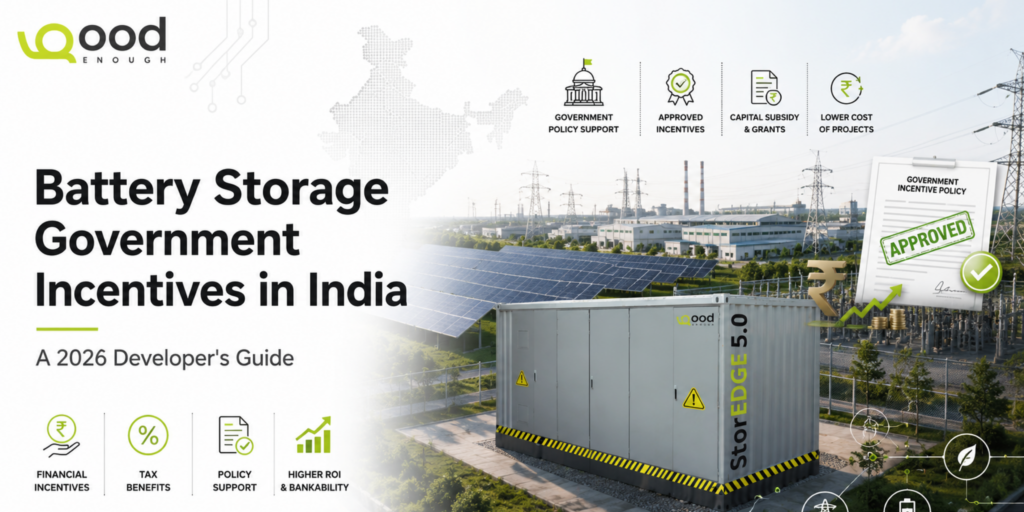
Battery storage government incentives in India have moved from policy promises to real capital flowing into projects. Developers now weigh Viability Gap Funding, manufacturing subsidies, and transmission waivers before they finalise a single site. This guide breaks down what each scheme covers, who qualifies, and where the incentive landscape is heading in 2026.
What Are Battery Storage Government Incentives in India?
Battery storage government incentives in India are the financial and regulatory tools central and state governments use. They lower the cost of deploying Battery Energy Storage Systems (BESS). They include capital subsidies, manufacturing support, tariff waivers, and mandates that create guaranteed demand.
The logic is straightforward. Standalone BESS projects still cost more than conventional peaking capacity. Without support, developers cannot offer tariffs that DISCOMs can afford. Incentives close that gap while battery prices continue to fall.
Why the Government Is Prioritising Energy Storage
India’s non-fossil capacity target of 500 GW by 2030 depends on firm, dispatchable power. Solar and wind alone cannot guarantee supply through the evening peak.
Storage bridges that gap. It absorbs surplus daytime solar generation and releases it when demand rises after sunset. Without adequate storage, grid operators face curtailment, and consumers face higher peak-hour tariffs.
Policymakers also see storage as an industrial opportunity. A domestic manufacturing base for cells and systems reduces import dependence and builds long-term technical capacity within the country.
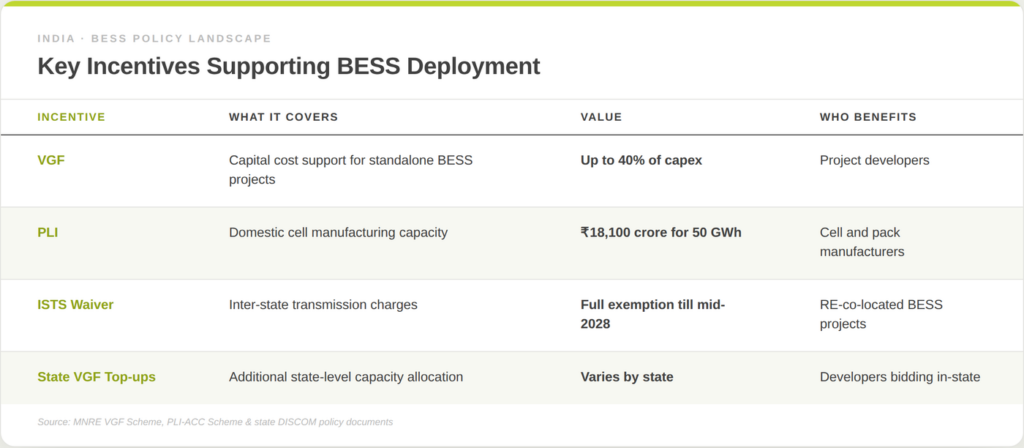
Quick answer: The two largest battery storage government incentives in India are the Viability Gap Funding (VGF) scheme, which covers up to 40% of a project’s capital cost, and the Production-Linked Incentive (PLI) scheme for battery cell manufacturing, worth ₹18,100 crore.
Key Battery Storage Government Incentives in India for 2026
Four mechanisms currently dominate the incentive landscape: capital subsidies, manufacturing incentives, transmission relief, and state-level top-ups. Each targets a different point in the project lifecycle.
Viability Gap Funding (VGF) for BESS Projects
The VGF scheme is the backbone of India’s storage rollout. It was approved with an initial outlay of ₹9,400 crore. It has since scaled to support roughly 43.2 GWh of BESS capacity nationwide.
Developers can recover up to 40% of project capital cost through VGF grants. The money is not paid upfront. It arrives in five tranches: 10% at financial closure, 45% at commissioning, and 15% annually across the following three years.
The scheme targets a Levelized Cost of Storage between ₹5.50 and ₹6.60 per kWh. To protect consumers, at least 85% of a project’s capacity must go to DISCOMs. Only the remainder can be sold on the open market.
Production-Linked Incentive (PLI) for Battery Manufacturing
While VGF supports project developers, the PLI scheme targets manufacturers. It offers ₹18,100 crore to build 50 GWh of domestic Advanced Chemistry Cell (ACC) production capacity.
The goal is to cut India’s reliance on imported cells, most of which still come from China. Progress has been slower than hoped, since manufacturers have struggled to meet the domestic content thresholds required to unlock payouts.
That is changing. Newer tenders now build local sourcing directly into their eligibility rules. This pushes developers and cell makers to collaborate earlier in the project cycle.
State-Level Battery Storage Government Incentives in India
National schemes set the framework, but states compete for BESS investment with their own allocations. The table below summarises approved capacity under state VGF programmes.
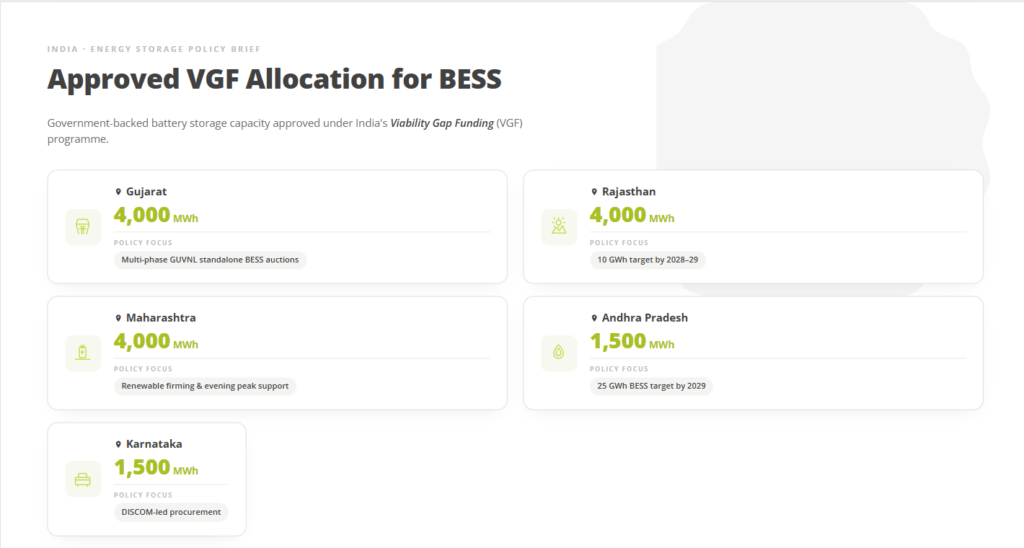
At GoodEnough Energy, we have observed that state-level allocations increasingly shape where developers site new projects. Sometimes they matter more than the national scheme.
Transmission Charge Waivers and Customs Duty Benefits
BESS projects co-located with renewable generation are exempt from inter-state transmission system (ISTS) charges if commissioned by 30 June 2028. This waiver alone can meaningfully improve project economics on long-distance renewable-storage hybrids.
The Union Budget 2024-25 also extended basic customs duty exemptions on battery components and raw materials. Combined with the ISTS waiver, this reduces both capital and operating costs for qualifying projects.
Comparing the Major Incentive Types
The table below gives a quick side-by-side view before the detailed breakdown.
How to Qualify for Battery Storage Government Incentives in India
Eligibility rules have tightened as the scheme has matured. Developers who assume 2023-era rules still apply often miss updated requirements.
Domestic Content Requirements
A Ministry of Power directive now requires a minimum of 20% domestic content for BESS projects to access VGF support. Recent large-scale tenders go further, phasing local content up to 50% within five years of commissioning.
This shift links VGF eligibility directly to the PLI manufacturing programme. Developers who partner early with domestic cell or pack suppliers are better positioned to qualify.
Common Mistakes That Disqualify Projects from Battery Storage Government Incentives in India
Three issues repeatedly trip up applicants. First, developers underestimate the domestic content documentation required at financial closure. Second, they misjudge the DISCOM allocation rule. They assume they can sell more capacity on the open market than the scheme allows.
Third, and most costly, developers submit grid compliance simulations that do not match updated CEA technical standards. The engineering team at GoodEnough Energy routinely reviews interconnection studies for exactly this reason before submission.
Benefits and Challenges of BESS Incentives in India
The benefits are measurable. Tariffs in recent state auctions have fallen sharply, partly because VGF and falling battery costs work together. Rajasthan’s 500 MW auction in late 2024 saw tariffs drop over 40% year-on-year.
The challenges are structural rather than financial. Domestic manufacturing is still ramping up, so supply chains remain exposed to import dependency. Financing costs also stay elevated because long-term battery degradation data is limited.
Lenders price risk conservatively when a project has no operating history to reference. This pushes up the cost of debt, even for developers who qualify for full VGF support. As more projects reach commissioning, this financing gap should narrow.
Underbidding is a related risk. A large pipeline of under-construction capacity has pushed some developers to bid aggressively. This happens ahead of confirmed cost reductions. Incentives can mask, rather than solve, weak project economics if diligence is rushed.
Why it matters: Incentives lower the entry barrier, but they do not remove execution risk. Developers still need strong technical diligence, realistic degradation assumptions, and a credible domestic sourcing plan.
Key Takeaways
- Battery storage government incentives in India centre on two pillars: VGF for developers and PLI for manufacturers.
- VGF can cover up to 40% of capital cost, disbursed across five tranches tied to project milestones.
- A 20% domestic content minimum now gates VGF eligibility, rising in newer tenders.
- States like Gujarat, Rajasthan, and Maharashtra add their own allocations on top of the national scheme.
- ISTS waivers and customs duty exemptions meaningfully improve project economics through 2028.
Conclusion
Battery storage government incentives in India have matured fast. What began as a single capital subsidy is now a layered ecosystem of grants, manufacturing support, and tariff relief. Developers who understand how VGF, PLI, and state programmes interact are better placed to structure bankable projects. GoodEnough Energy designs its StorEDGE systems with these evolving eligibility rules in mind. Incentive compliance now shapes project economics as much as battery chemistry does.