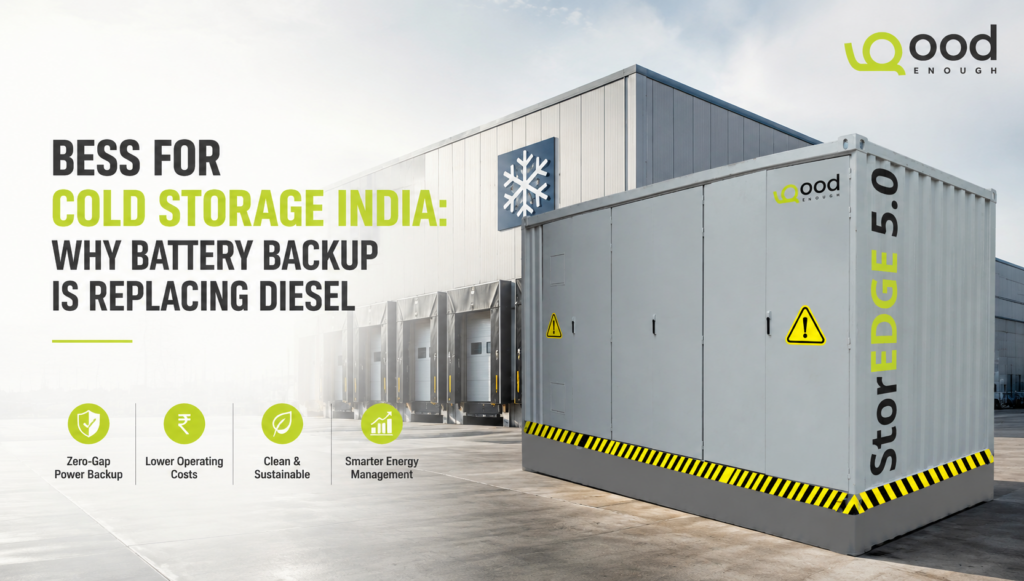
BESS for Cold Storage India is rapidly becoming a preferred alternative to diesel generators as cold storage operators look to reduce backup power costs, improve reliability, and protect temperature-sensitive inventory. A single prolonged outage can result in significant product losses, making resilient power infrastructure a critical business priority.
This is exactly why BESS for cold storage India has moved from a niche pilot technology to a mainstream capex decision on facility managers’ desks. Battery energy storage systems now sit between the grid and the compressor, absorbing outages in 20 milliseconds instead of the 10-30 seconds a diesel generator needs to spin up.
In this guide, we’ll break down how BESS for cold storage India actually works, what it really costs against diesel, how to size a system correctly, and the questions every cold-chain operator should ask before signing a contract.
What Is BESS for Cold Storage India and Why It Matters Now
A battery energy storage system, or BESS, stores electricity in lithium-ion battery packs and releases it the instant grid power fails or dips. For a cold store, that release has to happen before the compressor stalls and the chamber temperature starts to climb.
Cold storage is one of the least forgiving loads in the entire commercial and industrial sector. A dairy, pharma, or seafood facility running at -18°C to -25°C cannot tolerate even a two-minute gap between grid failure and backup pickup. That reality is driving demand for reliable battery backup in cold chain facilities across the country.
Three forces are converging to make this urgent:
- Grid instability during summer peaks, when DISCOMs impose load-shedding in industrial feeders.
- Rising diesel prices, which have made generator-based backup structurally more expensive every year.
- Spoilage economics, where the cost of one bad outage can exceed months of electricity bills.
How BESS for Cold Storage India Works During a Grid Outage
The sequence matters more than the marketing. When grid power drops, a properly configured cold storage battery system switches load to the battery bank in under 20 milliseconds fast enough that compressors, PLCs, and monitoring systems never register an interruption. Diesel generators, by contrast, need 10 to 30 seconds to reach stable voltage, and that gap is long enough to trip sensitive refrigeration controllers or force a manual restart.
Most Indian cold-chain deployments now pair the battery with existing rooftop solar. During the day, solar charges the battery and offsets grid draw. At night or during an outage, the battery discharges to the load. The diesel generator, where one still exists, becomes a rarely-used last resort rather than the primary backup path.
The Real Cost of Power Outages Without BESS for Cold Storage India
Cold storage economics in India are brutal and well documented. According to Ministry of Agriculture cold-chain data, the median Indian cold store spends roughly ₹19 lakh a year on grid electricity and another ₹9-10 lakh on diesel for backup generation. Larger multi-chamber facilities in states like Gujarat, running at 6-7.5 lakh kWh annually on HT industrial tariffs of ₹7-9 per kWh, see grid bills alone climb past ₹45-60 lakh a year.
The spoilage math is even starker. A single prolonged outage at a cold store can destroy inventory worth 10 to 50 times the facility’s monthly power bill, a loss no insurance claim fully covers, and one that damages buyer relationships long after the product is written off.
Key insight: For most cold-chain operators, the electricity bill is not the biggest risk. The uninsured cost of one bad outage usually is, which is why battery storage for cold chains is increasingly framed as risk management, not just a cost-saving upgrade.
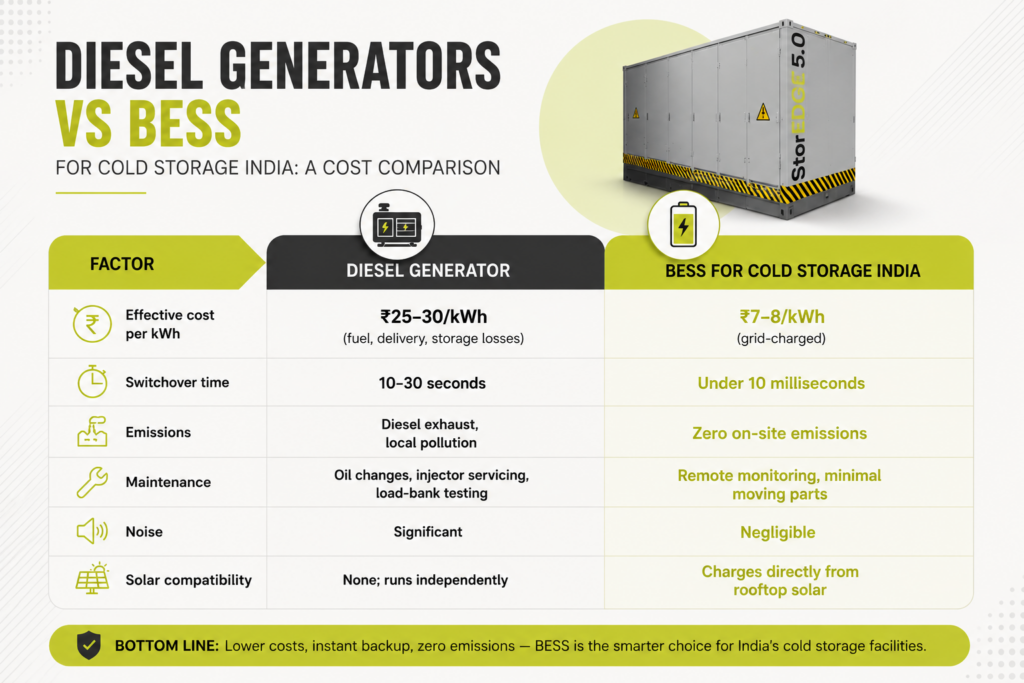
The gap between ₹25-30/kWh for diesel and ₹7-8/kWh for grid-charged battery power is the core financial argument for battery backup in Indian cold storage, and it holds even before spoilage risk enters the calculation.
Key Benefits of Battery Storage for Cold Chain Facilities
Beyond the headline cost comparison, operators adopting battery backup for their cold chain typically report a broader set of gains:
- Zero-gap continuity. No compressor cycling, no temperature spikes, no product at risk during the switchover window.
- Lower demand charges. Facilities on HT tariffs can discharge the battery during peak-demand windows, cutting the kVA-based charges that sit on top of the energy bill.
- Reduced diesel dependency. Less fuel storage, fewer statutory compliance headaches around diesel handling, and a smaller carbon footprint for buyers who audit supplier sustainability.
- Quieter, cleaner sites. No exhaust fumes near food storage areas, which matters for FSSAI and export-quality audits.
- Predictable operating costs. Battery degradation and maintenance schedules are far easier to budget for than volatile diesel prices.
Adoption is moving fastest among dairy cooperatives, pharma cold chains, and export-oriented seafood processors, where a temperature excursion doesn’t just spoil stock it can trigger a failed quality audit or a lost export contract. Several states are also sweetening the economics: capacity additions in Karnataka and Tamil Nadu are increasingly paired with storage to manage renewable curtailment, while states like Andhra Pradesh offer capital subsidies that make combined solar-plus-battery projects more attractive for new cold-storage builds. None of these incentives change the core engineering case, but they do shorten the payback period operators are working with today.
Sizing and Choosing the Right BESS for Cold Storage India
Undersizing a battery system defeats the purpose; oversizing wastes capital. Getting this right starts with an honest load audit, not a generic template.
Factors That Determine Your Cold Storage Battery Storage Capacity
- Compressor inrush current. Refrigeration compressors draw a sharp current spike on startup, and the battery inverter must be rated to absorb it without tripping.
- Required autonomy window. Facilities near unreliable feeders may need 2-4 hours of full backup; those with a reliable grid and a diesel fallback may only need bridging power until the generator stabilizes.
- Chamber temperature tolerance. A -25°C blast freezer has far less thermal buffer than a 4°C produce chamber, and that difference should drive backup duration, not an assumption.
- Existing or planned solar capacity. Sizing the battery alongside a rooftop solar array changes the economics significantly, since self-consumption during the day reduces how much backup capacity is truly needed at night.
- Growth plans. A facility expanding chamber capacity in the next two to three years should size for that load now, since retrofitting a battery bank later is more expensive than building in headroom upfront.
At GoodEnough Energy, we have observed that cold-chain operators who skip a proper load audit almost always end up either under-protected during peak summer outages or paying for capacity they never use. A right-sized system, not the biggest available one, is what actually protects margins.
As a rough starting point, a mid-sized multi-chamber cold store (500-1,000 MT capacity) typically needs somewhere between 100-250 kWh of usable battery capacity for a two-hour bridging window, while larger 5,000 MT facilities with round-the-clock compressor loads may require capacity in the megawatt-hour range. These figures are directional only the engineering team at GoodEnough Energy always confirms them against actual compressor nameplate data and a site’s historical outage log before finalizing a design.
Challenges to Consider Before Deploying Battery Storage for Your Cold Chain
No technology decision is free of trade-offs, and cold storage operators should go in with clear eyes on a few practical points:
- Upfront capital. Battery systems cost more per kW upfront than a comparable diesel genset, even though the lifetime cost of ownership is usually lower.
- Space and ventilation. Battery enclosures need a dedicated, well-ventilated footprint, which some older cold-storage sites were not designed to accommodate.
- Vendor track record. Not every supplier has field experience with the compressor-inrush and thermal-cycling demands specific to cold storage; ask for reference sites in refrigerated environments, not just generic C&I installations.
- Financing structure. Capex purchase, lease, and energy-as-a-service models all exist in the Indian market, and the right one depends on the facility’s balance sheet and how long the operator plans to hold the property.
GoodEnough Energy’s engineering team typically walks operators through a site-specific load profile before recommending a configuration, precisely because cold storage load patterns differ so much from a typical factory or office building.
Conclusion
Cold storage is one of the clearest use cases for battery backup in Indian industry today, because the cost of failure is measured in spoiled inventory, not just kilowatt-hours. BESS for cold storage India delivers sub-20-millisecond switchover, materially lower per-kWh backup costs than diesel, and a cleaner operating footprint all without asking operators to compromise on the thermal reliability their business depends on. For facilities still running diesel as a primary backup, the economics have shifted decisively enough that a proper load audit is now worth the hour it takes.
Key Takeaways
Pairing battery storage with rooftop solar further reduces both grid dependency and backup costs.
Diesel backup costs roughly ₹25-30/kWh in India versus ₹7-8/kWh for a grid-charged battery system.
A single prolonged outage can destroy cold-storage inventory worth 10-50 times the monthly power bill.
Battery systems switch load in under 20 milliseconds, compared to 10-30 seconds for a diesel generator to stabilize.
Correct sizing depends on compressor inrush current, required autonomy window, chamber temperature tolerance, and existing solar capacity.