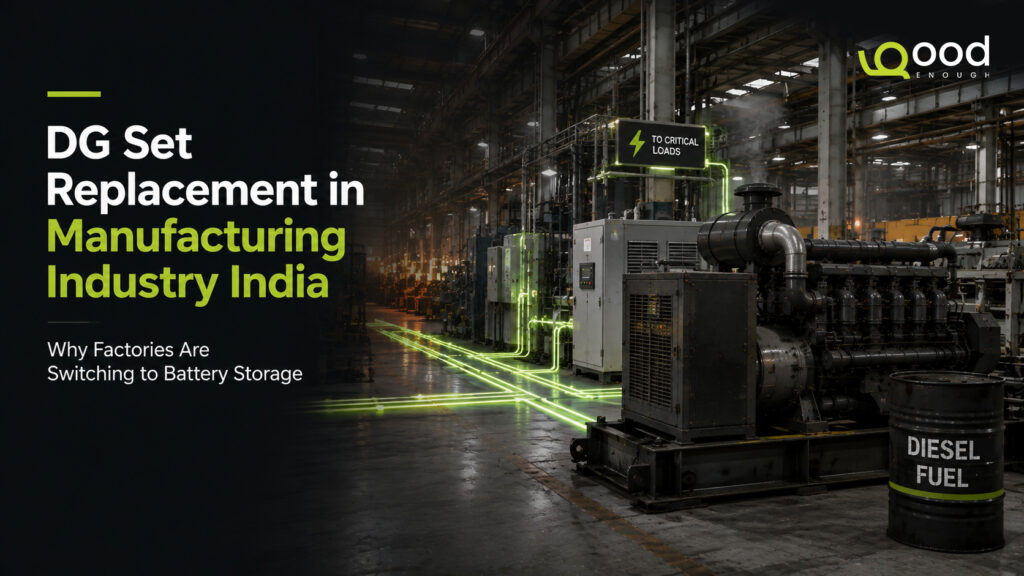
Every rupee spent running a diesel genset during a power cut gets questioned at the next budget review. That is exactly why DG set replacement manufacturing industry India conversations have moved off sustainability slide decks. They now sit on the capex agenda instead.
Diesel backup was the default for decades. It was the only reliable option available. That is no longer true today.
Battery energy storage now switches load fast enough, and cheaply enough, to flip the model. Diesel becomes the fallback. Battery storage becomes the primary plan.
In this guide, we’ll walk through why DG set replacement manufacturing industry India projects are accelerating. We’ll cover the real cost comparison, how to plan a transition, and the trade-offs worth weighing first.
Why DG Set Replacement Manufacturing Industry India Is Accelerating
Three pressures are converging on Indian factory floors at the same time. Together, they explain why this shift is happening now.
- Diesel price volatility. Fuel costs have climbed steadily over the past few years. Unlike a battery’s operating cost, diesel pricing sits entirely outside a plant’s control.
- Grid reliability gaps. Industrial feeders still see unplanned outages during summer peaks. Production lines lose output every time equipment stalls waiting for a genset to catch up.
- Demand-charge pressure. HT industrial tariffs carry kVA-based demand charges of roughly ₹250-500 per kVA per month. Battery storage is one of the few assets that can attack both backup power and demand charges with the same hardware.
How DG Set Replacement Manufacturing Industry India Protects Production Lines
A diesel genset takes 10 to 30 seconds to reach stable voltage after a grid trip. For a continuous casting line, an injection-moulding press, or a CNC cell mid-cycle, that gap matters. It can scrap a batch or force a manual restart.
Battery storage closes that gap in under 20 milliseconds. Sensitive equipment never registers the interruption. This is the single biggest operational argument driving DG set replacement manufacturing industry India adoption across process industries today.
The Real Cost Case for DG Set Replacement Manufacturing Industry India
The numbers, not the sustainability narrative, are what get this approved at the CFO level. Diesel backup runs roughly ₹25-30 per kWh once fuel, delivery, storage losses, and maintenance are factored in. A grid-charged battery system delivers backup power at roughly ₹8-10 per kWh.
That gap compounds fast. Even a plant running backup power for a few hundred hours a year sees the difference add up quickly.
Key insight: The diesel-versus-battery cost gap alone often pays back a battery system in three to five years. Add demand-charge savings on top, and payback compresses further which is why DG set replacement manufacturing industry India projects increasingly get greenlit as a cost initiative, not just a resilience upgrade.
Diesel vs Battery Costs in DG Set Replacement Manufacturing Industry India
| Factor | Diesel Generator | Battery Energy Storage |
| Effective cost per kWh | ₹25-30/kWh | ₹8-10/kWh (grid-charged) |
| Switchover time | 10-30 seconds | Under 20 milliseconds |
| Demand-charge impact | None | Can discharge during peak windows to cut kVA charges |
| Fuel storage & handling | Statutory compliance, fire risk | Not applicable |
| Noise and emissions | Significant, on-site | Negligible |
| Maintenance | Oil changes, injector servicing, load testing | Remote monitoring, minimal moving parts |
Key Benefits of Replacing Diesel Gensets with Battery Storage
Manufacturers who complete this transition typically see gains across several parts of the operation, not just the power bill.
- Fewer production interruptions. Sub-20-millisecond switchover protects work-in-progress on sensitive lines that a diesel gap would otherwise scrap.
- Lower demand charges. The same battery bank that provides backup can discharge during peak-demand windows. This trims the kVA-based portion of the electricity bill.
- Reduced statutory burden. Less diesel storage on-site means fewer fire-safety and pollution-control requirements to manage.
- Quieter, cleaner shop floors. No exhaust fumes or generator noise near production areas. This matters for worker-safety audits and ESG reporting to buyers.
- Predictable operating costs. Battery maintenance schedules are easier to budget than diesel prices, which swing with global crude markets.
Planning a DG Set Replacement Manufacturing Industry India Project
A rushed transition creates more problems than it solves. Getting this right starts with an honest load audit, not a vendor’s standard package.
Factors That Determine Battery Sizing for a Manufacturing Plant
- Critical load mapping. Not every circuit needs battery backup. Separate the lines that stall production from the lines that can tolerate a short gap, then size around the former.
- Inrush current from motors and presses. Industrial equipment often draws a sharp startup spike. The inverter has to be rated to absorb it without tripping.
- Required autonomy window. Sites on stable grids may only need 30-60 minutes of bridging power. Sites on weaker feeders may need several hours.
- Existing captive or rooftop solar. Pairing the battery with solar changes the sizing math. Daytime self-consumption reduces how much stored capacity is needed at night.
- Expansion plans. A plant adding a shift or a new line within two to three years should size the battery bank with that growth in mind. Retrofitting later costs more than building in headroom now.
At GoodEnough Energy, we have observed that manufacturers who skip this step usually end up in one of two positions. They are either under-protected on their most critical lines. Or they end up paying for capacity that never gets used in an average outage year.
Which Manufacturing Industries Are Leading This Shift
Not every sub-sector is moving at the same pace. Adoption tends to track how much a single outage actually costs the business.
- Steel and metals. Induction furnaces and rolling mills carry sharp demand spikes and heavy penalties for unplanned stoppages, making the payback case unusually strong.
- Auto components. Precision machining and paint-line processes are highly sensitive to voltage dips, and a scrapped batch is expensive to redo.
- Plastics and injection moulding. A mid-cycle stall can ruin a mould run and damage tooling, not just the material in progress.
- Electronics and textiles. Clean, stable power protects both product quality and expensive equipment from repeated switching stress.
These are also the sectors where GoodEnough Energy sees the most inbound interest. The cost of a bad outage is easy for a plant head to quantify. That makes it easy to defend internally.
What a Typical Transition Timeline Looks Like
Plant heads often assume this is a multi-year overhaul. In practice, a phased rollout is both faster and lower-risk than a single, all-at-once cutover.
Most projects start with a two-to-three-week load audit. An engineering team maps every circuit and logs historical outage data. They identify which lines genuinely need sub-second backup, and which can tolerate a short gap.
Procurement and site preparation typically take another six to ten weeks, depending on enclosure and grid-connection approvals. Installation and commissioning for a mid-sized industrial system usually run two to four weeks after equipment arrives on site.
Many manufacturers choose to phase the rollout by criticality. Critical lines get battery backup first, while less sensitive circuits remain on diesel until the first phase proves out. This staged approach limits capital exposure and gives the plant a live case study to justify the next phase internally.
Procurement teams evaluating multiple vendors should also confirm warranty terms and local service response times upfront. A battery system that sits idle for days after a fault defeats the purpose. It undoes the whole case for switching away from diesel, so this detail is worth confirming in writing before a contract is signed.
Challenges to Weigh Before Replacing Your Diesel Generator
No transition is entirely trade-off free. Manufacturing decision-makers should go in with clear expectations on a few points.
- Higher upfront capital. Battery systems cost more per kW to install than an equivalent diesel genset. Total cost of ownership is usually lower over the asset’s life, but the initial outlay is real.
- Space and layout. Battery enclosures need a dedicated, ventilated footprint. Older plants may need to reconfigure yard space to fit one in.
- Vendor experience with industrial loads. Not every supplier has field experience with the inrush and duty-cycle demands specific to manufacturing equipment. Ask for reference sites in comparable industries.
- Financing structure. Outright purchase, leasing, and energy-as-a-service models all exist in the Indian market. The right choice depends on the plant’s balance sheet and how long it plans to run the facility.
GoodEnough Energy’s engineering team typically starts with a site-specific load audit before recommending a configuration. Manufacturing load profiles vary too much between industries for a one-size template to work.
Energy Efficiency in Indian Manufacturing
Industrial manufacturers are increasingly looking at energy efficiency and demand-side management to reduce electricity costs and improve operational reliability. The Bureau of Energy Efficiency (BEE) provides guidance and resources on energy efficiency practices for industrial facilities.
Conclusion
DG set replacement manufacturing industry India projects are no longer a fringe sustainability initiative. They are a straightforward cost and reliability decision once the numbers are laid out clearly.
Battery storage closes the switchover gap that diesel can’t. It cuts effective backup costs by roughly two-thirds. It also gives plants a second lever against demand charges, using the same hardware investment. For manufacturers still running diesel as their primary backup plan, a load audit is the fastest next step. It shows exactly where the numbers land for your own facility.
Key Takeaways
- Diesel backup costs roughly ₹25-30/kWh in India versus ₹8-10/kWh for a grid-charged battery system.
- Battery storage switches load in under 20 milliseconds, compared to 10-30 seconds for a diesel generator to stabilize.
- The same battery bank used for backup can also reduce kVA-based demand charges during peak windows.
- Correct sizing depends on critical load mapping, motor inrush current, required autonomy window, and any existing solar capacity.
- Steel, auto components, plastics, and electronics manufacturers see the fastest payback from this transition.