Gujarat’s new RE policy 2025 is transforming how industries invest in renewable energy by making solar + battery storage more profitable, reliable, and scalable than ever before. Industrial power tariffs in Gujarat have been rising, and many plants are paying significantly higher per-unit costs than a few years ago, putting direct pressure on margins. At the same time, Gujarat’s new RE policy 2025 has opened a fresh window for captive solar and storage projects that can dramatically cut long-term energy costs for factories and large facilities.
Under this new framework, industrial consumers are watching closely because the policy integrates solar, wind, hybrid and storage-based projects under one umbrella, with a strong focus on reliability and affordable renewable power. For businesses planning their energy strategy for 2025–2030, Gujarat’s new RE policy 2025 is not just a regulatory update, it is a clear signal that the state wants industries to move towards flexible, dispatchable renewable power backed by battery storage.
What Is Gujarat’s New RE Policy 2025?
According to the Gujarat government’s renewable energy framework and GERC regulations, the policy aims to accelerate renewable adoption and storage deployment across industrial sectors.
It replaces the earlier 2023 renewable energy policy and is designed to stay in force until 31 December 2030, providing long-term stability for project developers and large consumers.
The main objective of this Gujarat integrated renewable energy policy is to help Gujarat achieve over 100 GW of renewable capacity by 2030 while delivering energy independence, affordable power, and accelerated decarbonisation. The government clearly positions storage as a core enabler of grid reliability and round‑the‑clock renewables, encouraging both integrated and standalone BESS projects.
Industries that stand to gain the most include energy‑intensive sectors with large, predictable loads that can benefit from captive or third‑party renewable projects such as manufacturing, process industries, and large commercial facilities. For these consumers, Gujarat’s new RE policy 2025 creates a structured way to access clean power with better control over costs and reliability.
Key Highlights of Gujarat’s New RE Policy 2025
Gujarat’s new RE policy 2025 makes it easier for industries to adopt solar + BESS through supportive open access and banking regulations. Some of the most relevant features for industrial decision‑makers under Gujarat’s new RE policy 2025 include:
- Integrated coverage: Solar, wind, hybrid projects, rooftop systems, floating solar and co‑located or standalone BESS are all covered under one policy.
- Captive and open access flexibility: The framework supports captive and third‑party sale projects, with no capacity restriction tied to contracted demand for many captive/open‑access consumers.
- Open access and banking: Gujarat allows banking of renewable energy with defined rules; solar generation can typically be banked within the day or billing cycle for HT/LT consumers, and green open access banking charges have been set at ₹1.50/kWh through June 2026.
- Strong push for storage: The policy explicitly promotes BESS to handle intermittency, provide peak support, and enable round‑the‑clock green power, treating storage as a core part of future renewable projects.
- Supportive approvals and processes: A Standard Operating Procedure (SoP) notified in 2026 streamlines registration, approvals, grid connectivity and commissioning for renewable and storage projects, improving ease of doing business.
- Long‑term benefits: Projects commissioned under the policy can typically avail benefits for up to 25 years, aligning well with industrial investment horizons.
For any industrial consumer looking at solar storage investment Gujarat wide, these provisions significantly reduce regulatory friction and make it easier to plan a multi‑year energy transition roadmap.
Why Gujarat’s New RE Policy 2025 Is a Big Opportunity for Industries
For factories and large plants, the biggest attraction of Gujarat’s new RE policy 2025 is the ability to generate or procure renewable energy at a much lower levelised cost than grid tariffs, especially under captive and open access models. By locking in long‑term tariffs through solar‑plus‑storage, industries can protect themselves against future grid price hikes and fuel volatility.
The policy also strengthens energy reliability by promoting hybrid and storage‑linked projects that can support operations during peak hours or grid instability. This directly supports ESG and carbon reduction goals by shifting a larger share of consumption to clean energy, improving sustainability disclosures while enhancing competitiveness in export and B2B supply chains where low‑carbon manufacturing is increasingly important.
How Solar + Battery Storage Becomes the Most Profitable Energy Investment
Under Gujarat’s new RE policy 2025, solar alone remains attractive, but policy makers have clearly recognised that solar without storage cannot fully address reliability and peak‑demand challenges. Mid‑day generation surpluses, curtailment risk and limited banking windows reduce the effective utilisation of standalone solar for many industrial load profiles. This is one of the biggest reasons Gujarat’s new RE policy 2025 is attracting industrial investment in solar + battery storage.
Battery Energy Storage Systems change this equation. By pairing BESS with captive or open‑access solar, plants can store surplus generation in low‑tariff hours and discharge during evening peaks, cutting demand charges and reducing expensive grid draw. This energy shifting, combined with backup capability during grid outages, significantly boosts solar ROI and makes solar storage investment Gujarat’s most compelling option for plants with high evening or continuous loads.
In practical terms, integrated solar + BESS allows you to:
- Flatten your load curve and manage contract demand more efficiently.
- Maximise self‑consumption of cheap solar energy instead of banking at a charge or selling at lower compensation.
- Maintain critical processes during grid interruptions, improving production continuity and reducing losses.
For plants evaluating system options, modular Indian-made solutions such as StorEDGE 0.25 (250 kWh / 125 kVA) make it practical to start with a right-sized deployment and scale capacity as your energy strategy matures without over committing capital upfront.
Explore the complete StorEDGE product lineup for commercial and industrial applications.
Industries That Can Benefit Most From Gujarat’s New RE Policy 2025
Gujarat’s new RE policy 2025 is especially attractive for sectors with high, steady, and often round‑the‑clock energy needs. Examples include:
- Textiles and garments: continuous processes, large spinning/loom loads, and significant evening operations.
- Chemicals and petrochemicals: process heat, agitation, pumping and environmental compliance loads.
- Automotive and engineering: paint shops, machining lines and robotic operations where downtime is expensive.
- Pharmaceuticals and life sciences: clean rooms, HVAC and quality‑sensitive continuous processes.
- Data centers and IT parks: strict uptime requirements, high power densities and 24×7 operations.
- FMCG and food processing: batch processes, packaging lines and strict temperature controls.
- Warehousing & cold storage: refrigeration loads and lighting that run well beyond solar hours.
For these users, combining the Gujarat integrated renewable energy policy with well‑designed BESS solutions allows them to hit energy‑cost, reliability and sustainability targets simultaneously.
Gujarat’s New RE Policy 2025 vs Traditional Energy Costs
Under Gujarat’s new RE policy 2025, the economics of solar + BESS compare favourably with traditional energy options for many industrial consumers.
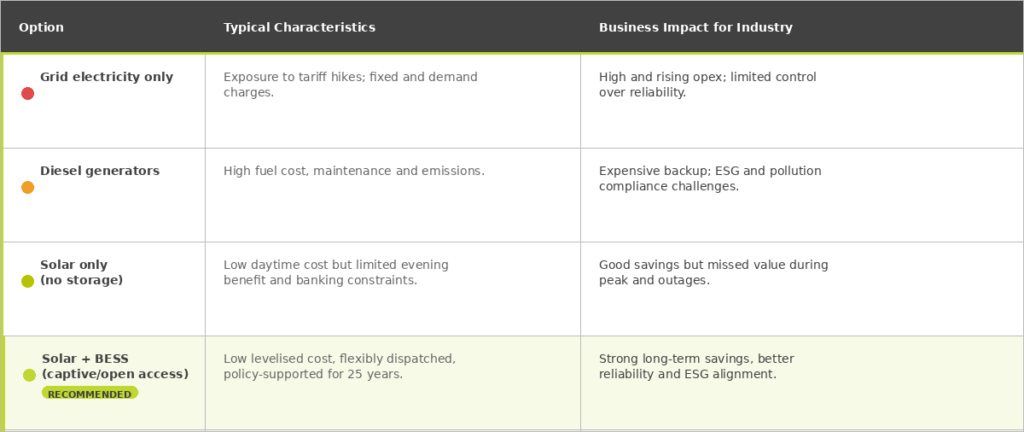
While exact numbers depend on plant profile and design, the combination of low solar LCOE, efficient lithium‑ion storage and policy‑enabled banking/transmission benefits makes solar storage investment Gujarat’s most compelling “hedge” against future energy cost uncertainty for many industrial users.
Challenges Industries May Face While Adopting Renewable Energy
Even with a supportive framework like Gujarat’s new RE policy 2025, many industrial teams hesitate because of practical concerns. Common challenges include:
- Confusion about optimal system sizing for solar + BESS to match complex load patterns.
- Difficulty translating technical models into clear ROI and payback numbers that finance teams can approve.
- Worries about intermittency, curtailment and whether the system will actually deliver the promised savings.
This is exactly where integrated solar + BESS solutions help. A well-designed system can absorb intermittency, provide dispatchable output in line with your load profile, and give predictable, contract-backed performance over 25 years or more, simplifying internal approvals.
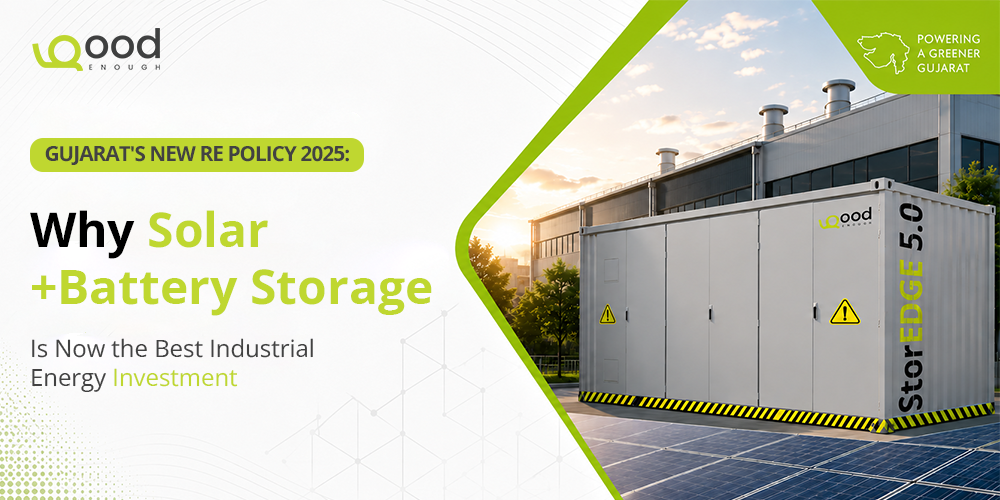
Indian-manufactured BESS products like StorEDGE by GoodEnough Energy are engineered specifically for these use cases available in modular configurations from 250 kWh (StorEDGE 0.25) for commercial facilities up to 5 MWh (StorEDGE 5.0) for large industrial and grid-scale applications. With containerised systems, advanced EMS software and Gujarat-compliant designs, they help industrial teams navigate policy, approvals and performance guarantees without managing multiple vendors. With Gujarat’s new RE policy 2025, industries now have a clearer pathway toward long-term renewable energy adoption.
Conclusion
If you are evaluating the best energy investment Gujarat 2025 for your plant, solar + battery storage under the new policy offers one of the strongest long-term business cases available today. GoodEnough Energy’s StorEDGE systems ranging from the 250 kWh StorEDGE 0.25 for commercial facilities to the 5 MWh StorEDGE 5.0 for large industrial plants are engineered for Indian grid conditions and Gujarat’s policy framework, covering textiles, chemicals, data centers and cold storage. The result: a move from high, volatile grid bills to predictable, low-carbon energy with a single, bankable solution.