If you run a factory in Vapi, Ahmedabad, Surat, or anywhere along Gujarat’s industrial belt, you’ve probably had this conversation in a management meeting already: Solar + Battery Storage in Gujarat: Is It Worth the Investment for Industries? Power costs keep climbing, diesel backup keeps getting more expensive to run, and every vendor pitching you a system has a different payback number. This article skips the sales pitch and walks through the real math of what solar plus storage actually costs in Gujarat today, what it saves, and who should (and shouldn’t) invest right now.
What Solar + Battery Storage in Gujarat Actually Means for Your Factory
Solar alone gives you cheap power but only while the sun is out. The moment your shift runs into the evening, or a cloudy day cuts generation, you’re back on grid power or diesel. Battery storage closes that gap. It stores the solar energy you generate during the day and releases it exactly when you need it during evening peak hours, during a grid outage, or during the high-tariff windows your DISCOM charges you the most for.
That combination of solar and battery storage for industries is what turns a rooftop solar installation from a partial fix into a full energy strategy. And Gujarat, more than almost any other state in India, is set up to make that combination pay off.
Why Gujarat Is a Strong Market for Solar + Battery Storage
Gujarat isn’t a random choice for this conversation. The state already has one of India’s highest concentrations of commissioned and under-construction battery storage capacity, backed by central Viability Gap Funding that covers up to 40% of project capital cost for eligible systems. Adani Energy Solutions has already commissioned a 40 MW / 120 MWh battery system in Gujarat paired with 300 MW of solar, running under a 25-year power purchase agreement proof that large-scale solar-plus-storage economics work in this state, not just on paper.
For industrial buyers specifically, three things make Gujarat different from most other states:
- Strong industrial tariffs that make demand charges and peak-hour consumption expensive enough for storage to pay back faster
- An active open access solar market, letting industries procure renewable power outside the DISCOM at competitive rates
- A state government and DISCOM ecosystem already comfortable approving and interconnecting storage-backed projects, unlike states still building that regulatory muscle
Gujarat’s Open Access and Policy Landscape
If your factory already uses (or is considering) open access solar Gujarat arrangements, adding battery storage is a smaller leap than it sounds. Open access already gets you cheaper power than grid tariffs typically ₹3–4 per unit for solar. Adding storage adds roughly ₹2–2.5 per unit on top of that. Even with the added cost, the combined rate frequently comes in well below what a 24×7 industrial consumer pays on the grid, especially for facilities running two or three shifts.
The Real Cost of Solar + Battery Storage in Gujarat: Is It Worth the Investment?
Here’s the part most vendor pitches skip. Solar plus battery storage in Gujarat isn’t a cheap add-on, it’s a genuine capital investment, and it doesn’t make sense for every factory. What determines whether it’s worth it comes down to three numbers:
- Your current backup cost per unit. If you’re running a diesel generator, you’re likely paying somewhere between ₹18–24 per unit of electricity. Battery storage typically delivers backup power for roughly ₹8 per unit less than diesel, a gap large enough to fund the investment on its own in many cases.
- Your peak demand charges. If your DISCOM bill shows a large gap between your normal tariff and your peak-hour or demand-charge tariff, storage earns its keep by shifting your consumption away from those expensive hours, a strategy called peak shaving.
- How often your power actually cuts out. If outages are rare once a month or less the capital cost of a full battery system is harder to justify purely on backup value. Storage makes the most sense when it’s working for you daily (peak shaving, DG replacement) rather than sitting idle waiting for an outage.
Upfront Investment vs Long-Term Savings
A commercial-scale battery system for a mid-sized industrial unit is a multi-year investment, typically paying back over 3–6 years depending on your load profile, tariff structure, and how aggressively the system is used for daily peak shaving versus occasional backup. Gujarat’s VGF-backed policy environment and mature open access market shorten that payback window compared to most other Indian states which is exactly why solar and battery storage for industries is being adopted faster here than almost anywhere else in the country.
Solar + Battery Storage in Gujarat vs Diesel Backup: A Practical Comparison
For a factory currently running on solar plus diesel, the comparison isn’t close on a per-unit basis. Diesel generators run at roughly 35–40% fuel efficiency and cost ₹18–24 per unit to operate. Battery systems, once charged from solar or off-peak grid power, deliver that same backup power at a fraction of the running cost, with none of the fuel logistics risk, noise, or emissions compliance overhead diesel carries. Many industrial buyers in Gujarat aren’t fully replacing diesel; they’re using DG replacement Gujarat strategies where the battery handles daily cycling and short outages, and the generator stays as a rarely-used emergency backstop. That hybrid approach cuts diesel runtime dramatically while avoiding the risk of removing backup entirely.
Who Should (and Shouldn’t) Invest Right Now
Strong candidates for solar plus battery storage in Gujarat include factories with high peak-hour demand charges, 24×7 operations like cold storage or textile processing, and any business already running diesel backup regularly. Weaker candidates are single-shift operations with low peak demand and infrequent outages for these, plain rooftop solar without storage may still be the better first step, with battery storage added later as tariffs or load patterns change.
The honest answer to whether industrial energy storage ROI works in your case depends entirely on your load profile which is why a proper site-specific assessment matters more than any generic percentage a vendor quotes you.
How GoodEnough Energy Helps Gujarat Industries Get This Right
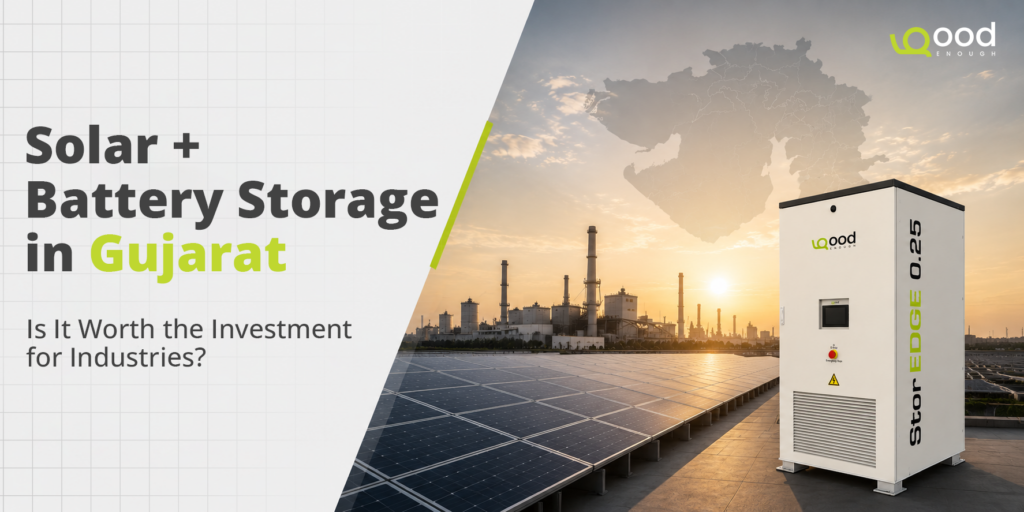
GoodEnough Energy manufactures the StorEDGE 0.25: a 250 kWh / 125 kVA commercial and industrial battery storage system built specifically for factories, cold storage, and 24×7 industrial loads like the ones common across Gujarat’s industrial belt. Instead of a generic sizing recommendation, our team runs the actual numbers against your DISCOM bill, your backup usage, and your solar setup before recommending a system size so the payback estimate you get reflects your factory, not an average.
The Bottom Line
Solar + Battery Storage in Gujarat is worth the investment for industries with real peak demand costs, frequent backup needs, or existing diesel dependence and Gujarat’s policy support and open access market make the payback period shorter than in most other states. It’s not automatically worth it for every factory, but for the growing number of Gujarat industries paying high diesel or peak-tariff costs, the math increasingly favors storage over standing still.