Solar Battery Storage Maharashtra: The 2026 Mandate Every Factory Owner Must Read Before It Costs Them
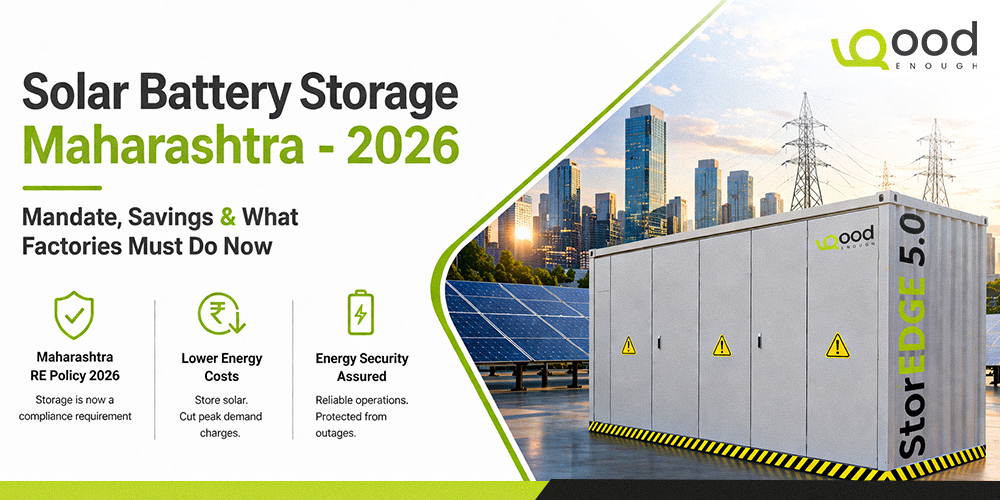
If your factory, warehouse or industrial plant in Maharashtra has rooftop solar above 100 kW or is planning one solar battery storage Maharashtra is no longer optional. As of April 1, 2026, Maharashtra’s newly notified Renewable Energy and Energy Storage Policy 2025 – 36 makes battery storage mandatory alongside all new solar installations above this threshold. Miss this deadline and your grid connectivity application gets rejected. Plan for it correctly and your electricity bill could drop by up to 50 percent.
This blog breaks down exactly what changed, what it costs you to ignore it, and what the numbers look like when you get it right.
What Is the Solar Battery Storage Maharashtra Mandate and Is Your Factory Affected?
Maharashtra’s cabinet approved the Renewable Energy and Energy Storage Policy 2025–2035 on February 22, 2026, with official notification on March 18, 2026. This is not a draft or a proposal, it is a notified state policy, already in force.
Here is what it mandates directly for industrial and commercial facilities:
- From April 1, 2026, every new rooftop solar or open-access renewable energy project above 100 kW must integrate battery storage equal to at least 50 percent of RE capacity for a minimum of 2 hours duration
- This requirement applies to both captive and open-access projects seeking grid connectivity
- The storage mandate will be reviewed and tightened every two years meaning by 2030, the requirement moves to 4 hours duration
- DISCOMs across Maharashtra are required to procure storage equivalent to at least 10 percent of total demand by FY 2035–36, translating to roughly 100 GWh of daily storage capacity
Practical example: If you are installing a 500 kW rooftop solar system at your Pune plant, you now need a minimum of 250 kWh of co-located battery storage with at least 2 hours of discharge capacity. No storage, no grid connectivity approval.
The Financial Case for Solar Battery Storage in Maharashtra Nobody Has Shown You Yet
Here is where most factory energy managers stop at compliance and miss the real opportunity. Solar battery storage Maharashtra done right does not just keep you compliant it restructures your entire electricity cost.
How Solar Battery Storage Maharashtra Cuts Your Electricity Bill
1. Zero Wheeling and Cross-Subsidy Charges on Stored Energy
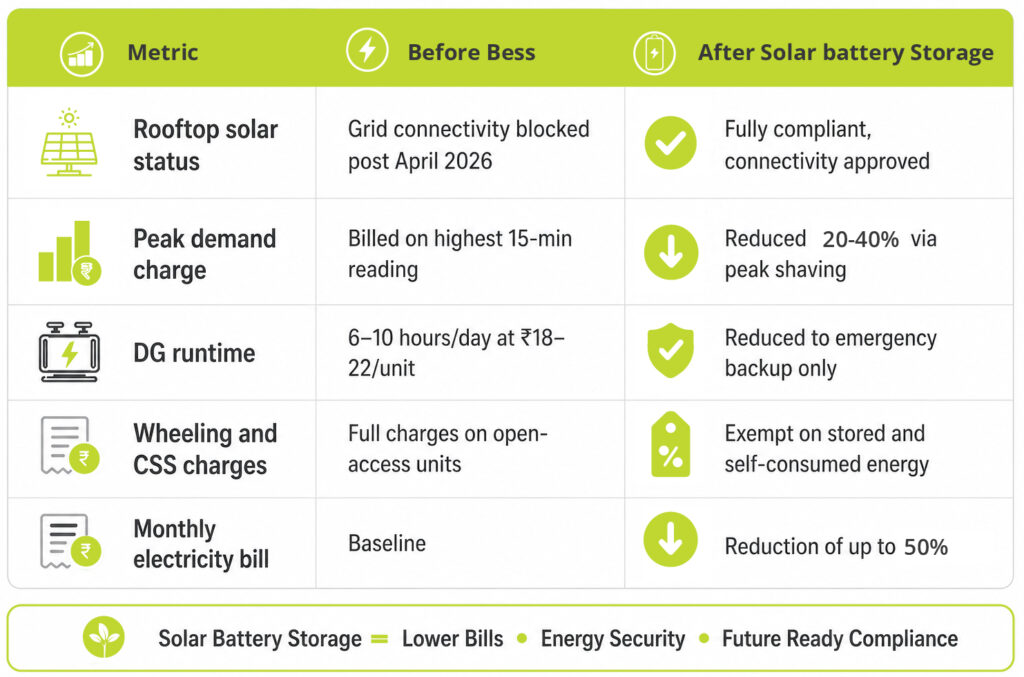
This is the headline number most factories have not calculated. Under the notified policy, storage systems drawing power for charging are fully exempt from transmission charges, wheeling charges, electricity duty and cross-subsidy surcharge, provided the stored energy is consumed within Maharashtra. For a mid-size factory on open-access solar drawing 1–2 MW during peak hours, this exemption alone can translate to savings of ₹15 to ₹25 lakh per year.
2. Peak Demand Charge Reduction
Maharashtra industrial tariffs bill demand charges based on your highest 15 or 30-minute recorded demand each month. A well-configured BESS discharges during your peak consumption windows furnace startups, compressor loads, press lines flattening your demand curve and reducing your recorded maximum demand by 20 to 40 percent. On a factory with a sanctioned load of 1 MVA, that can mean ₹8 to ₹15 lakh in annual demand charge savings depending on your tariff category.
3. Diesel Generator Replacement
A 500 kVA DG set running 8 hours a day in Maharashtra costs between ₹18 and ₹22 per unit in combined fuel and maintenance costs. A solar plus BESS system sized correctly can eliminate daytime DG hours entirely and reduce nighttime backup to genuine emergency use only. Payback on this saving alone typically falls between 4 and 6 years.
4. Time-of-Day Tariff Optimisation
Maharashtra’s ToD tariff structure charges higher rates during evening peaks typically 6 PM to 10 PM. A solar battery storage system charges during low-cost solar hours and discharges during high-cost evening hours, capturing the full spread between off-peak and peak tariff rates every single day.
Combined impact: factories deploying solar battery storage in Maharashtra have documented electricity bill reductions of up to 50 percent across all four levers simultaneously.
Maharashtra’s Storage Numbers in Context: Why This Policy Is Structural, Not Cyclical
This mandate is not a short-term subsidy programme that gets reversed. The scale of Maharashtra’s storage ambition makes that clear:
- Maharashtra’s peak electricity demand hit 30.7 GW in March 2025 and total demand is projected to reach 350–360 billion units by FY 2035–36, up from 202 billion units today
- The state is targeting 100 GW of renewable capacity and 100 GWh of daily energy storage by 2035–36
- Maharashtra has committed ₹1,650 crore over 10 years for policy implementation, expected to catalyse ₹3.12 lakh crore in sector investment
- MSEDCL has already launched a 2,000 MW / 4,000 MWh grid-connected BESS tender under the national VGF scheme
According to the official policy document, Maharashtra is also establishing Urban Solar plus Storage Hubs of 100 to 250 MW each near major cities and industrial clusters directly targeting C&I buyers seeking reliable, firm, green power.
Factories that install solar battery storage in Maharashtra now lock in today’s system costs, today’s tariff savings and today’s equipment pricing before demand for BESS drives both prices and lead times upward.
Which Solar Battery Storage System Does Your Maharashtra Factory Actually Need?
For Factories Between 100 kW and 1 MW StorEDGE 0.25
For mid-size manufacturing units, MSME plants, commercial buildings and logistics facilities, the StorEDGE 0.25 from GoodEnough Energy is a modular 125 kVA / 250 kWh battery energy storage system engineered for Indian industrial conditions.
It is designed specifically to:
- Meet the Maharashtra 2026 solar battery storage mandate for rooftop installations in the 200–500 kW solar range
- Cut demand charges and reduce DG dependency at the plant level
- Stabilise power supply across single-feeder and multi-load industrial setups
- Enable EV charging and solar plus BESS integration without a separate infrastructure overhaul
Its modular design means you can start with one unit and scale as your solar capacity or load grows making it the practical compliance and savings solution for Maharashtra’s MSME and mid-size industrial segment.
For Large Plants and Industrial Campuses StorEDGE 5.0
For factories with peak demands above 2 MW, industrial hubs, captive power plants and open-access solar projects above 2 MW, the StorEDGE 5.0 delivers 2.5 MVA / 5 MWh of battery storage engineered for high ambient temperatures, Indian grid fluctuations and large-scale peak demand management.
StorEDGE 5.0 is built for:
- Full compliance with the Maharashtra storage mandate on large open-access and captive RE projects
- Substation-level peak shaving and demand charge optimisation across multi-feeder campuses
- Integration with MSEDCL grid connectivity requirements for projects seeking transmission-level access
- Industrial parks, SEZs and large manufacturing clusters across Pune, Nashik, Aurangabad and Nagpur industrial belts
GoodEnough Energy manufactures both StorEDGE systems in India, with systems designed from the ground up for Indian grid conditions, temperature profiles and regulatory requirements not adapted from export products.
Before vs After: Solar Battery Storage Maharashtra at a Mid-Size Factory
What Maharashtra Factory Owners Should Do Before June 2026
The April 2026 deadline has passed. Every new grid connectivity application for rooftop or open-access solar above 100 kW in Maharashtra now requires a co-located BESS design submission. If you are in the process of planning or tendering a rooftop solar project, the BESS sizing, technical specification and manufacturer selection need to be finalized now, not after the solar EPC is appointed.
Three immediate actions for factory energy managers and plant heads:
- 1. Map your load profile Pull three months of interval meter data and identify your peak demand windows, DG usage hours and ToD exposure. This determines your BESS size and savings potential.
- 2. Calculate your compliance requirement Take your planned solar capacity in kW, divide by two, and that is your minimum BESS kWh requirement under the Maharashtra mandate. A 400 kW rooftop needs at least 200 kWh of storage.
- 3. Choose a manufacturer built for Indian conditions Not all BESS systems perform equally in Maharashtra’s heat, humidity and grid voltage conditions. Specify systems with a proven track record in Indian industrial deployments, local service capability and warranty terms aligned with your asset life.
Get Your Plant’s Solar Battery Storage Requirement Calculated
Whether your facility needs a modular StorEDGE 0.25 for a single feeder or a StorEDGE 5.0 for campus-level compliance and peak management, GoodEnough Energy will size the right system for your Maharashtra plant based on your actual load data and tariff structure, not a generic template.