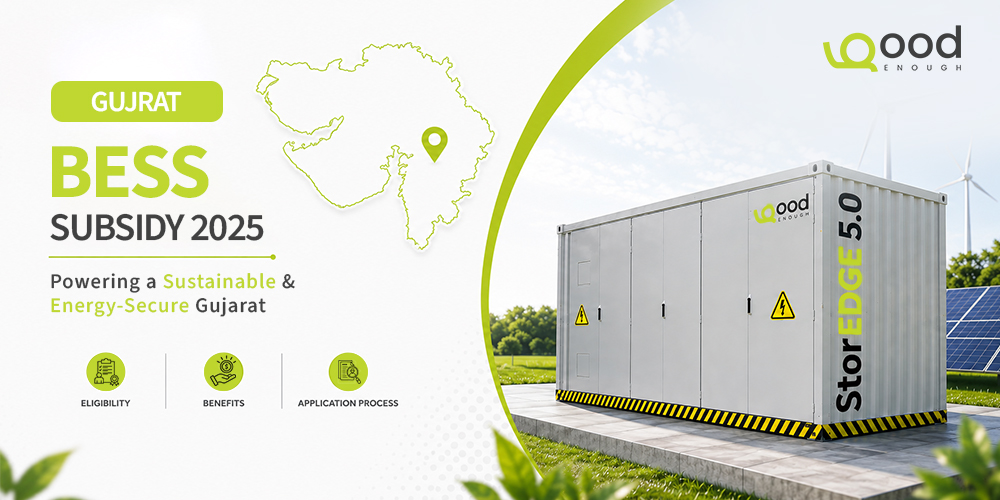
If you run an energy‑intensive plant in the state, understanding the solar battery subsidy Gujarat 2025 landscape can unlock 20 – 40% savings on your storage investment over the project life. While Gujarat remains India’s rooftop solar leader, the subsidy picture for Battery Energy Storage Systems (BESS) is a mix of central schemes, state‑level solar policy benefits and indirect incentives under the BESS subsidy India 2025 framework.
In this guide, we break down every relevant battery storage government scheme Gujarat industries should know, how the VGF BESS scheme Gujarat works, and a practical, step‑by‑step path to actually availing these benefits without getting stuck in paperwork.
BESS subsidy Gujarat 2025: quick overview
- Gujarat’s current solar policy (2021) runs till 31 December 2025 and sets the framework for rooftop and open‑access solar for commercial and industrial users.
- There is no separate Gujarat‑only capex subsidy dedicated purely to behind‑the‑meter industrial BESS as of 2025; instead, industries benefit through solar policy incentives plus central BESS subsidy India 2025 schemes.
- Central schemes like the Viability Gap Funding (VGF) for BESS and PM Surya Ghar indirectly support battery storage adoption, while GEDA acts as the state implementing agency.
This means your strategy in 2025 is less about chasing a single cheque for “solar battery subsidy” and more about combining the right central and state levers for your Gujarat facility.
What BESS subsidy options are available in Gujarat 2025?
For industrial and commercial consumers, the solar battery subsidy Gujarat 2025 ecosystem is essentially four buckets: central BESS support, rooftop solar incentives, state policy benefits and Make in India manufacturing schemes.
- Central VGF BESS scheme (grid‑scale / utility / aggregators)
- The Ministry of Power’s VGF scheme offers up to 40% of capital cost as viability gap funding for eligible BESS projects from 2023 – 24 to 2025 – 26, with disbursement up to 2030 – 31.
- A 2025 update pegs practical support around 30% of capex or about ₹46 lakh/MWh, whichever is lower, reflecting quickly falling storage costs.
- PM Surya Ghar rooftop solar scheme (mainly residential, but relevant for company housing)
- PM Surya Ghar: Muft Bijli Yojana targets 1 crore rooftop solar homes by FY 2026 – 27 and allows battery‑integrated rooftop systems to claim Central Financial Assistance (CFA).
- MNRE has explicitly clarified that rooftop solar with battery storage and hybrid inverters is eligible for CFA under this scheme.
- Gujarat Solar Policy 2021 – 25 (C&I)
- For commercial and industrial consumers, the policy allows large rooftop or ground‑mounted captive solar with benefits like surplus energy compensation and banking (with charges).
- While it does not pay a separate “BESS subsidy”, pairing solar plus BESS helps you maximise self‑consumption and value from these benefits, especially under higher banking charges for MSMEs and demand‑based consumers.
- Make in India BESS subsidy (manufacturing side)
- At the national level, Production Linked Incentive (PLI) and related schemes support domestic advanced chemistry cell and BESS manufacturing, indirectly lowering landed prices for Gujarat buyers.
- When you choose Make in India BESS vendors aligned with these schemes, the benefit flows to you via more competitive project pricing rather than a direct end‑user grant.
In short, industrial units in Gujarat tap solar storage incentives through tariff, policy and central VGF support, rather than a single state cheque labelled “GEDA solar battery subsidy” for factories.
How the VGF BESS subsidy Gujarat works for industrial buyers
The VGF BESS scheme Gujarat is part of the national BESS subsidy India 2025 program, administered by the Ministry of Power as a central sector scheme.
Core structure of the VGF BESS scheme
- Scheme period: Approvals in FY 2023 – 24 to 2025 – 26, with fund disbursement milestones stretching up to 2030 – 31.
- Support level: Up to 40% of BESS capital cost, though practical caps have been tightened to around 30% or ₹46 lakh/MWh in 2024 – 25 allocations.
- Disbursement: Released in five tranches linked to project milestones like financial closure, COD and successful operation over three years.
For a Gujarat industrial consumer, this typically plays out in two ways:
- You contract with a DISCOM / SECI / private developer who builds a grid‑scale or community BESS under the VGF scheme and passes part of the benefit via a competitive storage or round‑the‑clock (RTC) power tariff.
- Large energy‑intensive groups may participate in tenders via group captive or special vehicles, using VGF to make storage‑backed power competitive against diesel or pure solar.
In both cases, you are not filing a VGF application yourself as a small or mid‑size plant but you absolutely should factor VGF‑backed storage tariffs into your long‑term power sourcing strategy for Gujarat.
Can you claim BESS subsidy in Gujarat for existing rooftop solar?
Many Gujarat industries already have rooftop solar and are now exploring whether adding BESS in 2025 can get them any incremental subsidy.
- For residential systems, MNRE has clarified that rooftop solar with battery storage and hybrid inverters is eligible for Central Financial Assistance under PM Surya Ghar, including existing systems that are upgraded within scheme rules.
- For industrial and commercial rooftops, there is no dedicated central or GEDA subsidy exclusively for retrofitting batteries on existing systems as of 2025; benefits remain mostly in the form of energy arbitrage, demand management and improved use of existing solar.
However, if your plant participates in a DISCOM or third‑party program where your rooftop plus BESS are aggregated into a larger grid‑supporting project under the VGF BESS scheme, part of that project may indirectly benefit from central battery storage government schemes.
What subsidies are available for solar battery storage in Gujarat in 2025?
For industrial and commercial buyers, the solar battery subsidy Gujarat 2025 picture is about stacking multiple mechanisms:
- Policy‑driven value: Gujarat Solar Policy’s provisions for captive solar, surplus energy compensation and banking where BESS helps you capture more of the value on‑site.
- Tariff benefits from VGF‑backed projects: Lower effective cost of storage‑backed power from projects that use BESS subsidy India 2025 funds.
- Residential plus housing: Company townships, worker housing and executive residences using PM Surya Ghar with battery‑ready rooftop systems.
This makes BESS a strategic capex: not only do you hedge peak tariffs and outages, you also future‑proof your facility for upcoming time‑of‑day tariffs, grid support programs and V2G/V2B use cases that are expected under India’s evolving storage framework.
How to apply for BESS subsidy in Gujarat through GEDA
GEDA is the state‑level nodal agency implementing MNRE and state solar schemes, and its processes are critical when you structure a solar battery subsidy Gujarat 2025‑ready project.
1. Identify which scheme you actually fall under:
- Residential / company housing: Route is typically via the National Rooftop Solar portal or DISCOM portal under PM Surya Ghar, with GEDA and DISCOM validating installations.
- Industrial / commercial captive solar with BESS: You follow Gujarat Solar Policy 2021 – 25 processes application to DISCOM for connectivity, net‑metering / net‑billing where allowed, and approvals under GEDA’s implementing framework.
- Participation in VGF BESS projects: You engage with SECI, DISCOM or private tenders that are explicitly linked to the VGF guidelines, where subsidy flows to the project developer.
2. Work with empanelled or compliant vendors
For schemes where GEDA or MNRE subsidy is involved, installation must typically be through empanelled vendors who use approved modules, inverters and BoS components.
At this stage, choosing a BESS partner with pan‑India, grid‑compliant projects like our storEdge systems, deployed across multiple industrial states helps ensure your design, control strategy and documentation meet what both GEDA and DISCOMs expect from advanced storage.
3. End‑to‑end process (typical flow)
While details vary by scheme and DISCOM, most GEDA‑linked processes follow this sequence:
- Feasibility & sizing: Solar + BESS sizing based on load profile, sanctioned demand, transformer capacity and policy caps.
- Application to DISCOM / portal: Online application with technical details, single‑line diagrams and proposed interconnection scheme.
- Technical approval & inspection: DISCOM / GEDA review, field inspections and meter / protection checks.
- Commissioning & synchronization: Plant switched on, net‑metering / billing starts, and in VGF cases COD is declared.
- Subsidy or benefit claim: Uploading completion documents, photographs and commissioning reports to the relevant portal for CFA / subsidy / tariff benefit eligibility.
A BESS OEM‑integrator combination that already understands this Gujarat‑specific approval flow can save months of back‑and‑forth for your project team.
State vs central BESS subsidy Gujarat: which gives more benefit?
From an industrial buyer’s standpoint, “which pays more” is really “which combination of state and central frameworks reduces my overall cost of reliable power the most?”.
- Central VGF BESS scheme: Offers the largest direct capital support up to 30 – 40% of BESS capex at project level but is accessible mainly via grid‑scale / aggregated projects, not as a direct cheque to a single plant.
- State solar policy benefits: Gujarat’s policy up to 2025 provides structural advantages no cap on captive solar capacity, surplus energy compensation and defined banking rules where BESS amplifies the financial benefit by shifting more of your usage into low‑tariff solar hours.
For a typical Gujarat industrial or MSME unit, the highest practical benefit often comes from pairing a well‑optimised captive solar + BESS system under state policy, and where possible, sourcing part of your contracted power from VGF‑backed storage projects via DISCOM or group captive routes.
Documents needed to claim BESS subsidy in Gujarat 2025
The exact list varies by scheme and DISCOM, but if you want to be “application‑ready” for any solar battery subsidy Gujarat 2025 opportunity, have these prepared:
Project & technical documents
Detailed project report (DPR) with solar + BESS sizing, single‑line diagrams and load analysis.
OEM datasheets for modules, inverters, BESS racks, BMS and PCS meeting MNRE / BIS / CEA standards.
Grid interconnection study or protection coordination report, if required by DISCOM.
Statutory & compliance documents
- Copy of electricity bill and sanctioned load / contract demand letter.
- Factory registration / MSME certificate / GST registration for industrial applicants.
- Land / rooftop ownership proof or lease agreement, as applicable.
Implementation & verification documents
- Work order and commissioning certificates from empanelled vendor (for GEDA / PM Surya Ghar linked projects).
- Geo‑tagged photographs of the installed system; MNRE has clarified that only plant photos are needed and not necessarily with the consumer in frame.
- Net‑metering approval, synchronization report and test results as mandated by the DISCOM.
Keeping this checklist ready not only helps with formal subsidies but also speeds up financing, insurance and internal approvals for your BESS project.
Where StorEdge fits into the Gujarat BESS subsidy story
As a Make in India BESS manufacturer, our StorEdge solutions are designed to align with the technical and policy expectations behind the BESS subsidy India 2025 framework right from safety standards to grid‑support functions required in VGF‑eligible projects.
Across India, storEdge systems have been deployed for industrial peak‑shaving, solar self‑consumption and backup power, giving plants the data and performance history they need to justify BESS within boardroom RoI discussions even when direct state subsidies are limited.
In Gujarat, that translates into:
- BESS designs that maximise value from your captive solar under Gujarat Solar Policy 2021 – 25, with dispatch profiles tuned to local tariffs and banking rules.
- Architectures that can be integrated into future VGF‑backed or DISCOM aggregations, so your project is ready when grid‑service markets deepen.
Ready to claim your share of the solar battery subsidy in Gujarat?
If you are serious about leveraging the solar battery subsidy Gujarat 2025 environment for your plant, the biggest risk is not missing one scheme it is choosing a BESS design that cannot plug into tomorrow’s opportunities.
Get a free, no‑obligation “BESS Subsidy Roadmap for Gujarat” session with our StorEdge experts: we’ll map your load profile, identify which battery storage government schemes in Gujarat you can realistically benefit from, and outline a bankable project structure you can take straight to management.
To book your 30‑minute strategy call and turn policy into a real reduction in your energy cost per unit.
Q1: What is Gujarat BESS policy?
Gujarat’s BESS policy sits within the Gujarat Solar Policy 2021–25, which runs until 31 December 2025. While Gujarat does not yet have a standalone BESS-only policy, the solar framework creates strong indirect support for battery storage allowing commercial and industrial consumers to set up captive solar with no capacity cap, claim surplus energy compensation and use banking provisions. On top of this, the central government’s VGF (Viability Gap Funding) BESS scheme under the Ministry of Power applies across all states including Gujarat, offering up to 30–40% capital support for eligible storage projects. GEDA (Gujarat Energy Development Agency) acts as the state nodal agency implementing both MNRE and state-level schemes. As Gujarat prepares its next solar and storage policy beyond 2025, industries that deploy BESS now will be best positioned to plug into upcoming grid-service and time-of-day tariff frameworks.
Q2: Is there a solar battery subsidy in Gujarat?
Yes, but it works differently for residential versus industrial consumers. For residential and company housing, the PM Surya Ghar: Muft Bijli Yojana scheme provides Central Financial Assistance (CFA) for rooftop solar systems that include battery storage and hybrid inverters. For commercial and industrial units, there is no single direct GEDA cheque labelled “solar battery subsidy” as of 2025. Instead, industries benefit through three routes: the central VGF BESS scheme which supports grid-scale storage projects and passes savings via competitive tariffs; Gujarat Solar Policy incentives that make solar plus BESS financially stronger through banking and surplus compensation; and Make in India pricing benefits from PLI-backed domestic BESS manufacturers. Choosing a compliant, empanelled BESS vendor such as StorEDGE systems by GoodEnough Energy ensures your project qualifies under whichever scheme applies to your facility.
Q3: Who can apply for BESS subsidy in Gujarat?
Eligibility depends on which scheme you are applying under. Here is a quick breakdown:
- Residential consumers and company townships eligible for PM Surya Ghar CFA when installing rooftop solar with battery storage through empanelled vendors via the national portal or DISCOM
- Commercial and industrial (C&I) units eligible for Gujarat Solar Policy 2021–25 benefits when setting up captive solar plus BESS; no separate direct cash subsidy but significant tariff and banking advantages apply
- Large industrial groups and developers can participate in VGF BESS tenders floated by SECI, DISCOMs or private aggregators, where the subsidy flows to the project developer and benefits pass through via competitive storage tariffs
- MSMEs qualify under both state policy and central schemes; MSME certificate is one of the key documents required for GEDA and DISCOM applications
In all cases, your BESS installation must use approved components meeting MNRE, BIS and CEA standards, and must be commissioned through an empanelled or compliant vendor.
Q4: What industries benefit most from BESS in Gujarat?
Any industry with high electricity bills, diesel gensets, peak demand penalties or captive solar will see a strong return from BESS. The highest-benefit sectors in Gujarat specifically are:
- Textiles and dyeing units: continuous process loads with heavy peak demand charges; BESS directly cuts demand penalties and stabilises power quality
- Chemical and pharma plants: critical processes cannot tolerate interruptions; BESS provides instant backup and eliminates production losses from grid fluctuations
- Ceramics and glass manufacturers: energy-intensive kilns benefit from load shifting and solar self-consumption maximisation
- Cold chain and food processing: refrigeration loads run 24/7; BESS ensures uptime while cutting ToD tariff exposure
- Hospitals and healthcare: patient safety requires zero-interruption power; StorEDGE replaces diesel backup with silent, maintenance-free LFP storage
- IT parks and commercial real estate: demand penalty reduction and common area cost savings deliver fast payback periods
Across all these sectors, pairing captive rooftop solar with a StorEDGE BESS system under Gujarat Solar Policy 2021–25 typically delivers 20–40% reduction in effective cost per unit over the project life.