
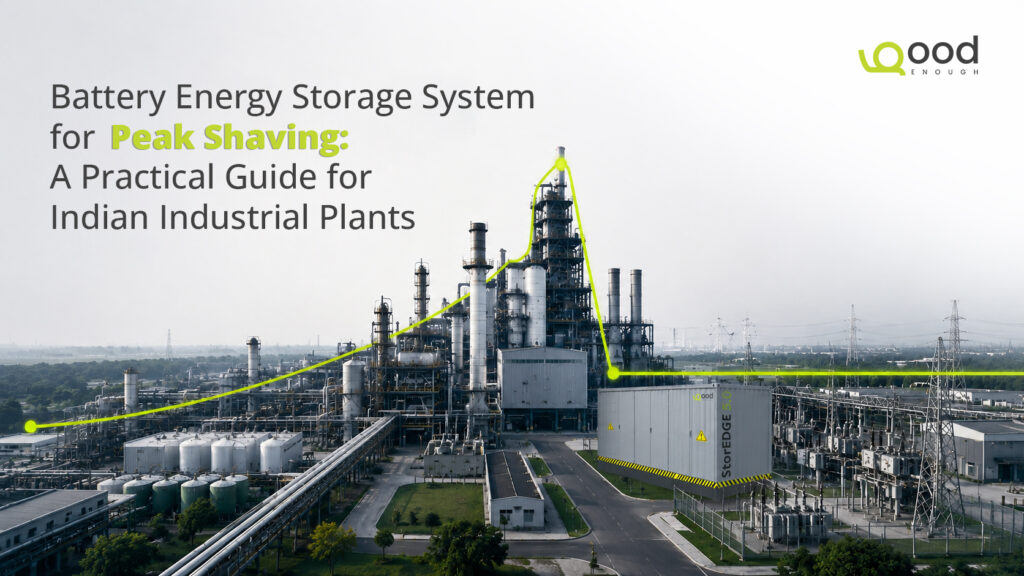
BESS peak shaving is becoming one of the most effective ways for Indian industrial facilities to reduce electricity costs and improve energy efficiency. If your electricity bill seems unreasonably high even during periods of lower production, demand charges are often the reason. By storing energy during low-demand periods and discharging it during load spikes, a battery energy storage system can significantly reduce maximum demand charges and deliver measurable cost savings.
How factory owners and plant managers can cut demand charges by 20–40% using battery storage without disrupting operations.
If your electricity bill seems unreasonably high even in months when production was slow, a closer look at your demand charges will tell you why. This is where a battery energy storage system for peak shaving becomes one of the most financially impactful investments an Indian industrial facility can make today. By storing energy during low-demand periods and discharging it precisely when your plant’s load spikes, BESS directly reduces the peak kilowatt figure on which your distribution company bases its highest tariff charges.
What Is Peak Shaving and Why Does It Hit Industrial Businesses Hard?
Peak shaving is the practice of flattening a facility’s electricity demand curve, specifically cutting the short, intense spikes that push your measured maximum demand (MD) to its highest point in a billing cycle. Most Indian DISCOMs charge HT industrial consumers not only for energy consumed (kWh) but also for the maximum demand recorded during the month, typically measured in kVA or kW over a 15- or 30-minute interval.
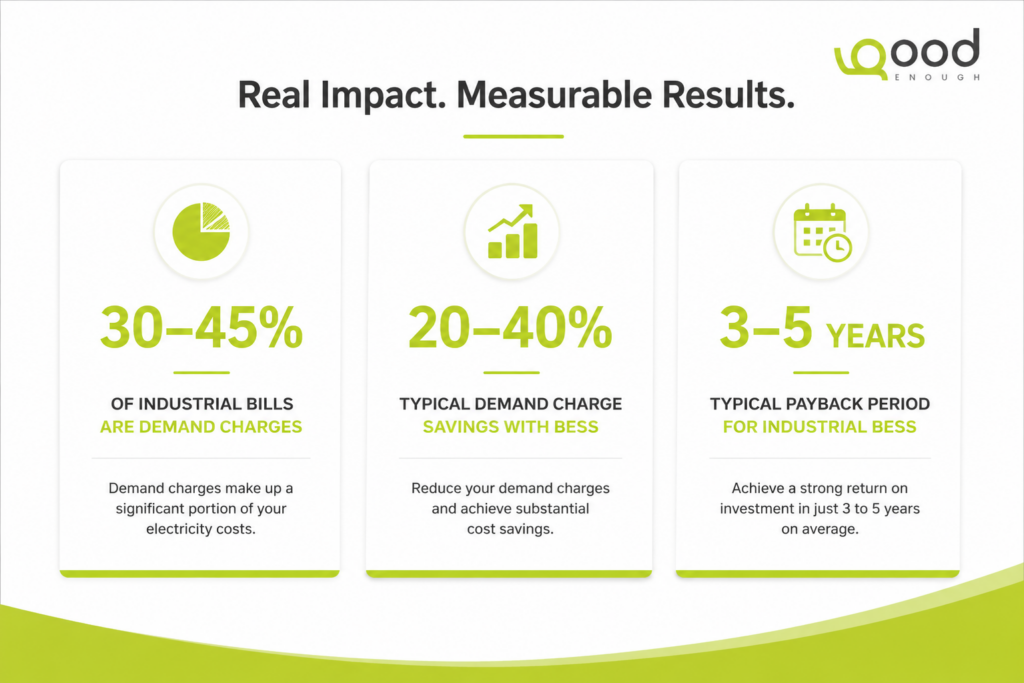
A single 20-minute surge perhaps when multiple motors start simultaneously, or when a chiller and a compressor happen to run together can set your MD for the entire month. You pay the demand tariff rate against that peak even if it occurred just once. For large manufacturing plants in Gujarat, Maharashtra, or Tamil Nadu, this demand charge component can account for 30–45% of the total electricity bill.
How a Battery Energy Storage System for Peak Shaving Works
A battery energy storage system for peak shaving works in a deceptively simple way. The system continuously monitors your plant’s real-time power draw. When demand approaches a pre-set threshold say 85% of your contracted MD the BESS automatically starts discharging stored energy into your internal grid. This supplements the power drawn from the DISCOM, keeping your measured demand below the spike threshold.
During off-peak hours, when grid tariffs are lower and plant demand is moderate, the battery recharges. The cycle repeats every day, automatically, without requiring manual intervention from your energy or operations team.
To better understand the fundamentals of battery storage technology and its role in modern energy management, explore the International Energy Agency’s overview of grid-scale energy storage
Key components of an industrial BESS for peak shaving
A properly designed battery energy storage system for peak shaving in an industrial context typically includes lithium iron phosphate (LFP) battery modules, a bidirectional inverter, an energy management system (EMS) with demand forecasting capability, and a protection and monitoring panel. EMS is the brain that decides when to charge, when to discharge, and at what rate, based on your plant’s load profile and DISCOM tariff structure.
Key Insight
LFP chemistry is the preferred choice for industrial peak shaving applications in India due to its thermal stability, 10,000+ cycle life, and suitability for daily charge-discharge cycling without significant degradation.
Industrial Sectors in India That Benefit Most from Peak Shaving BESS
Not every facility has the same demand profile, and peak shaving economics vary accordingly. The sectors where a battery energy storage system for peak shaving delivers the strongest return on investment are those with predictable, recurring demand spikes.
- Textiles and spinning mills
Ring frames and processing equipment draw heavy load during startup sequences. A BESS holds the measured demand from breaching the billing threshold each time these machines are switched on a common occurrence during shift changes.
- Pharmaceutical and chemical plants
Reactors, autoclaves, and HVAC loads often coincide with other equipment, creating sharp demand peaks. Energy storage for factories in this segment offers a clean, reliable way to manage these spikes while maintaining strict process continuity.
- Cold storage and food processing
Compressor loads in refrigeration systems are among the most aggressive demand creators. A battery energy storage system for peak shaving is particularly well-suited here because compressor cycling is predictable, making EMS algorithms highly effective.
- Automotive component manufacturers
Press shops, robotic welding cells, and paint shop exhausts create simultaneous load surges. Combined with solar integration, a BESS load management system provides these facilities with both demand charge reduction and daytime energy cost savings.
Demand Charge Reduction: Understanding the Financial Case
Let’s put numbers to it. Assume a mid-sized manufacturing plant in Gujarat with a contracted maximum demand of 1,000 kVA and a DISCOM demand tariff of ₹400 per kVA per month. If peaks can be shaved by 150 kVA consistently, the monthly saving is ₹60,000 or ₹7.2 lakh per year from demand charges alone. Add the arbitrage benefit of charging during off-peak hours and discharging during peak-tariff hours, and the total annual saving for a well-sized BESS installation can exceed ₹12–18 lakh for a plant of this scale.
This is why demand charge reduction is the primary financial driver for industrial BESS adoption in India, not backup power or energy arbitrage alone. With BESS costs having fallen significantly over the past four years, payback periods for industrial peak shaving projects now typically range from three to five years.
Integrating BESS with Your Existing Solar Setup
Many industrial facilities in India already have rooftop or ground-mounted solar installations. Adding a battery energy storage system for peak shaving to an existing solar system significantly improves its financial performance. During the day, excess solar generation can charge the BESS instead of being curtailed or exported at low rates. The stored energy is then deployed during evening peak-demand windows precisely when grid tariffs are highest and solar generation has ended.
This solar-plus-storage model is increasingly viable for HT industrial consumers, especially in states like Gujarat and Rajasthan with high solar irradiation and progressive open access regulations. The combination delivers on two fronts: lower per-unit energy cost through solar, and lower demand charges through BESS peak shaving.
What to Look for When Evaluating a BESS Solution for Peak Shaving
When your energy team or management reviews proposals for a battery energy storage system for peak shaving, several factors matter beyond just the battery capacity and cost.
The accuracy of the EMS demand forecasting algorithm is critical. A system that miscalculates your load curve will either fail to shave peaks in time or discharge the battery unnecessarily early, leaving it depleted when the real spike arrives. Ask vendors for references from similar industrial facilities and request actual demand charge reduction data, not projected figures.
Warranty terms on battery degradation are equally important for industrial BESS. Look for guarantees on capacity retention typically 80% of rated capacity over a defined number of cycles or years. A system cycling daily in peak shaving service will complete 300+ cycles per year; cycle life warranties matter far more here than in occasional backup applications.
Finally, ensure that the BESS provider understands your DISCOM’s tariff structure in detail. The demand interval length (15-minute vs 30-minute blocks), time-of-day tariff windows, and any applicable reactive power surcharges all affect how the EMS should be configured to maximize your demand charge reduction.
Getting Started: Steps for Industrial Decision-Makers
Implementing a battery energy storage system for peak shaving in your plant does not require an overhaul of your existing electrical infrastructure. The process typically begins with a load profile analysis your energy manager or an external consultant reviews 12 months of DISCOM demand data to identify peak patterns, their timing, duration, and frequency. This analysis forms the basis for sizing the BESS correctly in terms of both power (kW) and energy (kWh).
From there, a detailed financial model compares installation cost against projected demand charge savings and energy arbitrage benefits over a 10-year horizon. Most industrial BESS projects are now structured as EPC (Engineering, Procurement, and Construction) contracts or, increasingly, as Energy-as-a-Service (EaaS) arrangements where the provider bears the capital cost and the facility pays a fixed monthly fee lower than its current electricity bill.
If your plant has a significant demand charge burden typically above ₹5 lakh per month a battery energy storage system for peak shaving warrants serious evaluation as part of your energy cost reduction strategy for the years ahead.
Ready to see what peak shaving could save your plant?
Share your last 3 months of electricity bills for a no-obligation demand charge analysis. Most industrial facilities we assess find savings opportunities they hadn’t previously quantified.