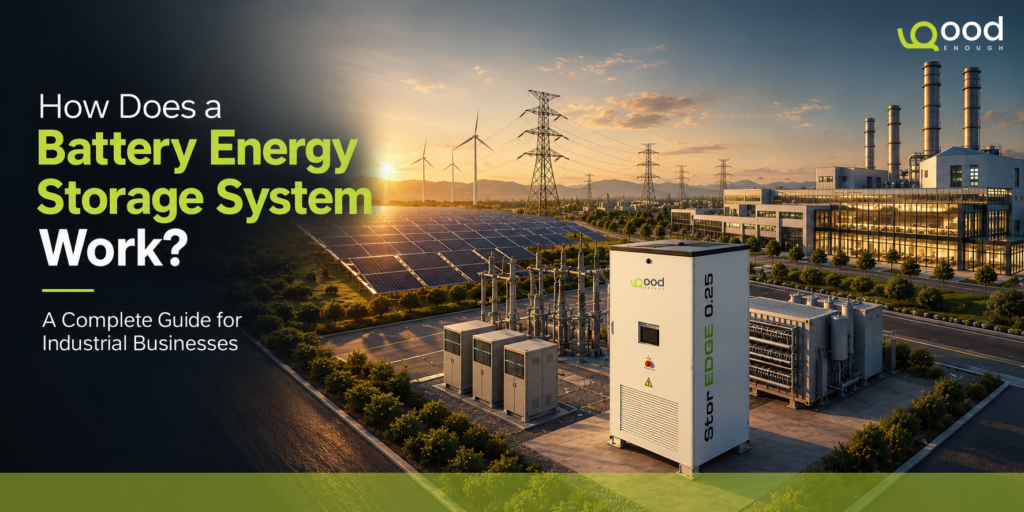
How does a Battery Energy Storage System work? It’s one of the most common questions industrial businesses ask before investing in energy storage. Understanding how a Battery Energy Storage System works can help factories reduce electricity costs, improve power reliability, maximize solar energy utilization, and minimize dependence on diesel generators. This guide explains the complete working of a Battery Energy Storage System (BESS), its key components, and why it is becoming an essential technology for Indian industries.
What Is a Battery Energy Storage System?
Before we get into the mechanics, let’s define what a BESS actually is. A Battery Energy Storage System, or BESS, is essentially a large-scale battery installation that stores electrical energy for later use. Think of it as a giant rechargeable battery for your factory except instead of powering a phone or laptop, it powers heavy machinery, HVAC systems, production lines, and critical backup loads.
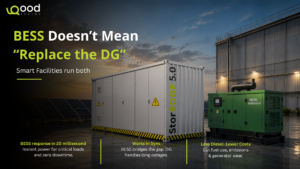
Unlike a diesel generator, which burns fuel to create power on demand, a BESS stores power that has already been generated either from the grid during off-peak hours or from a renewable source like solar and releases it exactly when you need it. That’s the fundamental difference, and it’s what makes battery energy storage cleaner and, over time, more cost-effective than conventional backup power.
For Indian manufacturers, this matters more than it might seem at first glance. Diesel gensets require ongoing fuel procurement and maintenance, plus emissions that draw growing scrutiny under environmental compliance norms. A BESS, by contrast, has no combustion and minimal moving parts.
How Does a Battery Energy Storage System Work? The Core Process
Now let’s answer the central question directly. The process can be broken into three simple stages: charging, storing, and discharging and understanding each one makes the rest of the technology far less intimidating.
Step 1: Charging the System
The BESS draws electricity from a source typically the grid, a solar array, or both during periods when power is cheap, abundant, or otherwise underutilized. For a factory with rooftop or ground-mounted solar panels, this often means charging during peak sunlight hours when solar generation exceeds immediate consumption needs. For facilities without solar, charging can happen during off-peak grid hours when tariffs are lower.
Step 2: Storing the Energy
Once charged, the energy is stored in the battery cells, usually lithium-ion in modern industrial installations until it’s needed. This is the part that trips people up when they first try to picture the process, because it seems almost too simple. But the real engineering complexity lives in the Battery Management System (BMS), which continuously monitors cell temperature, voltage, and state of charge to keep the system safe, efficient, and long-lasting.
During storage, the BMS also performs cell balancing ensuring no individual cell is overcharged or undercharged relative to its neighbors. Left unmanaged, this imbalance is a leading cause of premature battery degradation, which is why industrial buyers should weigh BMS quality, not just the headline capacity figure, when evaluating vendors.
Step 3: Discharging the Power
When your facility needs power whether that’s during a grid outage, a peak-demand period, or simply to run evening operations after solar generation has dropped off the BESS discharges stored energy back into your facility’s electrical system. This happens through an inverter, which converts the battery’s stored DC power into the AC power your equipment actually uses.
The Key Components Behind the Process
To fully grasp how a battery energy storage system works in an industrial setting, it helps to understand the core hardware involved:
1. Battery Cells and Modules
These are the heart of the system, where energy is chemically stored. Industrial-grade systems typically use lithium iron phosphate (LFP) chemistry for its safety profile, thermal stability, and long cycle life, all critical factors for continuous industrial use.
2. Power Conversion System (PCS) / Inverter
The PCS manages the flow of energy in both directions converting AC to DC during charging and DC to AC during discharging. This is what allows the system to interface smoothly with your existing electrical infrastructure.
3. Battery Management System (BMS)
The BMS is the “brain” of the operation. It tracks the health of every cell, prevents overcharging or over-discharging, balances load across modules, and triggers safety protocols if anything goes out of range. A well-designed BMS is often the difference between a BESS that lasts 10-plus years and one that degrades prematurely.
4. Energy Management System (EMS)
The EMS is the software layer that decides when to charge, when to discharge, and how to optimize the system for cost savings, backup readiness, or both. For industrial applications, the EMS can be programmed to respond to time-of-day tariffs, demand charges, or solar output patterns automatically.
5. Thermal Management and Enclosure
Since batteries generate heat during operation, industrial BESS units include cooling systems (liquid or air-based) and weatherproof enclosures, especially important given India’s climate variability. In high-ambient-temperature states, Rajasthan or Gujarat thermal management directly affects battery lifespan and safety, so site-specific thermal design matters as much as the battery chemistry itself.
Why Understanding How a Battery Energy Storage System Works Matters
Knowing how a battery energy storage system works isn’t just academic; it directly affects the decisions you’ll make around sizing, integration, and ROI. Here’s how the mechanics translate into real business value:
Peak Shaving and Demand Charge Reduction
Many industrial electricity tariffs in India include demand charges based on your facility’s peak power draw. Because a BESS can discharge stored energy during high-demand periods, it reduces the load your facility pulls from the grid at those critical moments directly lowering demand charges.
Backup Power Without Diesel
Because the discharge process is near-instantaneous, a properly sized BESS can seamlessly take over during grid outages, avoiding the downtime, fuel costs, noise, and emissions associated with diesel generators.
Solar Integration
For factories with rooftop or captive solar, a battery energy storage system for industries solves the classic problem of solar mismatch generation peaks at midday, but many industrial loads run into the evening or across multiple shifts. By storing midday solar output and discharging it later, a BESS extends the usable window of your solar investment. This pairing solar plus storage is increasingly the default configuration recommended for C&I facilities in India.
Grid Stability and Power Quality
Industrial equipment, especially sensitive electronics and automated machinery, can be damaged by voltage fluctuations or frequency instability. A BESS can respond within milliseconds to smooth out these fluctuations, protecting your equipment and reducing unplanned downtime particularly valuable for precision manufacturing or automated assembly lines where power quality issues cause costly, hard-to-trace defects.
Common Questions Industrial Buyers Ask About How a Battery Energy Storage System Works
Is a BESS Safe for Continuous Industrial Use?
Yes when designed with proper thermal management and a robust BMS, industrial BESS units (like those built on LFP chemistry) are engineered specifically for continuous, heavy-duty cycling, unlike consumer-grade batteries. LFP is favored for industrial energy storage solutions because it’s significantly more thermally stable than older lithium-ion chemistries.
How Long Does the Charge-Discharge Cycle Take?
This depends entirely on system sizing and your facility’s load profile. Some industrial systems are designed for daily full cycles (charge in the morning, discharge through the evening), while others are configured for shorter, more frequent cycles to manage peak shaving with battery storage throughout the day.
Does a Battery Energy Storage System Work With Existing Electrical Infrastructure?
In most cases, yes. A BESS is designed to integrate with your facility’s existing switchgear and electrical panels through the PCS, though a site assessment is typically needed to confirm compatibility and sizing.
What’s the Difference Between C&I and Utility-Scale BESS?
Commercial and industrial (C&I) systems are sized for a single facility’s load typically in the hundreds of kWh while utility-scale systems, sized in the megawatt-hour range, are built for grid-level applications like renewable integration and grid balancing. Most factories fall into the C&I category.
How Much Does a Battery Energy Storage System Cost for an Industrial Facility?
Costs vary based on capacity, chemistry, and site-specific requirements like thermal management and installation complexity. Rather than relying on generic per-kWh estimates, industrial buyers are better served by a site assessment that accounts for their actual load profile, backup requirements, and existing or planned solar capacity since these factors determine both system size and total cost.
Choosing the Right BESS for Your Facility
Once you understand the mechanics behind how a battery energy storage system works, the next step is sizing the right solution for your specific operation. This depends on factors like:
- Your facility’s peak and average power draw
- Existing or planned solar capacity
- Grid reliability in your region
- Whether your priority is cost savings, backup power, or both
- Available space for installation
- Your facility’s growth plans over the next 5–10 years
It’s also worth weighing the vendor’s manufacturing footprint and after-sales support, since a BESS is a long-term asset expected to perform reliably for a decade or more.
This is where working with an experienced BESS manufacturer matters. At GoodEnough Energy, India’s first BESS manufacturer, we design systems specifically for the realities of Indian industrial operations from the StorEDGE 0.25 (250 kWh / 125 kVA), built for commercial and industrial facilities looking to manage peak demand and integrate solar, to the StorEDGE 5.0 (5 MWh / 2.5 MVA), engineered for larger utility-scale and heavy industrial applications.
Final Thoughts
So, how does a battery energy storage system work? At its core, it’s a three-step process of charge, store, discharge supported by precision engineering in the form of battery management, power conversion, and thermal control systems. For Indian industrial businesses facing rising energy costs, unreliable grid supply, and growing pressure to integrate renewables, understanding this technology is the first step toward building a more resilient, cost-efficient operation.
The businesses that get the most value from a BESS investment tend to be the ones that go in with realistic expectations, grounded in an accurate picture of their own load profile, not just a general sense that “storage is the future.”
If you’re evaluating whether a battery energy storage system is right for your facility, the smartest next step is a proper load assessment and sizing consultation because the value of a BESS depends entirely on how well it’s matched to your actual operational needs.
Ready to explore how a battery energy storage system could work for your facility?