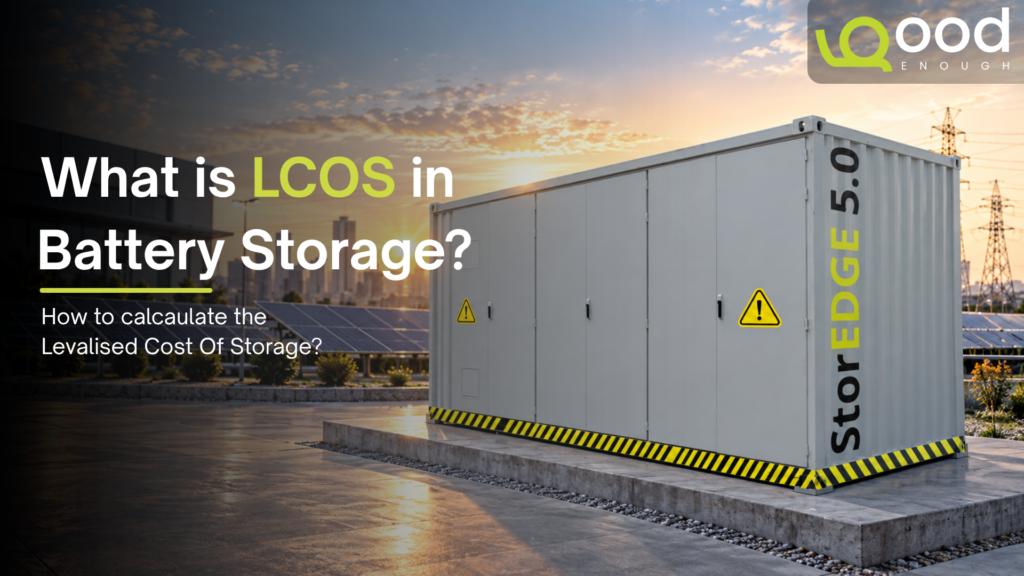
LCOS in battery storage helps businesses understand the true lifetime cost of electricity delivered by a Battery Energy Storage System (BESS). Instead of looking only at the upfront battery price, Levelized Cost of Storage considers charging electricity, efficiency losses, degradation, maintenance, replacement and financing costs.
A system may look inexpensive on a ₹/kWh CAPEX basis but become less attractive once you account for charging electricity, efficiency losses, degradation, replacement, operations and maintenance, financing and the amount of energy the battery actually delivers over its lifetime.
That is where LCOS battery storage economics becomes useful.
Levelized Cost of Storage (LCOS) measures the average lifecycle cost of delivering electricity from a storage system, generally expressed as ₹/kWh or ₹/MWh. It brings the major costs incurred throughout a BESS project’s life into one comparable metric. NREL’s methodology includes installation, maintenance, replacement, charging electricity and battery degradation, while the U.S. Department of Energy’s methodology also incorporates storage-specific costs such as augmentation and replacement.
For Indian BESS projects, LCOS is particularly useful because the economics can change significantly depending on charging tariff, storage duration, utilisation, financing structure and cycling profile.
What Is LCOS in Battery Storage?
LCOS is the discounted lifetime cost of a storage system divided by the discounted amount of electricity delivered by that system over its operating life.
In simplified form:
LCOS = Total lifetime discounted storage costs ÷ Total lifetime discounted energy discharged
The result is normally expressed as:
₹/kWh or ₹/MWh
Unlike a simple BESS price per kWh, LCOS asks a more useful question:
How much does each unit of electricity delivered by this storage system actually cost over its lifetime?
This distinction matters because two batteries with the same initial CAPEX can have very different LCOS values if one cycles more frequently, degrades faster or requires more expensive charging energy.
Why LCOS Matters More Than BESS CAPEX Alone
Understanding LCOS in battery storage helps procurement teams compare systems based on lifetime costs rather than upfront CAPEX alone. Suppose two BESS projects have similar upfront costs.
Project A operates only occasionally.
Project B cycles almost every day and has access to lower-cost charging electricity.
The second system may deliver considerably more energy over its lifetime. Its cost is therefore spread across a much larger volume of discharged electricity.
This is why procurement teams should not compare BESS systems only using ₹/kWh of installed capacity.
LCOS brings together:
- Initial CAPEX
- Financing costs
- Charging electricity
- Round-trip efficiency
- O&M
- Battery degradation
- Augmentation or replacement
- Cycle frequency
- Useful project life
- Energy actually discharged
DOE notes that LCOS is intended to capture these storage-specific lifecycle characteristics rather than treating storage like a conventional generation asset.
How to Calculate LCOS in Battery Storage?
To calculate LCOS in battery storage, divide the discounted lifetime costs by the discounted energy discharged over the project’s operating life. A more complete discounted LCOS formula can be written as:
LCOS =
Σ [CAPEX + O&M + charging cost + replacement/augmentation + other lifecycle costs] discounted over time
÷
Σ [energy discharged] discounted over time
The discount rate is important because ₹1 spent today is not economically equivalent to ₹1 spent ten years from now.
NREL’s published LCOS methodology similarly discounts lifecycle costs and discharged energy, while accounting for charging costs and end-of-life costs.
The five variables you should never ignore
When reviewing an LCOS calculation, ask for:
- CAPEX: What is included in the installed project cost?
- Charging cost: What does the project pay for the electricity used to charge?
- Throughput: How many MWh will the battery actually discharge each year?
- Degradation: How does usable capacity decline?
- Discount rate: What WACC or financing assumption is being used?
Without these assumptions, an LCOS number has limited meaning.
A Simple LCOS Calculation Example
Consider a hypothetical 1 MW / 2 MWh BESS.
This is an illustrative calculation not a GoodEnough Energy quotation or a market benchmark.
Assumptions:
| Variable | Assumption |
| BESS power | 1 MW |
| Energy capacity | 2 MWh |
| Illustrative CAPEX | ₹2.4 crore |
| Usable depth of discharge | 90% |
| Round-trip efficiency | 88% |
| Cycles per year | 330 |
| Initial degradation assumption | 2%/year |
| Project life | 15 years |
| O&M | 1.5% of initial CAPEX in Year 1 |
| O&M escalation | 3%/year |
| Charging electricity | ₹3/kWh |
| Discount rate | 10% |
The assumptions above are deliberately stated because changing them changes the result.
Step 1: Estimate annual discharged energy
Nameplate energy:
2,000 kWh
At 90% usable depth of discharge:
2,000 × 90% = 1,800 kWh per cycle
At 330 cycles:
1,800 × 330 = 594,000 kWh/year
So the first-year discharged energy is approximately:
594 MWh
The calculation then reduces annual delivered energy to reflect the assumed 2% annual degradation.
Step 2: Calculate charging energy
With an assumed 88% round-trip efficiency, more energy must be purchased for charging than is eventually delivered.
Approximately:
Charging energy = discharged energy ÷ 88%
At ₹3/kWh, charging electricity becomes a significant lifecycle cost.
Step 3: Discount the lifecycle costs and energy
Each year’s costs and discharged energy are discounted at the assumed 10% rate.
Under these assumptions, the illustrative LCOS is approximately:
₹10.1/kWh
This is not a market LCOS figure. It is the result of the stated hypothetical assumptions.
More importantly, change the charging cost from ₹3/kWh to ₹2/kWh and the illustrative LCOS falls to approximately ₹9.0/kWh. At ₹5/kWh charging cost, it rises to approximately ₹12.4/kWh.
That demonstrates one of the most important lessons in BESS economics:
The cost of the electricity used to charge the battery can materially change the cost of the electricity eventually delivered by it.
Factors Affecting LCOS in Battery Storage
1. CAPEX
Higher upfront cost generally increases LCOS.
But CAPEX should not be considered only at the battery-pack level. A complete BESS project may include PCS, transformers, EMS, thermal management, fire protection, civil works, EPC, interconnection and other balance-of-system components.
GoodEnough Energy’s BESS cost guide similarly notes that a system’s final cost depends on factors such as capacity, power rating, duration, PCS, thermal management, fire safety, grid connection, civil works and installation scope.
2. Charging electricity cost
Charging energy can be a major LCOS component.
A BESS charging from low-cost renewable or off-peak electricity has a different economics profile from one charging from expensive grid electricity.
This is particularly important in India, where tariff structures and time-of-day economics can vary by consumer category and state.
3. Round-trip efficiency
If a BESS has 90% round-trip efficiency, it cannot return all the electricity used to charge it.
The energy lost through conversion, battery operation and auxiliary systems ultimately affects the cost of delivered electricity.
Lower efficiency therefore generally increases LCOS, all else being equal.
4. Cycle frequency
A battery that delivers energy 300–350 times per year can spread its fixed investment across considerably more discharged electricity than a battery that is rarely used.
However, more cycling can also increase degradation and augmentation requirements.
The objective is therefore not simply maximum cycles.
It is economically valuable.
5. Battery degradation
Battery capacity does not remain constant indefinitely.
As usable capacity declines, the amount of electricity the system can deliver over its lifetime changes. If augmentation or battery replacement is required, those costs also need to be included in a robust LCOS model.
6. Storage duration
Duration changes the economics of a BESS.
A 1 MW/2 MWh system and a 1 MW/4 MWh system have the same power rating but different energy capacities.
Longer-duration systems can sometimes achieve lower LCOS because power-related equipment is spread across more MWh of storage capacity. A recent India-focused techno-economic study, for example, estimated lower LCOS for its 4-hour and 6-hour configurations than for its 2-hour configuration under its specific assumptions.
But this is not a universal rule. The optimal duration depends on the application, utilisation and revenue/value streams.
7. Financing cost
The discount rate can materially change LCOS.
A project financed at a lower cost of capital can have a different lifecycle economics profile from an otherwise identical project with more expensive financing.
This is one reason why quoting LCOS without stating the WACC can be misleading.
LCOS in Battery Storage in India
There is no single universal LCOS number for every BESS project in India.
Published estimates vary because their assumptions vary.
For example, the Government of India’s 2023 VGF scheme targeted an LCOS range of ₹5.50–₹6.60/kWh for supported BESS projects under the scheme’s assumptions.
More recent research produces different results.
A 2026 techno-economic study of grid-connected BESS reported baseline LCOS values of ₹5.08/kWh for a 2-hour configuration and ₹4.60/kWh for a 4-hour configuration, under its stated project and financial assumptions. Its sensitivity analysis also found CAPEX to be the strongest driver, followed by charging cost.
Mercom India’s 2026 analysis reinforces the same point from a market perspective: cell costs, project scale, storage duration, cycling profile and contract tenure are among the dominant factors influencing storage-delivered energy costs.
So if someone asks:
“What is the LCOS of BESS in India?”
the technically correct response is:
It depends on the project assumptions.
A credible LCOS number should always be accompanied by its CAPEX, charging cost, duration, cycle profile, degradation, financing and lifetime assumptions.
LCOS vs LCOE: What Is the Difference?
LCOS is often compared with (LCOE) Levelized Cost of Electricity.
They are related, but they answer different questions.
| Metric | What it measures |
| LCOE | Cost of generating electricity |
| LCOS | Cost of storing and delivering electricity from storage |
| BESS CAPEX | Upfront investment required to build storage |
| BESS tariff | Price paid under a specific procurement/contract structure |
A solar plant’s LCOE, for example, does not tell you what it costs to take electricity generated at noon, store it and deliver it during the evening.
LCOS is designed to capture that storage component.
But LCOS should not simply be added to LCOE in every solar+BESS project. The correct treatment depends on how the storage system is contracted and how energy flows through the project.
Is a Lower LCOS Always Better?
No.
A lower LCOS is generally attractive, but it does not automatically mean that the project is financially superior.
Consider two BESS projects:
- Project A: LCOS = ₹4.5/kWh
- Project B: LCOS = ₹5.5/kWh
Project B could still produce better investment returns if it has access to higher-value services, better utilisation, stronger contracted revenues or more favourable operating conditions.
This is why LCOS should be evaluated alongside:
- Revenue or avoided-cost opportunity
- Capacity payments
- Energy arbitrage value
- Peak-demand savings
- Ancillary-service revenues
- Contract tenure
- Utilisation
- Financing structure
- Replacement and augmentation requirements
Mercom’s recent Indian analysis makes this distinction particularly relevant: aggressive bidding can produce contracted prices that do not necessarily reflect the full underlying lifecycle economics of storage projects.
How Should Businesses Use LCOS When Evaluating BESS?
A practical BESS evaluation should follow this sequence:
1. Define the application
Is the system being used for:
- Peak shaving?
- Solar shifting?
- Backup?
- Energy arbitrage?
- Renewable integration?
- Grid services?
2. Define the operating profile
Estimate:
MW × hours × cycles/year
rather than evaluating the battery only by its MWh nameplate.
3. Establish the charging source
Identify whether the battery will charge from:
- Solar
- Grid
- Off-peak electricity
- A combination
4. Build the lifecycle model
Include:
CAPEX + charging + O&M + degradation + augmentation/replacement + financing + end-of-life costs
5. Calculate LCOS
Calculate the discounted cost per discounted MWh discharged.
6. Compare LCOS with the value created
Finally ask:
What is the value of each delivered kWh to this particular project?
For a C&I facility, that could be avoided demand charges or peak electricity costs. For a renewable project, it could be the value of shifting generation into higher-value periods. For a grid-scale project, multiple revenue streams may need to be stacked.
The Limitation of LCOS
LCOS is useful, but it is not a complete investment model.
It does not by itself tell you:
- whether a project will make money;
- what the project’s IRR will be;
- how much revenue a BESS can earn;
- whether a specific tariff will be attractive;
- whether a particular BESS should be 2, 4 or 6 hours;
- whether storage is better than every alternative flexibility option.
It is best treated as a lifecycle cost metric within a wider techno-economic model.
That distinction becomes increasingly important as India’s BESS market moves from pilot projects toward competitive procurement and large-scale deployment.
What LCOS Means for India’s BESS Market
India’s storage market is moving toward a more sophisticated economic question.
The discussion is no longer simply:
“How much does a battery cost?”
It is becoming:
“How much does useful stored electricity cost over the life of the asset?”
That shift matters for developers, EPCs, DISCOMs, C&I consumers and procurement teams.
As project sizes increase and bidding becomes more competitive, a BESS with a low headline CAPEX may not necessarily be the lowest-cost system over its operating life.
The better comparison is based on:
CAPEX → charging → efficiency → degradation → cycling → augmentation → financing → delivered MWh → LCOS
For anyone evaluating BESS in India, that is the economic chain worth understanding.
GoodEnough Energy’s broader BESS Cost in India guide can be used alongside this article when evaluating the components that make up project CAPEX.
If you are assessing BESS for an industrial, commercial or renewable-energy application, the next step is to model LCOS against your actual load profile, tariff structure and required operating duration rather than relying on a generic market number.