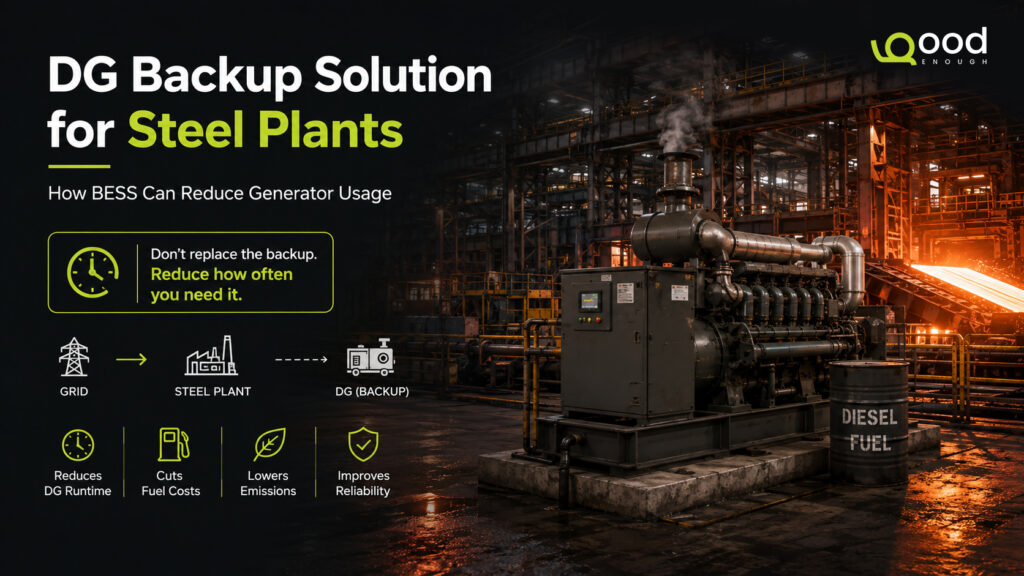
Every steel plant manager knows the disruption a grid trip, voltage dip or scheduled load-shedding event can cause. For decades, the standard DG backup solution for steel plants has been to keep diesel generators ready to cover the gap. But as fuel costs, operating requirements and power-quality demands change, relying on DG for every interruption is becoming harder to justify.
This article looks at why the conventional DG backup solution for steel plants is becoming an expensive habit, and how Battery Energy Storage Systems (BESS) are changing that equation. You’ll learn where diesel generators still fall short, how battery storage responds faster and cheaper, and what a realistic transition path looks like for an Indian steel or rolling mill operation.
Why Steel Plants Depend on Diesel Generators
Steel production is unforgiving of interruptions. A furnace that loses power mid-melt can solidify material inside the vessel, causing hours of cleanup and lost output. Rolling mills lose product quality if motor speed drops even briefly. Because of this, plants have historically over-invested in DG capacity rather than risk a single unplanned stop. Government data shows that electricity supply and reliability remain important considerations for industrial consumers. Ministry of Power – Government of India
Three factors reinforce this pattern:
- Grid supply in many industrial clusters is still inconsistent, especially during peak summer load.
- Captive DG capacity is easy to procure and quick to install.
- Plant engineers trust DG technology because it has run this way for 30+ years.
The Hidden Costs of DG-Based Backup
The problem isn’t whether diesel generators work. They do. The problem is what they cost once you account for the full picture, not just the fuel bill.
Diesel generators burn fuel even during their few seconds of startup lag, when plant loads are already unsupported. Maintenance costs climb with running hours. Emissions compliance is tightening under state pollution control board norms, and many industrial clusters now cap DG runtime hours. On top of that, diesel price volatility makes budgeting for backup power a moving target every quarter.
How BESS Improves DG Backup for Steel Plants
A battery-based DG backup solution for steel plants doesn’t try to out-diesel diesel. It changes the response profile entirely. Where a generator needs seconds to start, synchronize, and ramp up, a BESS responds in milliseconds because it’s already online, sitting at a partial state of charge, ready to discharge.
At GoodEnough Energy, we have observed that plants pairing BESS with existing DG infrastructure don’t eliminate generators outright in year one. They reduce how often those generators actually run, which is where most of the savings appear.
Peak Shaving and Load Management
Steel plants often pay demand charges based on their highest recorded load in a billing cycle. A BESS can discharge during that peak window, shaving the demand spike without starting a generator at all. This alone can lower monthly demand charges meaningfully for a plant running induction furnaces or rolling motors on a variable load profile.
Instant Response vs Diesel Generator Startup Lag
The startup lag on a diesel generator, typically 10 to 30 seconds, is exactly when sensitive equipment like furnace controllers and PLC-driven rolling lines are most vulnerable. A BESS bridges that gap instantly, holding the load steady until the generator is ready or the grid recovers. This turns a DG backup solution for steel plants from a reactive fix into a layered, faster-responding system.
Financial and Operational Benefits of Adding BESS to a DG Backup Solution for Steel Plants
The table below compares diesel-only backup with a hybrid BESS-DG approach across the factors that matter most to plant operations teams.
| Factor | DG-Only Backup | BESS + DG Hybrid |
| Response time | 10–30 seconds | Under 20 milliseconds |
| Fuel cost exposure | High, tied to diesel prices | Reduced, fewer running hours |
| Maintenance frequency | Tied to engine running hours | Lower, fewer DG cycles |
| Emissions | Ongoing diesel combustion | Reduced diesel combustion |
| Peak demand charge reduction | Not addressed | Directly addressed via peak shaving |
| Noise and local air impact | Present during every start | Minimal |
Key operational benefits worth highlighting:
- Fewer DG starts reduce wear on engines and cut unplanned maintenance visits.
- Lower fuel spend frees up working capital that would otherwise go to diesel procurement.
- Compliance headroom under state DG runtime restrictions, since the battery covers short outages independently.
- Quality protection for furnace and rolling processes that are sensitive to even brief voltage dips.
The engineering team at GoodEnough Energy typically sizes the battery to cover short-duration events and peak shaving, while the DG fleet remains as a deeper reserve for extended outages. This layered design keeps upfront investment proportional to what a plant actually needs.
Implementation Roadmap: Moving from DG-Only to a Hybrid DG Backup Solution for Steel Plants
Transitioning doesn’t require ripping out existing DG assets. Most plants take a phased path:
- Load audit — Identify which loads genuinely need instant backup (furnace controls, PLCs, safety systems) versus which can tolerate a short DG start delay.
- Right-size the battery — Match BESS capacity to peak shaving needs and critical-load ride-through time, not total plant load.
- Integrate controls — Configure the battery to discharge automatically during grid disturbances and peak demand windows, with DG sets as backup layer.
- Monitor and adjust — Track DG running hours and demand charges over two to three billing cycles to validate savings before scaling further.
Sizing Considerations for Different Plant Types
An induction furnace unit has different ride-through needs than a rolling mill or a finishing line. Furnace loads are typically continuous and power-dense, so battery sizing leans toward higher discharge power for shorter duration. Rolling and finishing operations, by contrast, often need longer ride-through to complete a batch safely, which shifts sizing toward higher energy capacity. A plant-specific load profile, not a generic template, should drive this decision.
Conclusion
A DG backup solution for steel plants isn’t going away, and it shouldn’t. Diesel generators still have a role as deep reserve for extended outages. But relying on them for every voltage dip and short interruption is an expensive, slow, and increasingly regulated way to run a plant. Battery storage closes the response gap that diesel can’t, cuts running hours, and gives plant managers a backup system that reacts before production is ever at risk.
Key Takeaways
- Traditional DG backup solutions for steel plants respond in seconds, not milliseconds, leaving critical loads exposed during startup lag.
- BESS can absorb short outages and demand peaks instantly, reducing how often generators actually need to run.
- Peak shaving with battery storage directly lowers demand charges, a cost DG-only backup never addresses.
- A hybrid BESS-DG approach reduces fuel spend, maintenance frequency, and emissions without abandoning existing DG infrastructure.
- Sizing should follow a plant-specific load audit, not a generic capacity template.