Every plant head we meet asks the same question first. Does adding battery storage mean the generator goes away? BESS doesn’t mean “replace the DG” and that single misunderstanding causes more delayed storage decisions than any real technical concern. In this article, you will learn how battery storage and diesel generators actually work together, why full DG replacement is rarely the right engineering choice, and how a hybrid backup architecture cuts diesel consumption without leaving critical loads exposed during extended outages.
BESS Doesn’t Mean “Replace the DG”: What This Actually Means
The phrase captures a simple engineering reality. A battery energy storage system handles instant, short-duration power needs. A diesel generator handles sustained, long-duration backup. These are two different jobs, not competing solutions for the same job, and confusing them leads to poor procurement decisions.
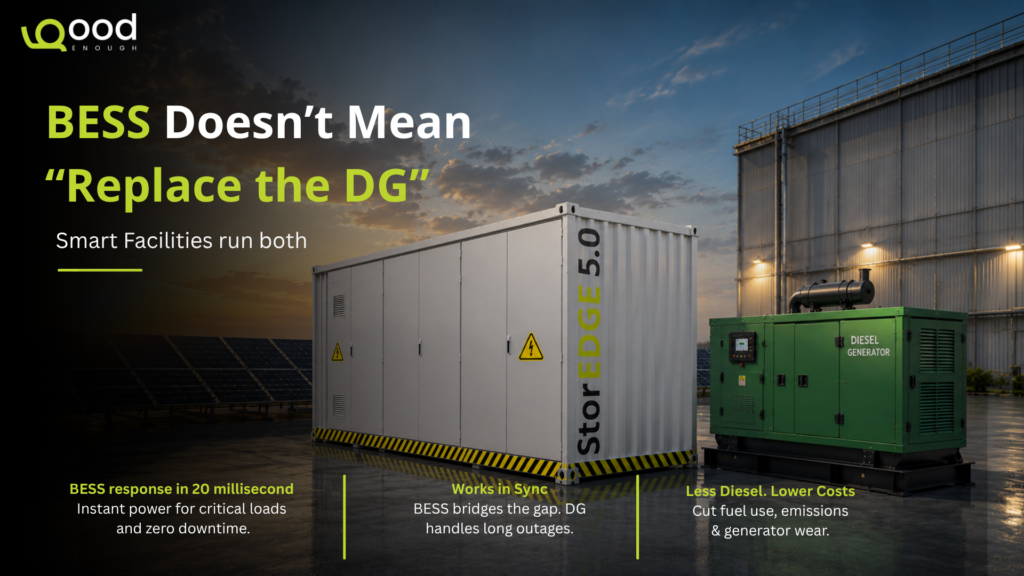
Our BESS reacts in 20 milliseconds. That speed matters because it closes the gap the moment grid power fails, before sensitive equipment even registers a dip. A diesel generator, by contrast, needs anywhere from 10 to 30 seconds to start, stabilize, and pick up load.
That gap is exactly where BESS earns its value. It is not there to out-run the generator over an eight-hour outage. It is there to make sure nothing goes dark, or trips, while the generator wakes up and comes online.
Why BESS Doesn’t Mean “Replace the DG” During Short Outages
Consider a printing press, a CNC machine, or a hospital ICU. A voltage sag lasting even a few cycles can corrupt a batch run, trip a sensitive drive, or interrupt life-critical equipment. Diesel simply cannot respond that fast, and it was never engineered to.
Battery storage closes that window instantly. Once the generator ramps up and stabilizes, the battery hands load back over, recharges quietly, and stands ready for the next event. This is not generator replacement. This is generator support, engineered around physics rather than marketing claims about total diesel elimination.
BESS Doesn’t Mean “Replace the DG”: Why Full Replacement Rarely Makes Sense
Some vendors pitch total diesel elimination as an achievable goal. In practice, this ambition ignores three real-world constraints that every energy manager eventually runs into.
1. Battery capacity is finite, and diesel fuel is not.
A battery bank sized for typical daily cycling would need to be dramatically oversized to cover a six-hour grid outage. That oversizing raises capital cost far beyond what the reliability gain actually justifies.
2. Regulatory and insurance requirements often mandate generator backup.
Regulatory and reliability requirements can still require backup generation. In critical healthcare facilities, for example, government guidelines emphasize uninterrupted power and emergency backup systems. The Ministry of Health and Family Welfare’s guidelines outline requirements for emergency power and backup for critical areas. [Read the Ministry of Health & Family Welfare guidelines on healthcare power backup].
3. Diesel remains the most energy-dense backup option per rupee of capital spent.
For rare, extended outages, a right-sized generator is still the most economical way to guarantee many continuous hours of power delivery.
Callout: Think of it this way BESS doesn’t mean “replace the DG,” it means retiring the DG’s least efficient job: the frequent, short, expensive starts that wear it down and burn fuel for no meaningful benefit.
Where the Diesel Generator Still Wins
| Scenario | Better Suited To |
| Outage under 2 minutes | BESS |
| Voltage sag or frequency fluctuation | BESS |
| Planned load shifting / peak shaving | BESS |
| Outage beyond the battery’s rated duration | DG |
| Extended grid failure (multi-hour) | DG |
| Statutory or insurance-mandated backup | DG |
This is precisely why the smartest facilities never choose one over the other. They design a hybrid system where each asset does the job it is genuinely good at, and nothing more.
BESS Doesn’t Mean “Replace the DG”: How the Hybrid System Actually Works
A well-engineered hybrid setup follows a clear operating sequence. Understanding this sequence is the fastest way to see why BESS doesn’t mean “replace the DG” in any realistic industrial setting.
- Grid failure is detected. The BESS controller senses the loss of utility power within milliseconds, far faster than any mechanical system could react.
- The battery picks up the load instantly. There is no flicker, no equipment trip, and no data loss on connected systems.
- The diesel generator starts automatically. This happens in parallel, not only after the battery has already begun discharging.
- Load transfers to the generator once stable. The battery steps back gracefully, begins recharging, and returns to standby duty.
- The battery resumes its daily duties. Peak shaving, demand charge reduction, and power quality correction continue exactly as before.
Reducing Diesel Consumption Without Removing the Generator
The financial case for this architecture is often stronger than a pure backup argument alone. Diesel generators are notoriously inefficient at partial load, and they are especially wasteful during frequent short starts triggered by brief outages or minor fluctuations.
By absorbing short outages and voltage events before they reach the generator, the battery removes the majority of start-cycles a facility experiences in a typical month. Fewer starts mean less fuel burned at low efficiency, longer intervals between maintenance visits, and a meaningfully longer generator service life overall.
The team at GoodEnough Energy has observed this pattern across manufacturing clients repeatedly: facilities that pair a right-sized BESS with existing diesel infrastructure report diesel run-hours dropping by 40 to 70 percent, even though the generator itself is never removed from site or decommissioned.
Real-World Applications Where BESS and DG Work Together
Different industries lean on this hybrid model for different reasons, but the underlying logic stays remarkably consistent across sectors.
- Manufacturing plants: Protect sensitive automation and CNC lines from micro-outages while keeping the DG for extended, shift-critical backup power.
- Hospitals and healthcare facilities: Bridge the transfer gap for life-support equipment, with diesel still mandated for extended statutory backup duration.
- Data centers: Use battery storage for instantaneous ride-through, with generators sized for multi-hour outages per uptime tier requirements.
- Commercial buildings and hotels: Reduce demand charges daily through peak shaving while retaining diesel for rare, extended grid failures.
- Cold storage and warehousing: Protect refrigeration compressors from damaging restart cycles that a brief outage would otherwise trigger.
GoodEnough Energy designs its StorEDGE systems specifically around this coexistence model, rather than positioning battery storage as a blunt diesel replacement product. The engineering approach starts with real outage-duration data gathered from the actual site, not generic assumptions.
Sizing Philosophy: BESS Doesn’t Mean “Replace the DG,” It Means Right-Sizing Both
Getting the hybrid balance right depends on a handful of site-specific inputs that vendors sometimes skip over.
- Average outage duration and frequency recorded over the past 12 to 24 months of operation.
- Critical load profile a clear picture of what absolutely cannot lose power, even for a moment.
- Existing generator capacity and age, since older units often benefit the most from reduced cycling stress.
- Daily peak-shaving potential, which determines whether the battery pays for itself through demand charge savings alone.
This is where the idea that BESS doesn’t mean “replace the DG” becomes a genuine sizing philosophy, not just a slogan on a brochure. The battery gets sized for ride-through and daily value; the generator stays sized for worst-case duration.
Benefits and Challenges of a Hybrid BESS-DG Strategy
Benefits:
- Instant, millisecond-level protection against voltage dips and short-duration outages.
- Meaningfully lower diesel consumption and associated fuel expenditure over a full year.
- Extended generator lifespan due to noticeably fewer start-stop cycles.
- Daily financial returns through peak shaving and demand charge reduction, beyond backup value alone.
- Continued compliance with statutory and insurance-mandated backup generation requirements.
Challenges:
- Upfront capital cost for both battery capacity and integration control systems.
- Correct sizing requires real site outage data, not vendor defaults or rough estimates.
- Switchgear and controls must be engineered carefully for seamless automatic transfer between assets.
Conclusion
BESS doesn’t mean “replace the DG,” and treating it that way sets facilities up for either overspending on an oversized battery or under-protecting critical loads during long outages. The smarter path is deliberate coexistence: battery storage for instant response and daily savings, diesel generation for extended, statutory, and worst-case backup scenarios. Facilities that design around this division of labor get better protection, lower fuel costs, and a longer-lasting generator, all without gambling everything on a single point of failure.
Key Takeaways
- BESS and diesel generators solve fundamentally different problems: instant response versus sustained duration.
- BESS doesn’t mean “replace the DG” it means reducing the generator’s least efficient, most wasteful workload.
- Well-designed hybrid systems can cut diesel run-hours by 40–70% without removing the generator from site.
- Correct sizing depends on real site outage data, not generic vendor assumptions.
- Statutory and insurance requirements often mandate generator backup regardless of installed battery capacity.