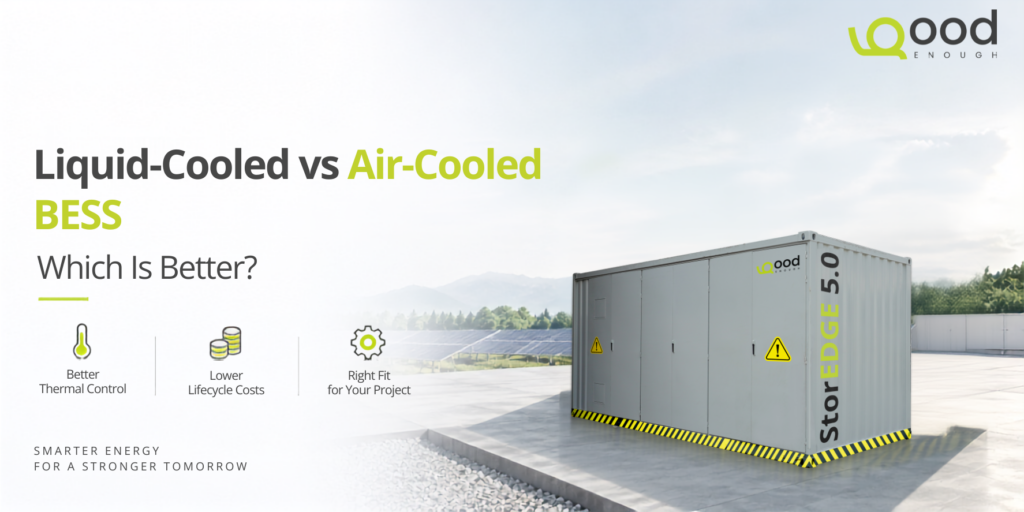
Choosing between liquid-cooled vs air-cooled BESS is not simply a choice between an older and newer cooling technology.
Both systems are designed to keep battery cells within their intended operating temperature range. The better option depends on the project’s power requirement, energy density, duty cycle, ambient conditions, available space, maintenance capability and lifecycle economics.
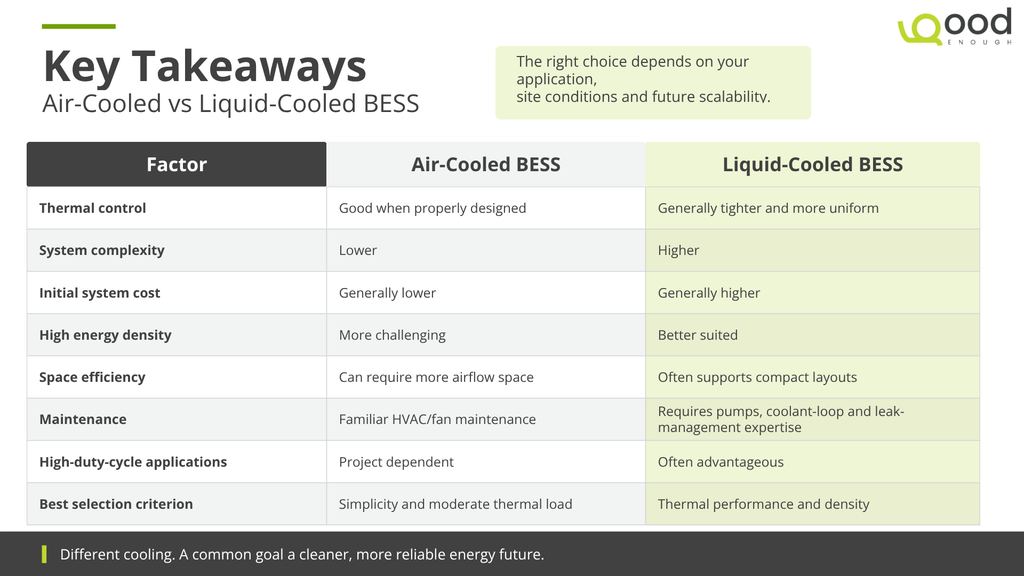
For high-density BESS applications with demanding cycling requirements, liquid cooling can provide tighter and more uniform thermal control. Air cooling can remain attractive where the thermal load is moderate and simplicity, lower initial complexity and easier servicing are priorities. Current BESS comparisons consistently identify this trade-off rather than one technology being universally superior.
For Indian projects, where outdoor equipment can face high ambient temperatures and where BESS is increasingly being deployed for renewable integration, peak management and grid-support applications, thermal management deserves to be evaluated as part of the complete system not as an isolated specification. India’s Ministry of New and Renewable Energy (MNRE) cites CEA projections of 34.72 GWh of BESS requirement in 2026–27 and 236.22 GWh in 2031–32.
What Is Air-Cooled BESS?
An air-cooled BESS uses fans, airflow paths and, depending on the design, HVAC equipment to move heat away from the battery modules.
The basic principle is straightforward: air absorbs heat from the battery enclosure and transfers that heat to a heat-rejection system.
Air cooling has several practical advantages:
- Relatively simple architecture
- Familiar maintenance procedures
- No liquid-coolant loop
- Generally lower system complexity
- Suitable for applications with moderate thermal loads
However, air has a relatively low heat-transfer capacity compared with liquids. As battery systems become more compact and power-dense, moving sufficient air through the enclosure becomes increasingly important.
Air distribution also matters. A system may have adequate average temperature while still developing temperature differences between modules if airflow is not properly distributed.
That is why buyers should not evaluate an air-cooled BESS simply by asking whether it has “air conditioning.” The important question is whether the complete thermal design can maintain the battery within its specified operating conditions under the project’s actual load profile.
What Is Liquid-Cooled BESS?
A liquid-cooled BESS transfers heat using a circulating coolant loop.
Depending on the system design, coolant passes through cold plates or other thermal interfaces positioned close to the battery modules. Heat is transferred from the battery into the coolant and then rejected through a heat exchanger or cooling unit.
The fundamental advantage is the ability to transfer significant heat through a relatively compact thermal path.
This makes liquid cooling particularly relevant to high-energy-density and high-duty-cycle BESS architectures. Current industry systems increasingly use liquid cooling for dense MWh-scale installations.
But liquid cooling is not automatically better in every application.
It introduces additional components such as:
- Pumps
- Coolant lines
- Heat exchangers
- Cooling units
- Sensors
- Expansion or reservoir components, depending on architecture
Consequently, system design, commissioning and maintenance quality become important.
Liquid-Cooled vs Air-Cooled BESS: Technical Comparison
The most useful way to compare the two technologies is to look at the factors that affect the project over its operating life.
1. Temperature Uniformity
Temperature uniformity is one of the strongest arguments for liquid cooling.
Battery cells do not all experience identical thermal conditions. Temperature differences can contribute to differences in performance and ageing between cells or modules.
A well-designed liquid cooling system can place the heat-transfer interface much closer to the battery modules, helping maintain a more uniform thermal environment.
Air cooling can also provide effective temperature management, but performance depends heavily on airflow distribution, enclosure geometry, fan performance and HVAC design.
Verdict: Liquid cooling generally has the advantage for demanding, high-density applications.
2. Energy Density and Footprint
As more energy is packed into a fixed container or cabinet, thermal management becomes increasingly important.
Air-cooled architectures need adequate airflow paths and sufficient heat-rejection capacity. This can influence rack arrangement and available usable space.
Liquid cooling can move heat through a compact thermal path, allowing system designers greater flexibility when developing high-density configurations.
This is one reason liquid cooling has become increasingly common in larger containerized BESS designs.
Verdict: Liquid cooling generally becomes more attractive as energy density increases.
3. Efficiency and Auxiliary Consumption
Cooling systems consume energy themselves.
Fans, compressors, pumps and other thermal-management equipment contribute to a BESS’s auxiliary load.
This matters because a battery system should not be evaluated solely on the energy stored inside the cells. The relevant question is how much useful energy the complete system can deliver after accounting for auxiliary consumption.
GoodEnough Energy’s own technical work on liquid-cooled BESS specifically highlights the importance of evaluating round-trip efficiency at the system level, including thermal management and auxiliary power rather than relying only on headline battery efficiency.
However, it would be misleading to claim that every liquid-cooled system automatically consumes less auxiliary energy than every air-cooled system.
The actual result depends on:
- Ambient temperature
- Cooling-load profile
- Fan and pump efficiency
- HVAC architecture
- Control strategy
- Battery chemistry
- BESS operating profile
- System size
Verdict: Compare measured system-level auxiliary consumption rather than relying on the cooling technology label alone.
4. Maintenance
Air cooling is generally simpler to understand from an O&M perspective.
Typical maintenance can include:
- Filter inspection/replacement
- Fan maintenance
- HVAC servicing
- Coil cleaning
- Airflow inspection
Liquid cooling introduces a different maintenance profile.
Operators may need to monitor:
- Coolant condition
- Pump operation
- Pipe and connection integrity
- Cooling-unit performance
- Sensors
- Potential leaks
That does not mean liquid cooling is inherently less reliable. It means that the quality of system design and O&M capability becomes particularly important.
Verdict: Air cooling has a simplicity advantage; liquid cooling requires more specialized thermal-system management.
Liquid-Cooled vs Air-Cooled BESS for India’s Climate
India should not be treated as one uniform thermal environment.
A BESS installed in a controlled indoor environment in a relatively mild climate faces different thermal conditions from an outdoor installation in a hot industrial location.
The important variables include:
- Maximum ambient temperature
- Solar exposure
- Enclosure location
- Humidity
- Dust
- Air quality
- Operating hours
- Charging/discharging intensity
- Available HVAC infrastructure
The Indian BESS market is also expanding into applications such as renewable integration, peak management and grid support. CEA and MNRE projections show a rapidly growing requirement for energy storage, increasing the importance of selecting appropriate system architectures.
For outdoor, high-density systems operating under demanding thermal conditions, liquid cooling can therefore be particularly attractive.
But climate alone should not determine the decision.
Choosing Between Liquid-Cooled vs Air-Cooled BESS
There is no universal winner.
Liquid cooling is generally worth considering when:
- The system has high energy density.
- The BESS will cycle frequently.
- Space is constrained.
- Tight temperature uniformity is important.
- The project operates under demanding ambient conditions.
- Long-duration or high-power operation creates significant thermal loads.
- The project has the O&M capability to support the cooling loop.
Air cooling can make sense when:
- Thermal loads are moderate.
- System density is relatively low.
- Space is readily available.
- Simplicity is a major project priority.
- The operating environment is suitable.
- The project owner prefers a more familiar HVAC-based maintenance approach.
The right question is therefore not:
“Is liquid cooling better than air cooling?”
It is:
“Which thermal-management architecture can maintain the required battery operating conditions at the lowest acceptable lifecycle cost for this project?”
What Should You Ask a BESS Supplier?
Cooling technology should be evaluated from the supplier’s technical documentation rather than from the marketing label alone.
Before selecting a system, ask for:
- Guaranteed operating temperature range
- Maximum ambient temperature
- Temperature difference across battery modules
- Cooling-system auxiliary consumption
- Thermal performance at the specified C-rate
- Cooling performance at maximum ambient conditions
- Cooling-system failure response
- Pump/fan redundancy
- Coolant type and replacement requirements
- Leak detection and protection
- HVAC/filter maintenance requirements
- Expected maintenance intervals
- Performance guarantees
- Battery degradation assumptions
- System-level round-trip efficiency
This is particularly important because cooling performance cannot be separated from the battery, PCS, BMS, EMS, enclosure and control strategy.
Where Does GoodEnough Energy Fit?
GoodEnough Energy’s StorEDGE portfolio uses proprietary liquid thermal-management technology and positions thermal management as part of the overall BESS architecture rather than as an isolated component.
The company’s technical material also emphasizes evaluating BESS efficiency at the system level, including thermal management and auxiliary energy consumption.
For a buyer, that distinction matters: the objective is not simply to choose liquid cooling. It is to choose a complete BESS whose thermal system, battery chemistry, controls, safety architecture and operating strategy work together for the intended application.
Conclusion
Liquid-cooled vs air-cooled BESS is ultimately a project-design decision, not a technology popularity contest.
Air cooling can offer a simpler architecture and easier servicing where thermal loads and energy density are moderate.
Liquid cooling becomes increasingly compelling when the BESS requires high energy density, tight thermal control, demanding cycling or operation in challenging thermal environments.
For Indian BESS projects, the most useful evaluation is therefore based on actual operating conditions: ambient temperature, duty cycle, power-to-energy ratio, footprint, auxiliary consumption, maintenance capability and lifecycle economics.
Rather than asking a supplier which cooling technology is “better,” ask them to demonstrate how the complete BESS performs under your project’s actual operating conditions.
If you are evaluating BESS for a commercial, industrial or renewable-energy application, GoodEnough Energy can help assess the appropriate system architecture based on your load profile and operating requirements.