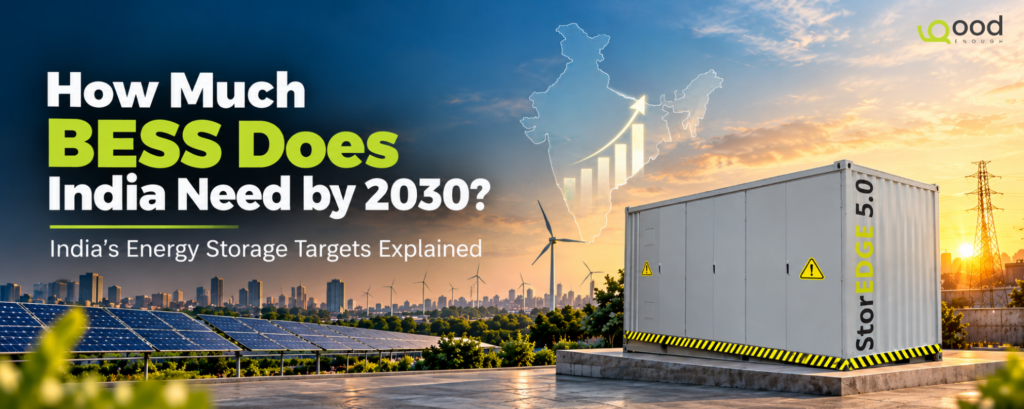
The BESS requirement in India is expected to grow significantly as the country expands its renewable energy capacity. India reached 50% of its installed electricity capacity from non-fossil fuel sources in June 2025, ahead of its original target timeline. As solar and wind generation increase, Battery Energy Storage Systems (BESS) will play an increasingly important role in storing electricity and supplying it when demand rises.
According to the Central Electricity Authority (CEA), India could require 41.65 GW / 208.25 GWh of BESS by 2029–30 and 47.24 GW / 236.22 GWh by 2031–32. These figures are planning requirements for the projected power system, rather than a single officially declared national BESS target for 2030.
But generating renewable electricity is only part of the challenge.
Solar power is strongest during the day, while electricity demand often rises later in the day. Wind output also varies with weather conditions. This creates a fundamental power-system challenge: how do you make renewable electricity available when the grid actually needs it?
That is where Battery Energy Storage Systems (BESS) become important.
According to the CEA’s National Electricity Plan (NEP), India could require 41.65 GW / 208.25 GWh of BESS by 2029-30, while the requirement rises to 47.24 GW / 236.22 GWh by 2031-32. These are planning requirements not a single government-declared “BESS target for 2030.” Central Electricity Authority
How Much BESS Does India Need?
Understanding the BESS requirement in India means looking at both battery power capacity, measured in GW, and energy storage capacity, measured in GWh. The clearest way to understand India’s BESS requirement in India is to separate battery storage from total energy storage.
| Financial year | BESS power requirement | BESS energy requirement | Total storage requirement* |
| 2026-27 | 8.68 GW | 34.72 GWh | 82.37 GWh |
| 2029-30 | 41.65 GW | 208.25 GWh | 336.40 GWh |
| 2031-32 | 47.24 GW | 236.22 GWh | 411.40 GWh |
Total includes BESS and pumped storage projects (PSP). Source: CEA National Electricity Plan and CEA’s Optimal Generation Capacity Mix study.
There is an important distinction here.
GW measures how much power a BESS can deliver at a given moment. GWh measures how much energy it can store.
For example, a 100 MW/200 MWh battery can theoretically deliver 100 MW for two hours. Therefore, saying India needs “200+ GWh of BESS” tells us much more about the amount of energy that must be shifted than simply quoting a GW figure.
The CEA’s 2029-30 study also shows that BESS requirements vary substantially across scenarios from 22.6 GW/113.1 GWh to 49.3 GW/246.9 GWh. This is another reason why a planning requirement should not automatically be presented as a fixed policy target.
Why Does India Need 200+ GWh of BESS?
India’s energy transition is increasingly becoming a timing problem.
Solar generation peaks around the middle of the day. Electricity demand, however, does not necessarily peak at the same time. Storage can absorb electricity when renewable generation is available and discharge it later.
The basic system becomes:
GENERATE → STORE → SHIFT → DISPATCH → CONSUME
The CEA’s modelling explicitly finds that storage is primarily charged during solar hours and used to meet peak demand as well as demand during late-night and early-morning periods.
This gives BESS several roles:
- Peak-demand management: discharge during high-demand periods.
- Renewable shifting: move solar-generated electricity from daytime to later hours.
- Grid balancing: respond quickly to changes in supply and demand.
- Renewable integration: make variable renewable generation more dispatchable.
- Flexibility: provide an additional resource alongside thermal, hydro and pumped storage.
- Industrial energy management: support applications such as peak-demand management, solar shifting and backup where the economics and technical configuration are appropriate.
This does not mean every renewable project needs the same amount of storage. Storage requirements depend on the generation profile, demand pattern, grid location, transmission availability and the services the project is expected to provide.
India’s BESS Requirement vs Total Energy Storage Requirement
This distinction is critical when discussing India’s energy storage requirement.
The CEA’s NEP does not expect batteries to provide all of India’s storage. It models a combination of Battery Energy Storage Systems and Pumped Storage Projects.
By 2031-32, the projected requirement is:
- 47.24 GW / 236.22 GWh BESS
- 26.69 GW / 175.18 GWh pumped storage
- 73.93 GW / 411.40 GWh total storage
Pumped storage uses electricity to move water to a higher reservoir and generates electricity later. BESS stores electricity electrochemically and can respond rapidly.
The two technologies are therefore complementary rather than interchangeable.
For India’s BESS capacity required in India, the key number is 236.22 GWh by 2031-32. For India’s broader energy storage requirement, the number is 411.4 GWh.
How Much BESS Will India Need by 2032?
The growth trajectory is significant.
The CEA projects BESS energy requirements rising from 34.72 GWh in 2026-27 to 208.25 GWh in 2029-30 and 236.22 GWh in 2031-32.
That means the requirement in 2031-32 is almost seven times the 2026-27 BESS energy requirement.
The increase reflects the scale of renewable generation being integrated into India’s electricity system. The NEP’s 2031-32 generation mix includes around 364.6 GW of solar and 121.9 GW of wind, alongside other generation sources.
Importantly, the BESS requirement should not be interpreted as “India must install 236 GWh immediately.” It is a planning requirement associated with the projected power-system configuration.
India’s Energy Storage Obligation Explained
The Energy Storage Obligation (ESO) is different from the CEA’s BESS capacity requirement.
The Ministry of Power notified an ESO trajectory that increases from 1% of electricity consumption in FY2023-24 to 4% in FY2029-30, increasing by 0.5 percentage points annually. Ministry of New and Renewable Energy
| Financial year | ESO |
| 2023-24 | 1.0% |
| 2024-25 | 1.5% |
| 2025-26 | 2.0% |
| 2026-27 | 2.5% |
| 2027-28 | 3.0% |
| 2028-29 | 3.5% |
| 2029-30 | 4.0% |
The ESO is calculated on an energy basis as a percentage of electricity consumption, rather than as a fixed national BESS capacity in GW or GWh. It is also treated as fulfilled only when at least 85% of the energy stored in the ESS annually is procured from renewable energy sources.
Therefore:
ESO ≠ India’s total BESS requirement.
One is a regulatory obligation expressed through energy consumption; the other is a system-planning estimate of how much storage capacity the power system may need.
How Is India Supporting BESS Deployment?
India is using several mechanisms to accelerate storage deployment.
The most significant financial mechanism is Viability Gap Funding (VGF). In September 2023, the government approved a ₹3,760 crore VGF scheme initially supporting 4 GWh of BESS. Falling BESS costs subsequently allowed the supported capacity to increase to 13.8 GWh within the same approved budget.
A second VGF scheme launched in 2025 supports 30 GWh through the Power System Development Fund, with a ₹5,400 crore financial support framework. Together, the two schemes cover 43.8 GWh of BESS development.
As of July 2026, the government reported that under the first scheme, 12.7 GWh had received Letters of Award, 6.54 GWh had achieved financial closure and 0.5 GWh had been commissioned. Under the second scheme, 22.43 GWh had received LoAs, 19.65 GWh had executed BESPAs and 5 GWh had achieved financial closure.
Other policy measures include procurement frameworks, participation of storage in ancillary services and transmission-charge measures intended to improve project economics.
What Does India’s BESS Requirement Mean for Businesses?
The growth in India’s BESS requirement India 2030 has implications across the electricity value chain. The projected BESS requirement in India creates opportunities for renewable energy developers, DISCOMs, commercial and industrial consumers, EPCs, system integrators and battery manufacturers.
Renewable energy developers
Storage can help renewable developers offer more controllable power profiles and participate in firm and dispatchable renewable procurement. It can also help align renewable generation with demand.
DISCOMs
For distribution companies, BESS can become a resource for peak management, renewable integration and reducing dependence on expensive power purchases during certain periods.
C&I consumers
Commercial and industrial consumers can evaluate BESS for applications including:
- Peak-demand management
- Solar energy shifting
- Backup power
- Renewable energy utilisation
- Reducing diesel dependence where technically and economically suitable
The business case, however, needs to be evaluated against electricity tariffs, load profiles, battery duration, cycling requirements, backup requirements and alternative flexibility options.
EPCs and system integrators
The market increasingly requires expertise beyond battery procurement including PCS, EMS, thermal management, protection, fire safety, grid integration and system commissioning.
BESS manufacturers
The projected requirement creates a substantial need for manufacturing capacity, system integration and long-term operations and maintenance capabilities.
For companies evaluating the technology, understanding BESS cost in India is therefore only one part of the decision. Project duration, utilisation, degradation, tariff structure and application-specific value are equally important.
The Real Challenge: Closing India’s BESS Gap
One of the biggest mistakes in discussing India’s storage market is treating every announced number as installed capacity.
There is a major difference between:
Required capacity → Awarded projects → Financial closure → Under construction → Operational capacity
India’s government-supported BESS programmes illustrate this clearly. A project can receive an award without having reached financial closure, and a project at financial closure is still not necessarily operational.
CEA also maintains periodic reports tracking the development and deployment of BESS projects in India, showing that the market is progressing through multiple project stages rather than moving directly from planning to operation.
This distinction matters because India’s BESS deployment India story is ultimately not about how large the announced pipeline becomes. It is about how quickly planned capacity becomes financially viable, constructed, commissioned and effectively utilised.
What India’s Energy Storage Outlook Means for 2030–32
India’s storage trajectory can be reduced to three numbers:
34.72 GWh → 208.25 GWh → 236.22 GWh
These represent the CEA’s BESS energy requirement for 2026-27, 2029-30 and 2031-32, respectively. Ministry of New and Renewable Energy
At the broader system level, total storage rises from 82.37 GWh in 2026-27 to 336.4 GWh in 2029-30 and 411.4 GWh in 2031-32. Central Electricity Authority
But these numbers should be read as planning signals not as a promise that every GWh will be delivered through one technology, one procurement mechanism or one market segment.
The direction is nevertheless clear: as renewable capacity grows, flexibility becomes as important as generation capacity.
Conclusion
India’s next renewable-energy challenge is not only how much clean electricity it can generate, but how much of that electricity it can make available at the right time.
The CEA’s projections indicate a BESS requirement of 208.25 GWh by 2029-30 and 236.22 GWh by 2031-32, alongside pumped storage that takes total energy storage requirements to 336.4 GWh and 411.4 GWh respectively.
That makes storage an increasingly important part of India’s electricity infrastructure not simply as a battery technology, but as a mechanism for turning variable renewable generation into more flexible, controllable and dispatchable electricity.
For businesses evaluating storage for industrial, commercial, renewable or grid applications, the question is therefore shifting from “Do we need BESS?” to “Where, how much and for what application does storage create the most value?”
If you are evaluating a BESS project, explore GoodEnough Energy’s BESS solutions or connect with the team to assess the right storage configuration for your application.