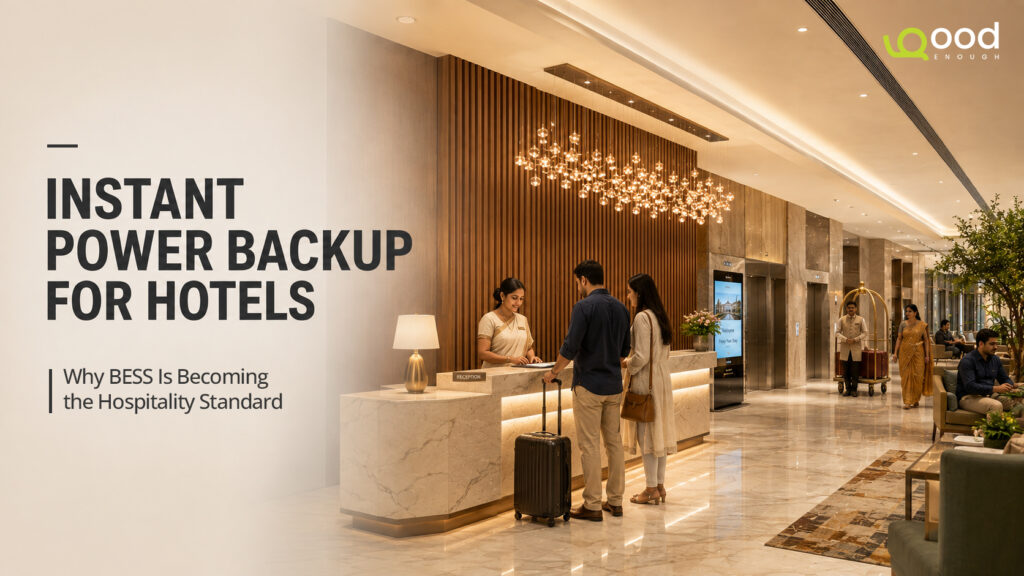
Instant power backup for hotels is becoming an important consideration for properties that need reliable electricity for critical systems during grid outages. Battery Energy Storage Systems (BESS) can provide fast-response backup while working alongside diesel generators for longer-duration power requirements.
That is why instant power backup for hotels requires more than simply having a generator on site.
A Battery Energy Storage System (BESS) can provide a fast-response layer between the grid and critical hotel loads, helping bridge the interruption while a diesel generator starts or, for appropriately sized systems and loads, providing backup for the required duration.
The important point is that BESS and diesel generators do not necessarily compete. In many hotel applications, they can perform different jobs within the same backup architecture.
What Is Power Backup for Hotels?
Instant power backup refers to a power system capable of transferring a facility’s critical electrical loads to an alternative source with very little interruption when the grid fails.
Battery systems are particularly suited to this role because power electronics can respond far faster than a conventional combustion generator.
For example, commercial BESS platforms are available with millisecond-scale transfer or response capabilities for critical applications.
This matters in a hotel because not every electrical load can tolerate the same interruption.
A short interruption may be inconvenient for lighting but more disruptive for:
- Elevators
- IT and networking equipment
- POS systems
- Refrigeration
- Building-management systems
- Security systems
- Selected HVAC equipment
The objective, therefore, is not necessarily to keep every electrical load running indefinitely.
It is to identify the loads where continuity has the highest operational value and design the backup system around them.
Why Conventional Generator Backup Has a Gap
Diesel generators remain useful for long-duration backup.
Their limitation is response time.
A generator needs to detect the outage, start its engine, reach operating conditions and connect to the electrical system. Depending on the installation, this creates a gap between grid failure and generator supply.
BESS approaches the problem differently.
The battery is already charged and connected through power electronics. When the system detects the appropriate grid condition, it can transition to battery operation much faster.
This is why modern critical-power architectures increasingly combine batteries with conventional generation rather than treating them as mutually exclusive technologies. Vertiv, for example, describes BESS systems for C&I and critical applications with millisecond-scale transfer and support for both backup and peak shaving.
BESS VS Diesel Generator for Hotels
For hotels evaluating instant power backup for hotels, the key decision is how to balance fast-response BESS capacity with longer-duration generator backup.
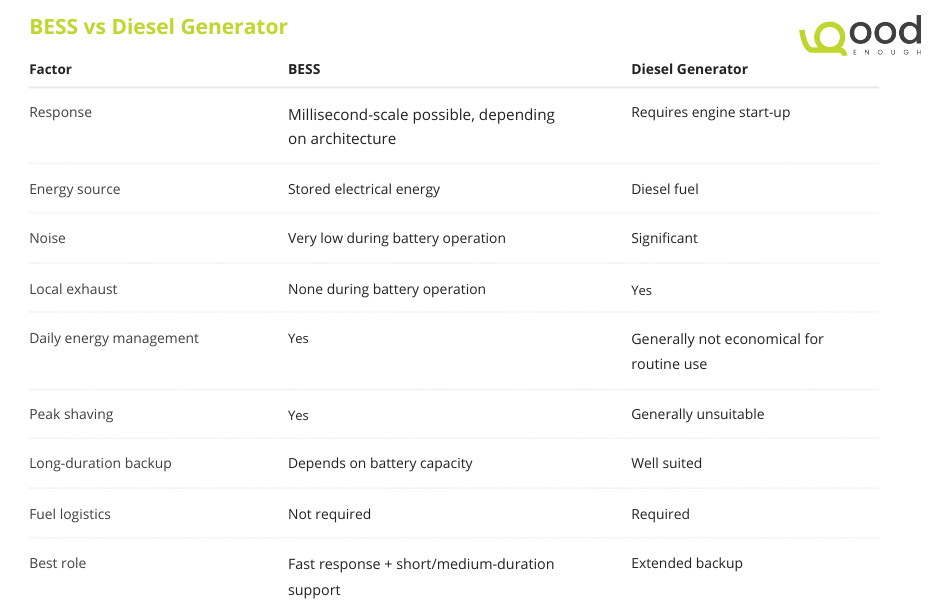
The practical answer for many hotels is therefore not BESS or DG.
It is:
BESS for fast response and energy management + DG for extended-duration backup.
How BESS Can Reduce Hotel Energy Costs
The first step in designing an instant backup system is to divide hotel loads according to their operational importance.
1. Life-safety systems
These can include systems such as emergency lighting and other electrically powered safety infrastructure that must remain available according to the applicable design and regulatory requirements.
2. Elevators
A power interruption can create an immediate guest-safety and operational issue. The required backup architecture depends on the elevator system and the property’s electrical design.
3. Refrigeration
Hotels operate kitchens, restaurants, cold rooms and refrigeration equipment. Protecting selected refrigeration loads can help prevent operational disruption and inventory losses.
4. IT and payment systems
Property-management systems, network infrastructure, point-of-sale systems and communication equipment may require continuous power or carefully designed ride-through protection.
5. HVAC
HVAC is one of the largest energy-consuming systems in hotels. BEE’s India Energy Scenario report highlights HVAC, lighting, kitchens, laundry and other services as significant contributors to hotel energy use.
However, backing up an entire hotel’s HVAC load can require substantially more inverter power and battery capacity than protecting selected critical circuits.
That is why load prioritization is important.
How to Size BESS for a Hotel
Choosing the right BESS is essential for reliable instant power backup for hotels because the system must match both the hotel’s critical power demand and required backup duration. One of the most common mistakes is sizing a battery based only on the number of rooms.
A 100-room business hotel and a 100-room resort can have very different electrical profiles.
The sizing process should start with the hotel’s actual load.
Two numbers are particularly important:
Power: kW
kW tells you how much electrical load the BESS can supply at a given moment.
For example, if your selected critical loads require 300 kW simultaneously, a 100 kW power-conversion system cannot support all of them at once.
Energy: kWh
kWh tells you how much energy is stored and therefore influences backup duration.
A simplified calculation is:
Required battery energy = Critical load × backup duration ÷ usable system efficiency
Example
Assume:
- Critical load = 250 kW
- Required backup = 30 minutes
- Simplified efficiency assumption = 90%
Energy requirement:
250 × 0.5 ÷ 0.90 = approximately 139 kWh
This is only an illustrative calculation.
Actual BESS sizing also needs to account for:
- Load variation
- Peak demand
- Battery usable state-of-charge window
- PCS rating
- Temperature
- Efficiency
- Degradation
- Required reserve
- Motor starting loads
- Future load growth
- Backup philosophy
Therefore, a hotel should not select a BESS solely from a generic “rooms-to-kWh” table.
BESS Can Do More Than Provide Backup
This is one of the biggest differences between a battery system and a conventional standby generator.
A hotel may only experience a few major outages in a month.
That means a conventional backup asset can spend most of its time waiting for an emergency.
A BESS can potentially perform other functions every day.
Peak Shaving
The battery can discharge during periods when hotel demand is high.
For example, a hotel may experience increased demand when several systems operate simultaneously:
- HVAC
- Kitchens
- Elevators
- Laundry
- Lighting
- Banquet facilities
- EV charging
A BESS can be programmed to reduce the facility’s grid demand during selected periods.
Commercial BESS platforms explicitly support peak shaving and load shifting alongside backup applications.
Load Shifting
Energy can be stored during a lower-cost or lower-demand period and used later, subject to the hotel’s tariff structure and operating strategy.
Whether this produces meaningful savings depends on the local electricity tariff, demand charges, battery efficiency, cycling costs and the hotel’s actual load profile.
Solar Integration
Hotels with rooftop or other onsite solar generation can use BESS to shift some of the generated energy to periods when solar production is lower.
That can make the storage asset useful even when the grid is operating normally.
BEE also identifies renewable integration as one of the energy-efficiency opportunities for hotels in India.
Should Hotels Replace Diesel Generators With BESS?
Not necessarily.
The right question is:
What does the hotel need the backup system to accomplish?
If the objective is:
Instant transition + critical-load protection
BESS can be highly relevant.
If the objective is:
Several hours of backup for a large proportion of the hotel
The required battery capacity can become substantially larger.
If the objective is:
Instant transition + extended outage protection
A hybrid architecture may be more appropriate.
A simplified hybrid architecture
Grid → Hotel electrical system
During normal operation:
Grid + Solar → Hotel loads + BESS charging
During a short outage:
BESS → Critical loads
During an extended outage:
BESS → Critical loads
while the:
DG → Extended-duration backup
The exact architecture depends on the electrical system, critical-load definition, required duration and local installation conditions.
BESS Safety Considerations for Hotels in India
BESS should not be treated as simply a large battery placed next to a hotel.
The project needs appropriate attention to:
- Electrical protection
- Battery management
- Thermal management
- Fire detection and protection
- Ventilation
- Equipment spacing
- Emergency access
- Isolation
- Site conditions
- Applicable electrical and fire-safety requirements
India’s BESS regulatory and standards environment is also evolving. CEA has been working on BESS technical and safety requirements, while BIS has published and is developing relevant electrical energy-storage and battery-management standards.
In September 2026, CEA also published guidance concerning training of fire-safety officials for BESS installations under the amended safety framework.
This makes safety assessment an important part of hotel BESS planning not an afterthought.
How Hotels Should Evaluate a BESS Project
Before requesting a quotation, a hotel should prepare a basic energy and electrical profile.
Ask the BESS provider to evaluate:
1. Load profile
What is the hotel’s actual demand throughout the day?
2. Critical loads
Which circuits genuinely need uninterrupted power?
3. Backup duration
Is the requirement:
- Seconds?
- 15 minutes?
- 30 minutes?
- One hour?
- Several hours?
4. Power requirement
What is the maximum simultaneous critical load in kW?
5. Existing DG system
Can BESS operate alongside the existing generator?
6. Solar generation
Is rooftop or onsite solar already installed or planned?
7. Tariff structure
Are there meaningful demand or time-based tariff opportunities?
8. Site constraints
Where can the battery system, PCS and associated equipment be installed safely?
9. Safety and compliance
What standards, approvals and site-specific requirements apply?
10. Lifecycle economics
Don’t compare only the purchase price.
Consider:
CAPEX + installation + maintenance + electricity savings + diesel savings + battery degradation + replacement assumptions + financing costs
This gives a more realistic view of project economics.
Conclusion
For hotels, instant power backup is fundamentally a power-quality and continuity problem not simply a generator problem.
BESS can address the fast-response portion of that problem by supplying selected critical loads when the grid fails. At the same time, the same system can potentially provide peak shaving, load shifting and solar integration when the grid is available.
That makes BESS different from a backup asset that sits idle until an outage.
For many properties, the most practical architecture may be a hybrid BESS + DG system: battery storage handles fast transitions and selected operational requirements, while the generator remains available for longer outages.
The right configuration, however, depends on the hotel’s load profile, critical circuits, backup duration, tariff structure, electrical infrastructure and site conditions.
GoodEnough Energy provides customized BESS solutions and energy-storage project support for commercial and industrial applications.