
Peak shaving with BESS helps industrial plants reduce electricity costs by managing short-duration periods of high power demand. By charging a Battery Energy Storage System (BESS) during lower-demand periods and discharging it when plant demand approaches its peak, facilities can reduce maximum demand and better manage demand-related electricity charges.
That creates a specific opportunity for Battery Energy Storage Systems (BESS).
Peak shaving with BESS means using a battery to supply part of the plant’s load when grid demand approaches a defined threshold, thereby reducing the facility’s recorded maximum demand. The battery can charge during lower-demand periods or from available solar generation and discharge during short periods when the plant’s power requirement rises.
The important point is that a peak-shaving BESS does not necessarily need to supply the entire factory. It only needs enough power capacity and usable energy to manage the targeted demand peaks.
What Is Peak Shaving with BESS?
Peak shaving is the practice of reducing a facility’s highest grid power demand.
Imagine a factory normally importing approximately 1,500 kW from the grid. During a production event, several large machines operate simultaneously and grid demand rises to 2,000 kW.
Instead of allowing the grid to supply the entire 2,000 kW, a BESS could discharge 400 kW during the event.
The grid would then supply approximately:
2,000 kW − 400 kW = 1,600 kW
The battery has therefore shaved approximately 400 kW from that particular demand event.
The actual financial benefit depends on how the relevant electricity tariff measures and charges maximum demand.
This distinction is important because Indian electricity tariffs are not uniform across states or consumer categories. Demand measurement intervals, demand charges, contract-demand provisions and penalties can differ by DISCOM and tariff category.
Therefore, a BESS business case should always use the facility’s actual electricity tariff rather than a generic national demand-charge assumption.
Why Maximum Demand Matters
Industrial facilities often have highly variable electrical loads.
Examples include:
- Large motor starts
- Compressors
- Pumps
- HVAC systems
- Welding equipment
- Furnaces
- Chillers
- Production-line startups
- EV charging
- Simultaneous shift-change loads
A plant can therefore have relatively stable energy consumption while still experiencing short periods of very high demand.
This is why analysing only monthly kWh consumption is insufficient when evaluating a peak-shaving BESS.
The engineering team should examine the facility’s interval demand profile and identify:
- When peaks occur
- How high they reach
- How long they last
- How frequently they occur
- Which equipment creates them
- Whether the peaks are predictable
- Whether they occur during specific tariff periods
How Does Peak Shaving with BESS Reduce Peak Demand?
A typical peak-shaving control strategy works as follows:
1. Monitor
An EMS continuously monitors facility demand and the BESS state of charge.
2. Define a demand threshold
The system establishes a target grid-import limit.
For example:
Target grid demand = 1,600 kW
3. Detect a rising load
If the plant begins drawing 1,850 kW, the EMS identifies that demand is approaching or exceeding the target.
4. Dispatch the BESS
The battery supplies the difference.
If the plant requires 1,850 kW and the target is 1,600 kW:
BESS output = 1,850 − 1,600 = 250 kW
5. Recharge
After the peak event, the BESS can recharge during an appropriate lower-demand period, subject to its operating strategy, tariff and state of charge.
The objective is not simply to make the battery discharge as often as possible. The objective is to dispatch it when doing so creates the greatest operational or financial value while maintaining appropriate battery operating limits.
Peak Shaving Is Not the Same as Backup Power
This is one of the most important considerations when sizing BESS.
A backup system may be designed to supply a critical load for a specified duration during an outage.
A peak-shaving system has a different objective.
Suppose a facility has a 3 MW maximum demand but only experiences a 500 kW peak above its desired grid threshold for 30 minutes.
The peak-shaving system does not necessarily need to be a 3 MW / several-MWh system.
It may need approximately:
Power requirement: 500 kW
Energy requirement:
500 kW × 0.5 hour = 250 kWh
Actual system sizing must then account for usable energy, efficiency, operating limits, reserve requirements and the characteristics of the load.
This illustrates why power and energy must be analysed separately.
Power rating
Determines how much load the BESS can offset at a particular moment.
Energy capacity
Determines how long the BESS can maintain that output.
For short industrial demand spikes, insufficient power capability can be just as problematic as insufficient energy capacity.
How to Size a BESS for Peak Shaving
The correct starting point is not:
“How large is the factory?”
It is:
“What does the factory’s interval load profile actually look like?”
A practical sizing process is:
Step 1: Collect interval data
Obtain historical electricity-meter data for an appropriate period, ideally covering representative production conditions.
Analyse:
- kW
- kVA
- timestamp
- maximum demand
- demand duration
- production schedule
- tariff period
Step 2: Identify recurring peaks
Separate recurring operational peaks from unusual events.
For example:
Event | Peak | Duration | Frequency |
Shift change | 1,950 kW | 15 min | Daily |
Compressor startup | 1,800 kW | 10 min | 3×/day |
Furnace operation | 2,200 kW | 45 min | 4×/week |
Exceptional production run | 2,600 kW | 20 min | Once/month |
The fourth event should not automatically determine the entire BESS size.
Step 3: Establish the target grid demand
Suppose:
- Historical peak = 2,200 kW
- Desired grid limit = 1,700 kW
Required peak reduction:
2,200 − 1,700 = 500 kW
The BESS therefore needs sufficient discharge power to provide approximately 500 kW during the relevant event.
Step 4: Determine the duration
If the 500 kW reduction is required for 30 minutes:
500 kW × 0.5 hour = 250 kWh
That is the theoretical energy delivered during the event.
The actual nameplate battery capacity will need to be higher depending on usable state-of-charge window, conversion losses, thermal conditions, degradation allowance and the required operating reserve.
Example: Peak-Shaving Economics
Consider a hypothetical industrial facility.
Assumptions
- Existing recorded demand: 2,000 kW
- Target demand after BESS: 1,600 kW
- Demand reduction: 400 kW
- Applicable demand charge: ₹X per kW per month
- Recurring qualifying peak: 30 minutes
The monthly demand-charge saving would conceptually be:
400 kW × ₹X/kW/month
For example, if the applicable demand charge were ₹300/kW/month:
400 × ₹300 = ₹1,20,000/month
Annual demand-charge saving:
₹1,20,000 × 12 = ₹14,40,000/year
Important
The ₹300/kW figure above is only a calculation assumption, not a national Indian tariff.
Actual economics must use the applicable tariff order for the facility’s:
- State
- DISCOM
- Consumer category
- Voltage level
- Contract demand
- Demand-measurement mechanism
- Applicable tariff period
This is why a BESS ROI calculation based only on a generic “Indian industrial tariff” can be misleading.
What Makes a Plant a Good Candidate for Peak Shaving?
BESS tends to be more interesting when a facility has:
Frequent peaks
Repeated demand events provide more opportunities for the battery to create value.
Short-duration peaks
A battery can be particularly useful when high-power events last for relatively short periods.
Predictable load patterns
If the EMS can anticipate when demand will rise, battery dispatch can be planned more effectively.
High demand-related costs
The larger the financial impact of maximum demand, the greater the potential value of reducing it.
Limited operational flexibility
If production cannot simply be rescheduled, BESS can provide another mechanism for controlling grid demand.
Existing solar
Solar can potentially provide an additional charging source, allowing excess generation to be stored and used later when plant demand rises.
When BESS May Not Be the First Solution
A battery should not automatically be the first intervention.
Consider lower-cost measures first where appropriate.
Load scheduling
Staggering the startup of compressors, pumps or other large loads may prevent simultaneous demand peaks.
Power-factor correction
If poor power factor is increasing apparent power demand, correcting the underlying electrical issue may reduce kVA demand without installing storage.
Equipment efficiency
Replacing inefficient motors, compressors or other equipment can reduce both energy consumption and peak load.
Process optimisation
Production sequencing can sometimes eliminate demand spikes without additional hardware.
The strongest BESS projects therefore do not necessarily begin with:
“We need a battery.”
They begin with:
“We need to understand what is causing our maximum demand and determine the most economical way to control it.”
Solar + BESS for Peak Demand Management
Solar and BESS can complement each other, but they solve different problems. The Ministry of New and Renewable Energy (MNRE) also recognises energy storage applications such as peak shifting, energy arbitrage, grid stability and renewable-energy integration.
Solar primarily generates electricity when solar irradiance is available.
The plant’s highest demand may occur at another time.
A BESS can bridge this mismatch by storing available energy and dispatching it later.
For example:
Midday
Solar generation > immediate site requirement
→ surplus energy can potentially charge BESS.
Later peak period
Site demand increases
→ BESS discharges
→ grid import is reduced.
This makes solar + BESS particularly relevant where the plant has both significant solar generation and recurring later-day demand.
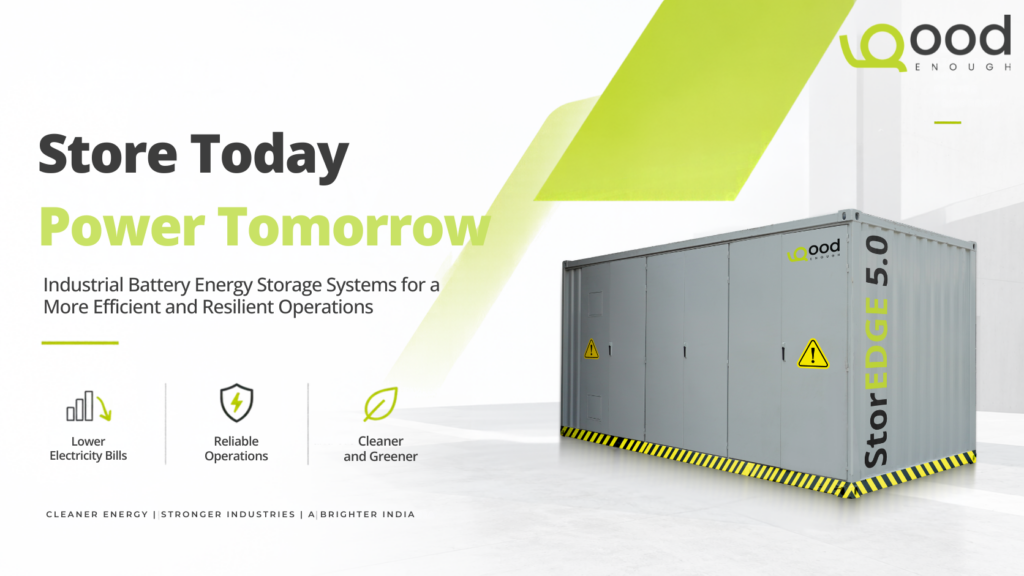
GoodEnough Energy’s StorEDGE portfolio is positioned for applications including peak-demand reduction and renewable-energy optimisation. StorEDGE 5.0, for example, is listed as a 5 MWh / 2.5 MVA system with peak-demand reduction functionality based on real-time load monitoring and automated dispatch.
Why the EMS Matters
The battery is the physical asset, but the Energy Management System determines when and how it is operated.
For peak shaving, the EMS can monitor parameters such as:
- Real-time site demand
- Maximum demand
- BESS state of charge
- Solar generation
- Grid conditions
- Tariff periods
- Load behaviour
- Dispatch limits
The control strategy should balance:
Demand reduction + battery availability + operating limits + financial value
An overly aggressive strategy may discharge the battery too early and leave insufficient energy for a later, more valuable peak.
A conservative strategy may fail to capture available savings.
GoodEnough Energy’s industrial EMS material describes monitoring of real-time consumption, maximum demand, solar generation, BESS state of charge, grid conditions, ToD tariffs and equipment loads as inputs for energy management.
A Practical Checklist Before Buying a Peak-Shaving BESS
Before requesting a BESS quotation, collect:
- 12 months of electricity bills where available
- Interval meter data
- Maximum recorded demand
- Contract/sanctioned demand
- Applicable tariff order
- Demand-charge calculation method
- Peak occurrence times
- Peak duration
- Production schedule
- Existing solar capacity
- Existing DG capacity
- Critical loads
- Desired peak-demand threshold
- Available electrical infrastructure
- Site constraints
Then ask the BESS supplier to provide:
- Recommended power rating
- Recommended energy capacity
- Expected operating profile
- Annual cycling assumptions
- Demand-charge savings methodology
- Battery degradation assumptions
- Round-trip efficiency assumptions
- EMS strategy
- Backup capability, if required
- CAPEX/OPEX and payback calculation
The most useful proposal is therefore not simply:
“Here is a 1 MWh battery.”
It is:
“Here is why this power and energy rating matches your load profile, tariff and operating objective.”
Real-World BESS Applications for Peak Load Shaving
Peak shaving is already being applied across different types of facilities in India. Two GoodEnough Energy deployments illustrate how BESS can be configured around different operational requirements.
Power Distribution Utility — Saket, Delhi
At a power distribution facility in, New Delhi, rising peak electricity demand was increasing demand charges. GoodEnough Energy deployed a 115 kVA / 232 kWh cabinet-style BESS to support peak load management and energy arbitrage. The project documentation reports reduced peak demand through intelligent load management and reduced peak-load pressure on the distribution network.
Textile Manufacturing Unit Nagpur, Maharashtra
At a textile manufacturing facility in Nagpur, Maharashtra, peak electricity demand was driving up power costs alongside energy-arbitrage and backup requirements. GoodEnough Energy deployed a 375 kVA / 783.6 kWh cabinet-style BESS. The documented benefits include peak-load optimisation, energy-cost optimisation and reliable power continuity.
These projects show why BESS sizing should be based on the facility’s load profile, peak duration, required demand reduction and operating requirements, rather than selecting a battery based only on total facility load.
Conclusion
Peak shaving with BESS can give industrial plants another way to manage maximum electricity demand without changing every production process around the plant’s electricity bill.
But the business case depends on more than battery capacity.
The key variables are:
Load profile + demand tariff + peak duration + required demand reduction + BESS power + usable energy + EMS strategy + project cost.
A plant with short, recurring demand spikes may require relatively high battery power but comparatively modest energy capacity. Another facility with longer peak periods may need substantially more stored energy.
That is why the first step should always be load-profile analysis, followed by tariff-specific financial modelling and technical sizing.
For industrial facilities evaluating whether BESS can reduce their electricity costs, the objective should not simply be to install storage. It should be to install the right amount of storage for the right operating problem.
Ready to evaluate peak shaving for your facility?