Electricity costs in India keep rising, while grid reliability is still a daily concern for many factories, warehouses, and commercial buildings. A battery energy storage system with solar is fast becoming a practical solution for industrial businesses that want to control energy costs and avoid production downtime.
By combining rooftop or ground‑mounted solar with an intelligent solar battery storage system, industrial plants can use more of their own clean energy, cut diesel generator use, and maintain stable operations even when the grid is unstable. This is where GoodEnough Energy’s industrial‑grade BESS solutions come in.
Why Indian Industries Need Smarter Energy Management
Indian industries are under pressure from multiple directions:
- Rising electricity tariffs and time‑of‑day (ToD) charges
- Unreliable grid power, with frequent voltage dips and outages in many regions
- Increasing diesel costs and maintenance headaches from running DG sets
- Peak demand penalties that inflate monthly bills
- A constant need for uninterrupted industrial operations
Traditional solar alone reduces day‑time grid consumption, but it cannot solve evening peak tariffs, sudden outages, or night‑shift loads. Without a battery energy storage system with solar, most factories still depend heavily on the grid and diesel during their most critical hours. That is why industrial solar energy storage is now a strategic priority rather than a “nice to have.”
How Solar and Energy Storage Work Together
In simple terms, a battery energy storage system with solar combines three core elements:
- Solar panels that generate electricity during the day.
- Battery packs that store excess solar energy when generation is higher than consumption.
- Smart inverters and control systems that decide when to charge, discharge, or draw from the grid.
During sunny hours, solar supplies your running loads first. Any surplus power charges the batteries instead of being wasted or exported at low tariffs. Later, the stored energy is used during peak demand hours, night shifts, or when there is a grid outage. This solar plus battery storage approach turns your plant into a cleaner, smarter and more resilient power user.
How the System Works in Industrial Facilities
For an Indian factory or warehouse, the working of a battery energy storage system with solar can be understood in a simple step‑by‑step flow:
- Daytime solar generation
Solar panels feed power directly into your plant loads, reducing the kWh you buy from the grid. - Battery charging
When solar generation is higher than real‑time demand, the BESS charges automatically, building up solar energy storage for factories. - Energy storage
The commercial battery energy storage system holds this energy, ready for use whenever your plant needs it most. - Evening and night‑time usage
During evening ToD peaks or night shifts, stored energy is discharged to cut grid draw and manage demand charges. - Backup during outages
If the grid fails, the system can instantly support critical loads, either independently or in coordination with a smaller, more efficient DG run. - Peak load management
When your load spikes—for example, when multiple heavy machines start together—the battery provides short bursts of power, shaving peaks and protecting your contract demand.
This is industrial solar energy storage in action: simple, automated, and fully aligned with factory realities.
Key Benefits for Industrial Businesses
A well‑designed battery energy storage system with solar delivers clear business benefits:
- Lower electricity bills
- Reduced diesel generator dependency
- Run gensets fewer hours and at higher efficiency.
- Cut fuel, maintenance, and noise.
- Peak demand charge reduction
- Discharge batteries during monthly peak intervals.
- Avoid demand penalties and transformer overloads.
- Uninterrupted operations
- Protect critical processes, cold rooms, IT and safety loads during grid disturbances.
- Better solar utilization
- Store surplus solar instead of curtailing or exporting at low prices, improving the effective yield of your plant.
- Improved ROI on solar investment
- Higher self‑consumption plus ToD optimization shortens overall payback compared to solar‑only projects.
Industries Seeing the Highest Impact
A battery energy storage system with solar is relevant across many sectors, but the impact is especially strong for:
- Textile factories – continuous processes and high motor loads where outages and voltage dips cause material loss.
- Manufacturing plants – automotive, engineering, packaging and FMCG units with energy‑intensive machinery.
- Warehouses – large roofs for solar plus long‑hour lighting and material handling loads.
- Cold storage facilities – refrigeration that must never fail; solar battery storage systems help maintain temperature and protect inventory.
- Hospitals – critical medical equipment and HVAC that require seamless power, with DGs used more sparingly.
- Commercial buildings and malls – elevators, HVAC and lighting with high ToD tariffs.
- Data centers – extremely high cost of downtime and strong push for renewable integration.
Each of these segments gains differently some focus on cost savings, others on reliability, many on both.
Battery Energy Storage System with Solar vs Solar‑Only Systems
Comparing solar‑only systems with a battery energy storage system with solar makes the value very clear:
- Energy availability
- Backup reliability
- Solar‑only: depends on grid or DG for backup.
- Solar plus battery storage: instantly supports critical loads during grid failures.
- Solar utilization efficiency
- Solar‑only: excess energy often curtailed or exported cheaply.
- Solar + BESS: captures and uses a higher percentage of generated solar on‑site.
- Dependence on grid electricity
- Solar‑only: still highly dependent on grid tariffs and reliability.
- BESS with solar: offers greater independence and price control.
ROI and Cost Savings from Battery Energy Storage System with Solar
For industrial users in India, the ROI of a battery energy storage system with solar typically comes from four buckets:
- Peak shaving savings – using stored energy to flatten your load curve and avoid expensive peak tariffs.
- Reduced DG fuel costs – every unit supplied from batteries instead of diesel cuts fuel, servicing and lubricant costs.
- Lower grid dependency – less exposure to future tariff hikes and surcharges.
- Optimised solar investment – higher solar self‑consumption and better alignment with your load profile improve overall payback.
With careful sizing and control, many industrial projects can achieve attractive payback periods while also improving reliability and ESG performance.
Real‑World Industrial Use Case in India
Consider a mid‑sized manufacturing plant in India running two shifts with a 500 kW rooftop solar plant. Solar alone cuts day‑time bills, but the plant still pays high ToD tariffs in the evening and runs DG sets during frequent outages.
After deploying a battery energy storage system with solar, the plant now charges batteries from excess mid‑day solar and discharges during evening peaks and outages. This reduces monthly grid consumption, lowers diesel run hours, and stabilizes production. Similar modeled projects in India have shown grid import reductions of up to 25–30% and significant improvement in solar utilization when BESS is added.
Future of Battery Energy Storage System with Solar in India
India’s industrial energy transition is accelerating with strong policy support and renewable energy targets. According to the Ministry of New and Renewable Energy (MNRE), India continues to expand its clean energy infrastructure to improve energy security and reduce dependence on fossil fuels.
For factories, this means a shift from reactive energy buying to proactive energy management. A battery energy storage system with solar will be at the heart of future “energy‑independent” industrial campuses that can run reliably even when the grid is stressed.
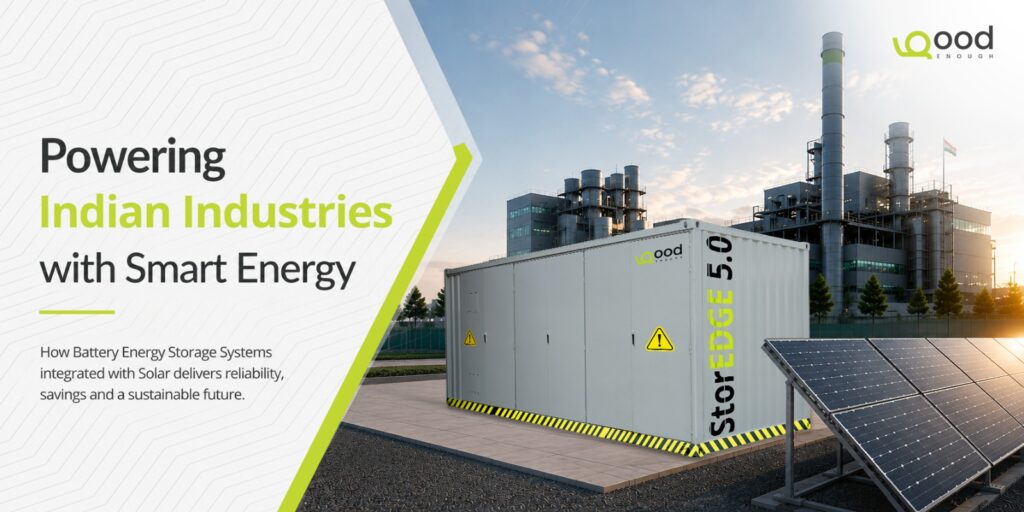
GoodEnough Energy Solutions: StorEdge0.25 and StorEdge 5.0
GoodEnough Energy offers modular, industry‑ready BESS platforms designed specifically for Indian industrial and commercial users:
- StorEdge0.25 – ideal as a building block for smaller plants, warehouses, and critical process lines that need targeted backup and peak shaving.
- StorEdge 5.0 – a higher‑capacity commercial battery energy storage system suited for large factories, industrial parks and multi‑building campuses.
Both solutions are engineered to integrate seamlessly with your existing solar plant, providing industrial solar energy storage, peak load management and backup in one unified system. Our experts design each project around your load profile, tariff structure and reliability requirements, ensuring your battery energy storage system with solar delivers real, measurable business value.
Ready to optimize your plant’s energy?
Get a customized battery energy storage system with solar design, savings estimate and implementation roadmap tailored to your facility.